Stoichiometry: Reacting Masses, Limiting Reagent and Yield
Chemistry · Balancing equations, mole ratios, the 4-step method for reacting masses, the limiting reagent and percentage yield, with WAEC worked examples.
What stoichiometry means
Stoichiometry uses a balanced equation to calculate how much of each substance reacts or is produced. It builds directly on the mole concept, so make sure you can do moles = mass ÷ molar mass first.
Balancing equations and mole ratios
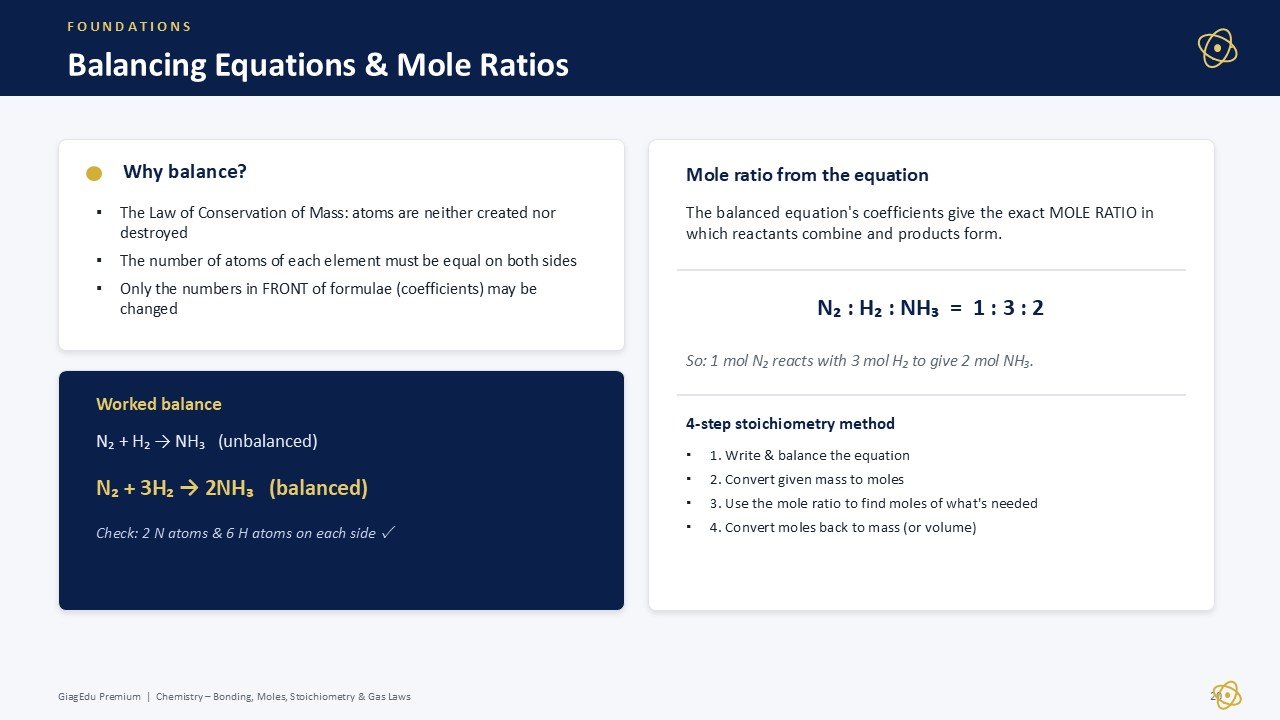
Why balance? The law of conservation of mass: atoms are neither created nor destroyed, so each element must have the same number of atoms on both sides.
- Only change the numbers in front of formulae (the coefficients), never the small subscripts.
- Unbalanced: N2 + H2 → NH3
- Balanced: N2 + 3H2 → 2NH3 (2 N atoms and 6 H atoms on each side ✓)
The coefficients give the mole ratio: N2 : H2 : NH3 = 1 : 3 : 2. So 1 mol of N2 reacts with 3 mol of H2 to give 2 mol of NH3.
The 4-step method for reacting masses
- Write and balance the equation.
- Convert the given mass to moles.
- Use the mole ratio to find the moles of the substance you need.
- Convert those moles back to mass (or volume).
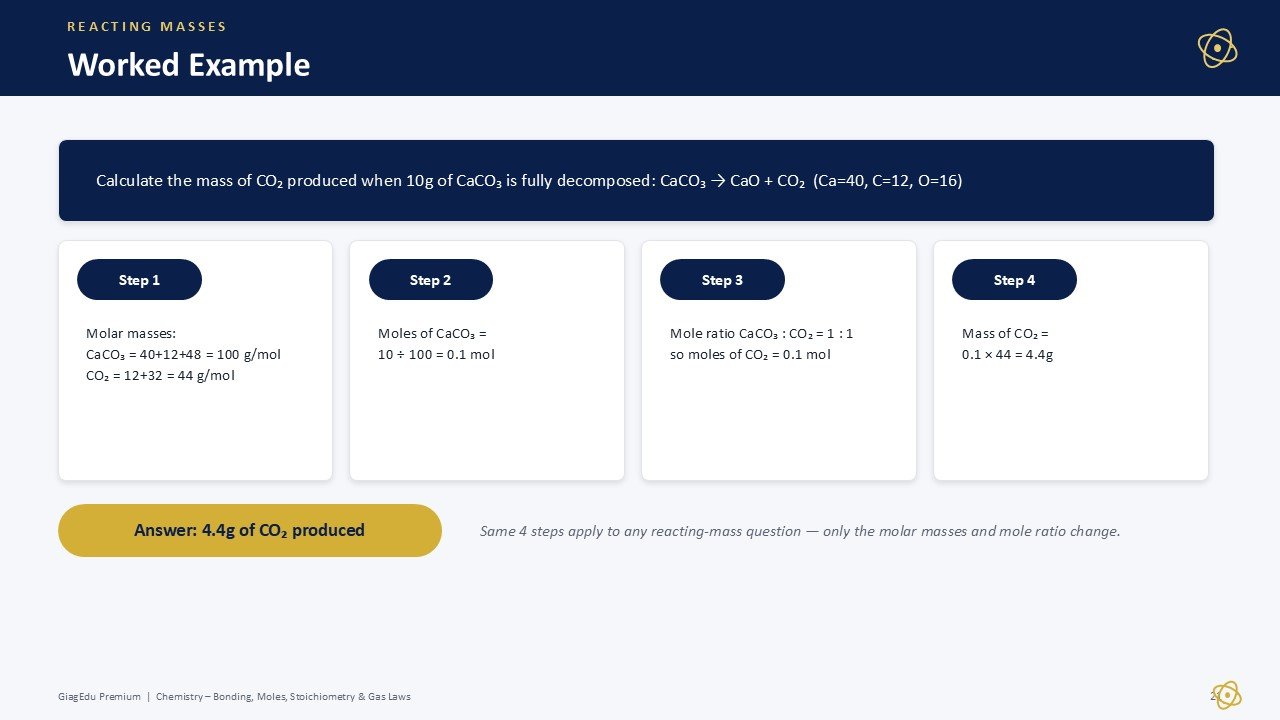
The same 4 steps work for every reacting-mass question. Only the molar masses and the ratio change.
Limiting reagent and percentage yield
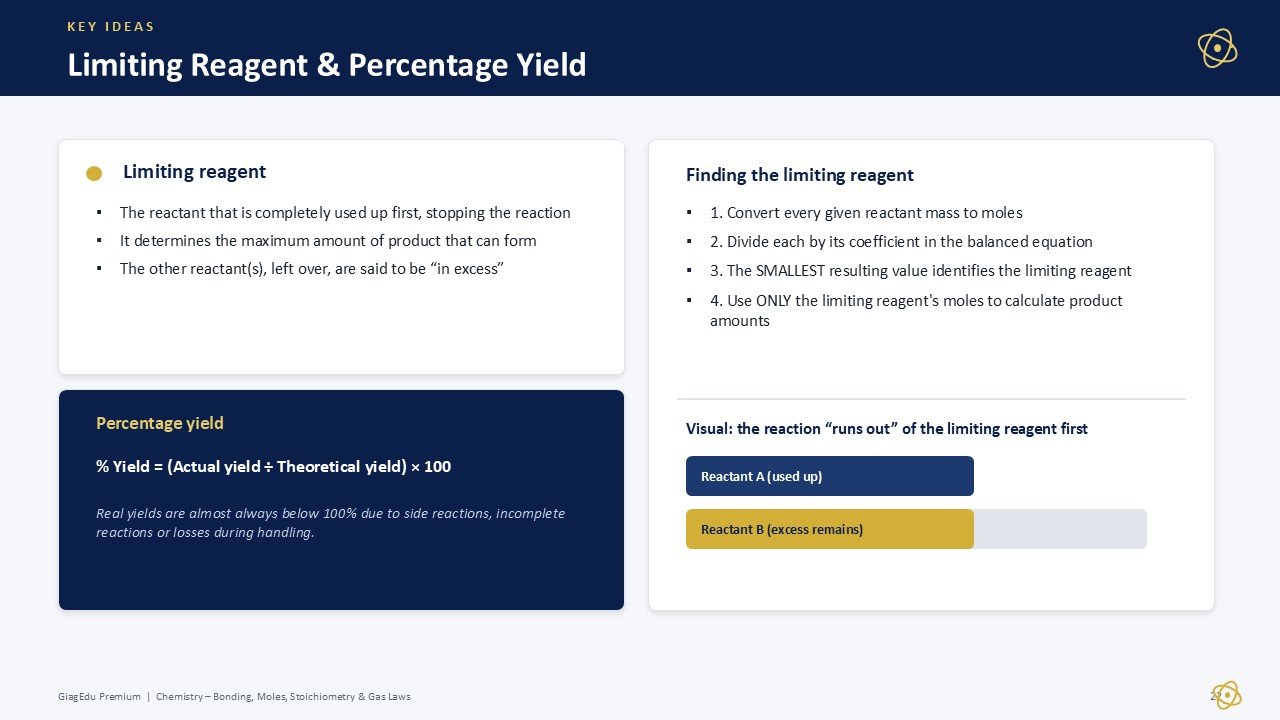
- The limiting reagent is the reactant that is used up first. It stops the reaction and fixes the maximum amount of product.
- The other reactant is in excess: some of it is left over.
How to find the limiting reagent:
- Convert each reactant's mass to moles.
- Divide each by its coefficient in the balanced equation.
- The smallest result is the limiting reagent.
- Use only the limiting reagent's moles to calculate the product.
Special case: with 4 g of H2 and 32 g of O2, both give 1 after dividing by the coefficient. The reactants are in exact proportion, so neither is in excess, and 2 mol (36 g) of water forms.
Percentage yield = (actual yield ÷ theoretical yield) × 100
Real yields are almost always below 100%, because of side reactions, incomplete reactions and losses during handling.
Practice
- What mass of O2 is needed to burn 4 g of H2 completely? (2H2 + O2 → 2H2O)
- How many moles of NH3 form from 2 mol of N2 with excess H2? (N2 + 3H2 → 2NH3)
- A reaction should give 4 g of water but gives 3.6 g. What is the percentage yield?
- In 2H2 + O2 → 2H2O, how many moles of O2 react with 6 mol of H2?
- Balance __Al + __O2 → __Al2O3 and state the mole ratio of Al to O2.
Answers: 1. 32 g · 2. 4 mol · 3. (3.6 ÷ 4) × 100 = 90% · 4. 3 mol (ratio 2 : 1) · 5. 4Al + 3O2 → 2Al2O3; Al : O2 = 4 : 3
Previous topic: The Mole Concept · Next topic: Gas Laws.
Practise Stoichiometry: 10 questions in study mode, with an explanation after each answer.
Start Practice