The Periodic Table and Trends Across Period 3
Chemistry · How the periodic table is organised (blocks, groups, periods), how electronic configuration gives an element's group and period, and the Period 3 trends WAEC tests every year.
How the periodic table is organised
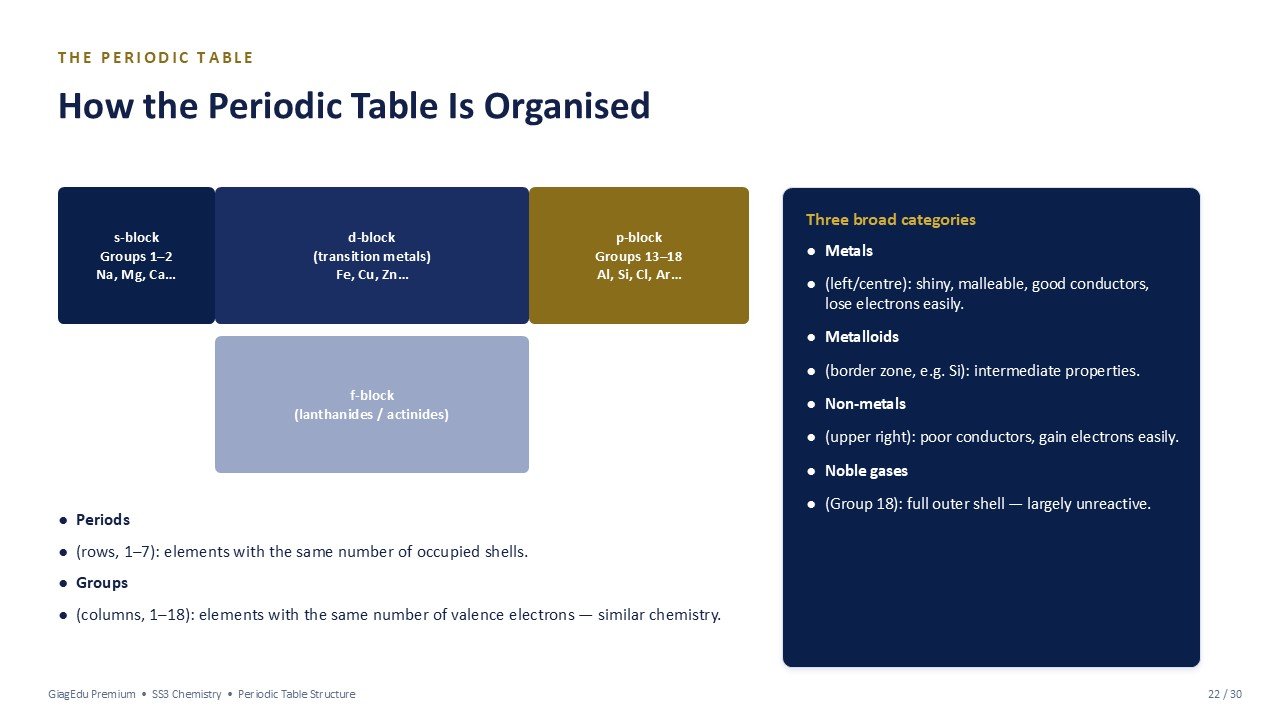
- Periods are the rows (1–7). Elements in the same period have the same number of occupied shells.
- Groups are the columns (1–18). Elements in the same group have the same number of outer (valence) electrons, so they have similar chemistry.
The table is divided into blocks:
- s-block: Groups 1–2 (e.g. Na, Mg, Ca)
- d-block: the transition metals (e.g. Fe, Cu, Zn)
- p-block: Groups 13–18 (e.g. Al, Si, Cl, Ar)
- f-block: the lanthanides and actinides
Three broad categories of element:
- Metals (left and centre): shiny, malleable, good conductors, lose electrons easily
- Metalloids (the border zone, e.g. silicon): in-between properties
- Non-metals (upper right): poor conductors, gain electrons easily
- Noble gases (Group 18): full outer shell, so largely unreactive
Connecting configuration to group and period
Two rules to remember:
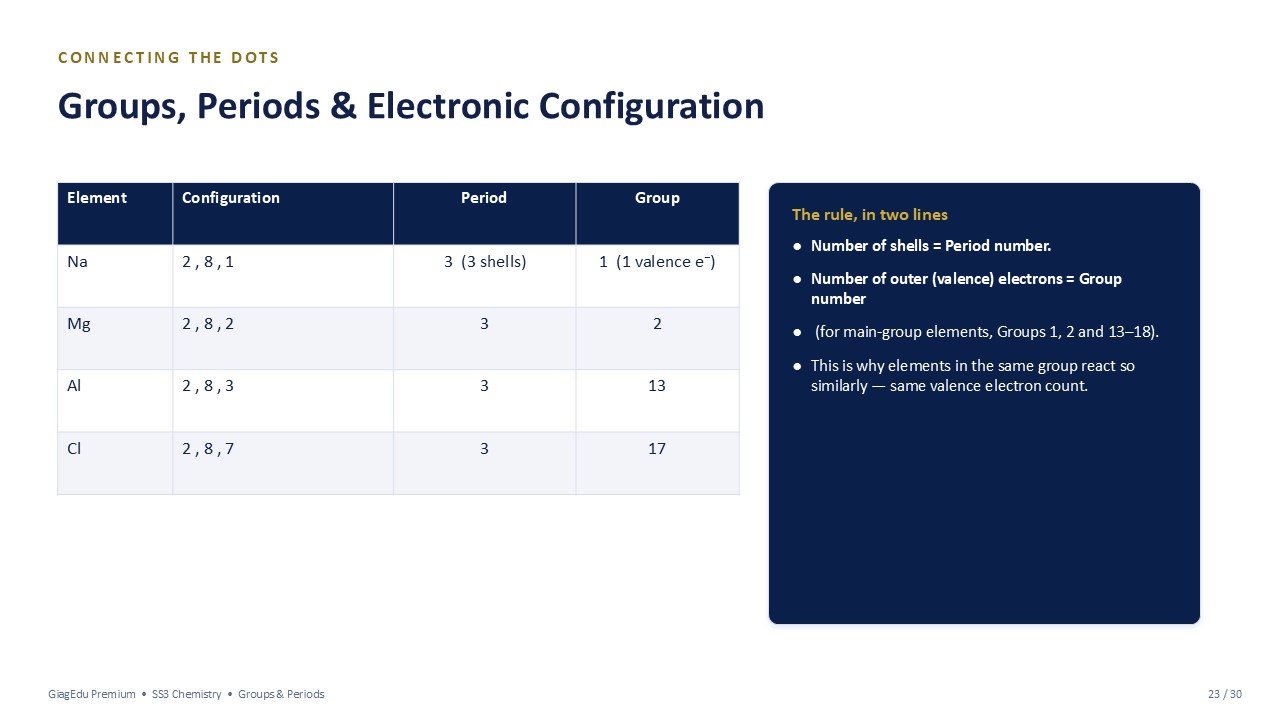
- Number of shells = period number
- Number of outer electrons = group number (for the main groups: 1, 2 and 13–18, where the group number's last digit gives the outer electrons)
Examples: Na (2, 8, 1) is in Period 3, Group 1. Mg (2, 8, 2) is in Period 3, Group 2. Al (2, 8, 3) is in Period 3, Group 13. Cl (2, 8, 7) is in Period 3, Group 17.
Periodic trends across Period 3 (Na → Ar)
The WAEC syllabus names Period 3 specifically: Na, Mg, Al, Si, P, S, Cl, Ar. Going across, the elements change from metals → metalloid → non-metals → noble gas.
Trend 1: atomic radius
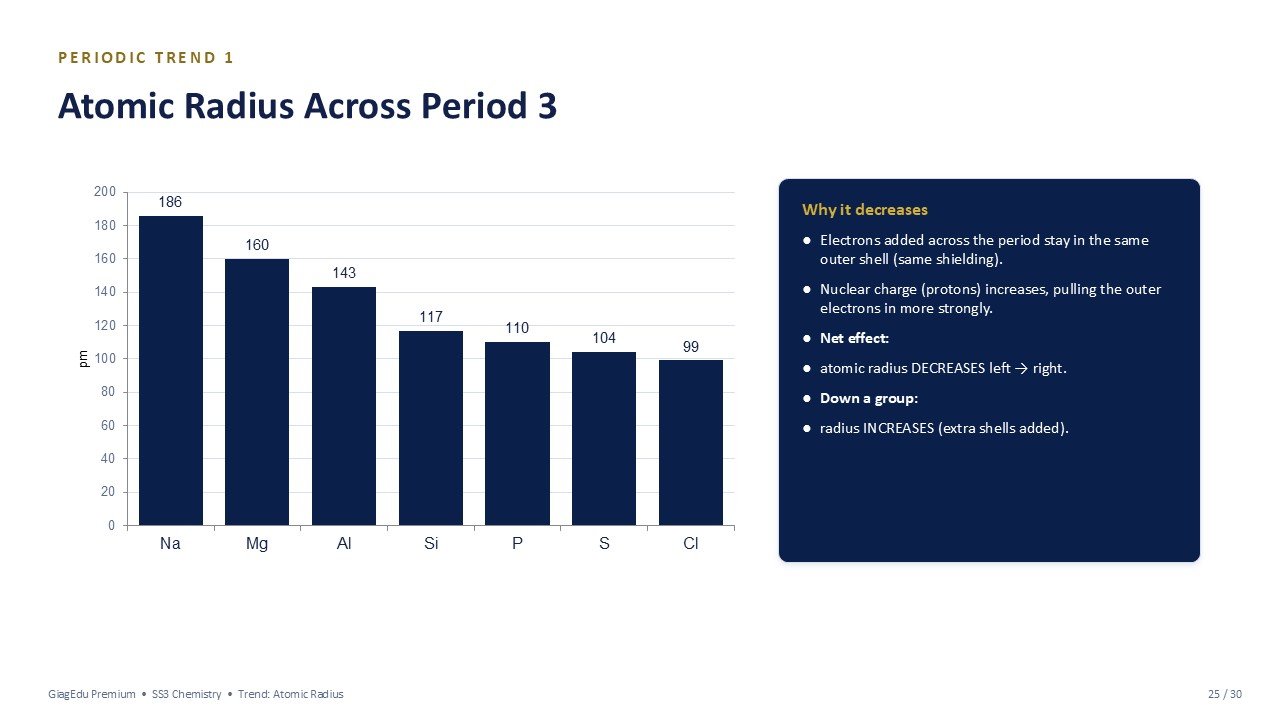
- Electrons added across the period go into the same outer shell, so shielding stays about the same.
- The nuclear charge increases, pulling the outer electrons in more strongly.
- So atomic radius decreases from left to right (Na 186 pm → Cl 99 pm).
- Down a group, radius increases because extra shells are added.
Trend 2: first ionisation energy
Ionisation energy is the energy needed to remove the outermost electron from an atom.
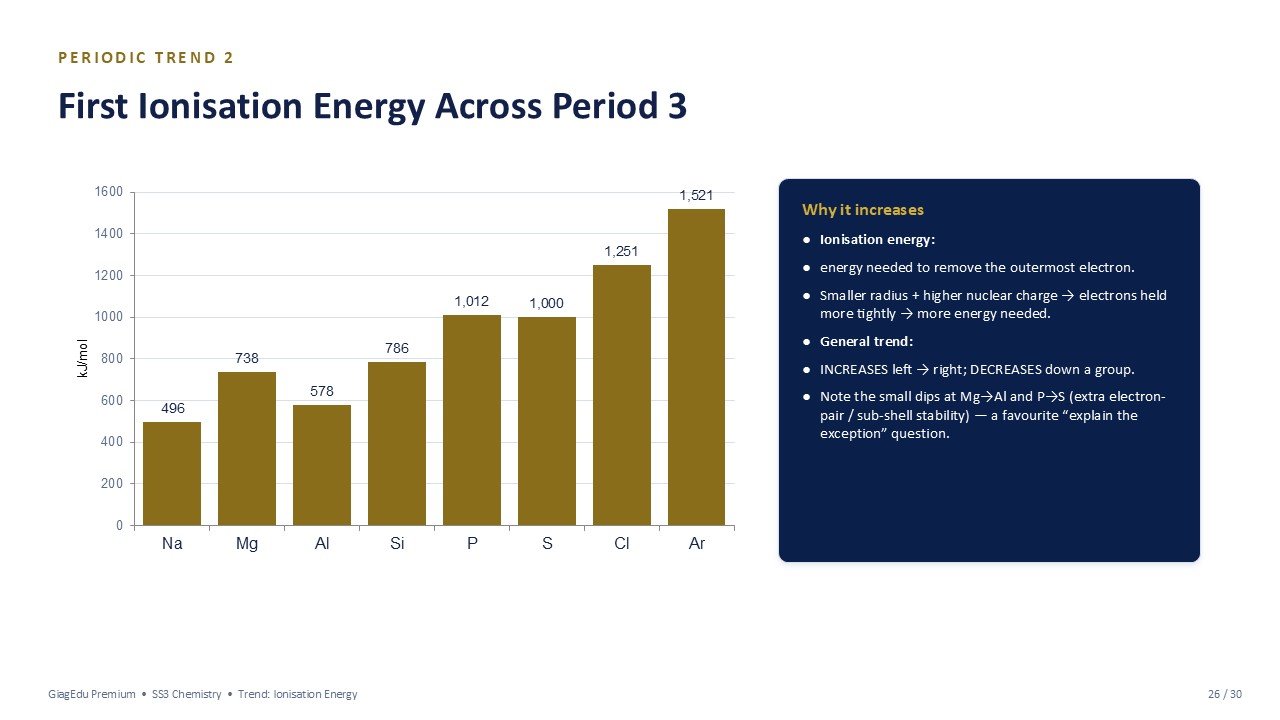
- A smaller atom with a higher nuclear charge holds its electrons more tightly, so more energy is needed.
- Ionisation energy increases from left to right and decreases down a group.
Trend 3: electronegativity and metallic character
- Electronegativity is an atom's ability to attract bonding electrons. It increases from left to right; chlorine is the most electronegative element in Period 3.
- Metallic character is the tendency to lose electrons. It decreases from left to right: sodium is very metallic, chlorine is a non-metal and argon is inert.
- Both trends reverse down a group.
- Argon has no electronegativity value, because it does not normally form bonds.
All the trends at a glance

- Atomic radius: decreases across, increases down
- Ionisation energy: increases across, decreases down
- Electronegativity: increases across, decreases down
- Metallic character: decreases across, increases down
Exam trap
Mixing up which way each trend runs across a period and down a group. Learn the summary list above, and always give the reason (nuclear charge or number of shells), because WAEC Paper 2 awards marks for the explanation.
Check yourself
- State and explain the trend in atomic radius across Period 3, from Na to Cl.
- In one sentence, explain why ionisation energy increases across Period 3.
- An element has the configuration 2, 8, 6. State its group and period.
- Why do elements in the same group have similar chemical properties?
- Bromine is in Group 17, below chlorine. Is it more or less reactive than chlorine? Explain.
Answers: 1. It decreases: the nuclear charge increases while the electrons stay in the same shell, so they are pulled closer. 2. The nuclear charge increases and the atom gets smaller, so the outer electron is held more tightly. 3. Group 16, Period 3 (it is sulphur). 4. They have the same number of valence electrons. 5. Less reactive: bromine's atom is bigger, so it attracts an extra electron less strongly than chlorine does.
Previous topic: Atomic Structure.
Practise Periodic Table: 10 questions in study mode, with an explanation after each answer.
Start Practice