Atomic Structure: from Dalton to Electronic Configuration
Chemistry · Atoms and elements, Dalton's theory, protons/neutrons/electrons, atomic and mass number, isotopes, relative atomic mass, electronic configuration and ions.
Introduction: atoms, molecules and elements
Chemistry is the study of matter: what substances are made of, how they behave and how they change. Everything starts with the atom.
- An atom is the smallest particle of an element that can take part in a chemical reaction. It cannot be split into anything simpler by any chemical reaction.
- An element is a substance made of only one kind of atom, e.g. sodium (Na), chlorine (Cl).
- A molecule is two or more atoms chemically joined, e.g. O2, H2O.
Dalton's atomic theory
John Dalton proposed that:
- All matter is made of tiny, indivisible particles called atoms.
- Atoms can neither be created nor destroyed in a chemical reaction.
- Atoms of the same element are alike; atoms of different elements are different.
- When atoms combine, they do so in simple whole-number ratios.
Inside the atom: three subatomic particles
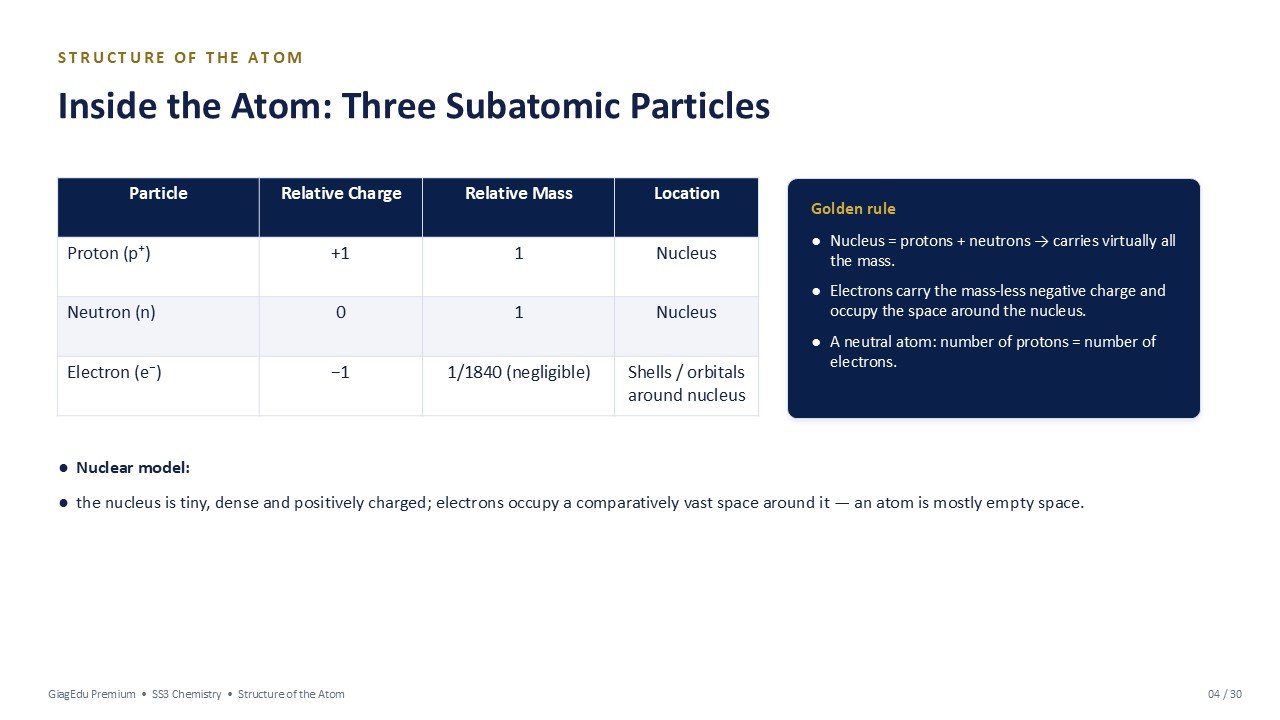
- Proton (p+): charge +1, relative mass 1, found in the nucleus
- Neutron (n): charge 0, relative mass 1, found in the nucleus
- Electron (e−): charge −1, relative mass 1/1840 (negligible), found in shells around the nucleus
The nucleus (protons + neutrons) carries almost all the mass. The nucleus is tiny, dense and positively charged; an atom is mostly empty space. In a neutral atom, number of protons = number of electrons.
The Bohr (shell) model

Sodium has atomic number 11 (11 protons, 11 electrons) and mass number 23, so it has 23 − 11 = 12 neutrons. Its electrons fill the shells from the inside out: 2, 8, 1. That tells us sodium is in Period 3, Group 1.
Atomic number (Z) and mass number (A)
- Atomic number (Z) = number of protons. It defines the element.
- Mass number (A) = protons + neutrons (the nucleons).
- Neutrons = A − Z
Examples: Na (Z = 11, A = 23) has 12 neutrons; Cl (17, 35) has 18; Ca (20, 40) has 20; Fe (26, 56) has 30.
Isotopes
Isotopes are atoms of the same element (same number of protons) with different numbers of neutrons, and so different mass numbers.

- Same: protons, electrons, and therefore chemical properties
- Different: neutrons, mass number, physical properties (some isotopes are radioactive)
Uses of isotopes:
- Carbon-14: radiocarbon dating of fossils and artefacts
- Chlorine-35 and chlorine-37 (about 75% : 25%): explain why chlorine's relative atomic mass is 35.5
- Deuterium (2H): nuclear reactors; tritium (3H): medical tracers
- Uranium-235: nuclear fuel
- Cobalt-60: cancer radiotherapy
Relative atomic mass (RAM)
Relative atomic mass is the weighted average mass of the isotopes of an element, compared with 1/12 of the mass of a carbon-12 atom. It takes account of each isotope's mass and how common it is, which is why RAM is rarely a whole number (Cl = 35.5, Cu = 63.5).
RAM = Σ (% abundance × isotopic mass) ÷ 100

Worked example (chlorine): (35 × 75) + (37 × 25) = 2625 + 925 = 3550. Then 3550 ÷ 100 = 35.5.
Your turn: copper has 63Cu (69%) and 65Cu (31%). Find its RAM to 1 decimal place.
Answer: (63 × 69) + (65 × 31) = 4347 + 2015 = 6362; 6362 ÷ 100 = 63.6.
Electronic configuration (shells)
Electrons occupy energy levels (shells) numbered 1, 2, 3… outwards from the nucleus.
- Maximum electrons in a shell = 2n2 (n = shell number)
- Shell 1 holds 2, shell 2 holds 8, shell 3 holds 8 (up to calcium) or 18
- Electrons fill the lowest-energy shell first

Sub-shells and orbitals: s, p, d, f
An orbital is a region where an electron is most likely to be found. Each orbital holds at most 2 electrons, with opposite spins.
- s: 1 orbital, holds 2 electrons (spherical)
- p: 3 orbitals, holds 6 (dumbbell-shaped)
- d: 5 orbitals, holds 10
- f: 7 orbitals, holds 14
Order of filling (lowest energy first): 1s, 2s, 2p, 3s, 3p, 4s, 3d, 4p…
Example: sodium (Z = 11) is 1s2 2s2 2p6 3s1. The superscript is the number of electrons in that sub-shell.
Rule 1: the Aufbau ("building up") principle
Electrons fill orbitals starting from the lowest available energy level before occupying higher ones.

Rule 2: the Pauli exclusion principle
An orbital holds a maximum of 2 electrons, and if it holds 2 they must spin in opposite directions (↑↓, never ↑↑). This is why the sub-shell maxima are s = 2, p = 6, d = 10, f = 14.
Rule 3: Hund's rule
Electrons fill orbitals of equal energy (e.g. the three p orbitals) singly first, with parallel spins, before any orbital gets a pair.

Example: nitrogen's 2p3 is ↑ ↑ ↑ (one in each orbital), not ↑↓ ↑. Unpaired electrons in separate orbitals repel each other less, which is more stable.
Worked examples
- Sodium, Na (11): 2, 8, 1 → 1s2 2s2 2p6 3s1
- Chlorine, Cl (17): 2, 8, 7 → 1s2 2s2 2p6 3s2 3p5
- Calcium, Ca (20): 2, 8, 8, 2 → 1s2 2s2 2p6 3s2 3p6 4s2
- Iron, Fe (26): 2, 8, 14, 2 → 1s2 2s2 2p6 3s2 3p6 4s2 3d6
For iron, 4s fills before 3d (Aufbau), so the shell count 2, 8, 14, 2 looks unusual. Some textbooks write the 3d before the 4s (in shell order); the electrons are the same either way.
Practise: Mg (12) = 2, 8, 2; Al (13) = 2, 8, 3; P (15) = 2, 8, 5; S (16) = 2, 8, 6; Ar (18) = 2, 8, 8; K (19) = 2, 8, 8, 1.
Ions: how atoms gain or lose electrons
Cations: metals lose electrons
A cation is a positive ion formed when an atom loses electrons, usually a metal reaching a stable full outer shell.
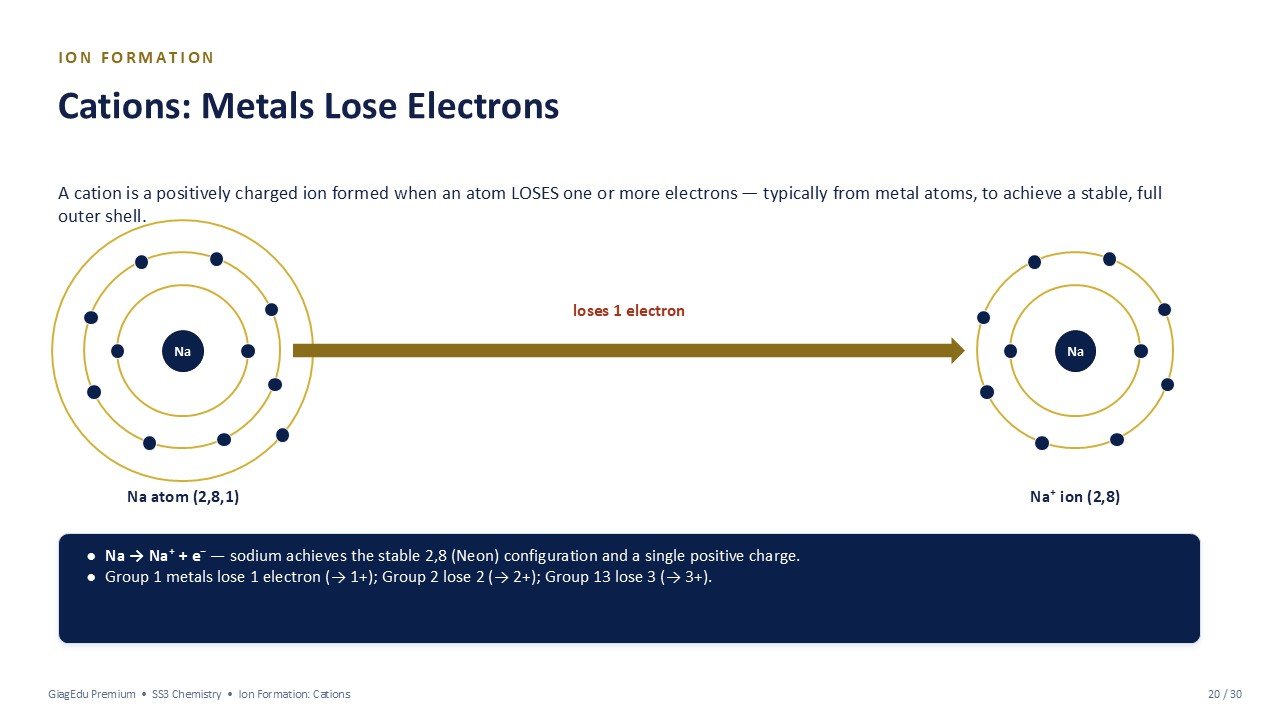
Na → Na+ + e−: sodium (2, 8, 1) becomes Na+ (2, 8), the stable arrangement of neon.
Group 1 metals form 1+ ions, Group 2 form 2+, Group 13 form 3+.
Anions: non-metals gain electrons
An anion is a negative ion formed when an atom gains electrons, usually a non-metal completing its outer shell.

Cl + e− → Cl−: chlorine (2, 8, 7) becomes Cl− (2, 8, 8), the stable arrangement of argon.
Group 17 forms 1− ions, Group 16 forms 2−, Group 15 forms 3−.
Top exam traps
- Confusing atomic number (Z) with mass number (A).
- Forgetting that shell 3 stops at 8 until calcium.
- Forgetting that 4s fills before 3d.
- Thinking isotopes differ in chemical properties. They only differ in physical properties.
Check yourself
- An atom X has 17 protons and 18 neutrons. What is its mass number, and what is its electronic configuration?
- Explain why sodium forms a 1+ ion while chlorine forms a 1− ion.
- Two isotopes of an element have mass numbers 24 and 26, in the ratio 9 : 1. Calculate the relative atomic mass.
- Write the full electronic configuration of potassium, K (Z = 19).
- Bromine has isotopes 79Br (51%) and 81Br (49%). Calculate its RAM.
Answers: 1. A = 35; 2, 8, 7 or 1s2 2s2 2p6 3s2 3p5 (it is chlorine). 2. Sodium (2, 8, 1) loses its 1 outer electron to reach 2, 8; chlorine (2, 8, 7) gains 1 electron to reach 2, 8, 8. 3. (24 × 9 + 26 × 1) ÷ 10 = 24.2. 4. 1s2 2s2 2p6 3s2 3p6 4s1. 5. (79 × 51 + 81 × 49) ÷ 100 = 79.98 ≈ 80.0.
Next topic: The Periodic Table, where electronic configuration explains groups, periods and trends.
Practise Atomic Structure: 10 questions in study mode, with an explanation after each answer.
Start Practice