The Living World: Classification and the Five Kingdoms
Biology · Why living things are classified, and the five kingdoms (Monera, Protista, Fungi, Plantae, Animalia) with examples.
Why do we classify organisms?
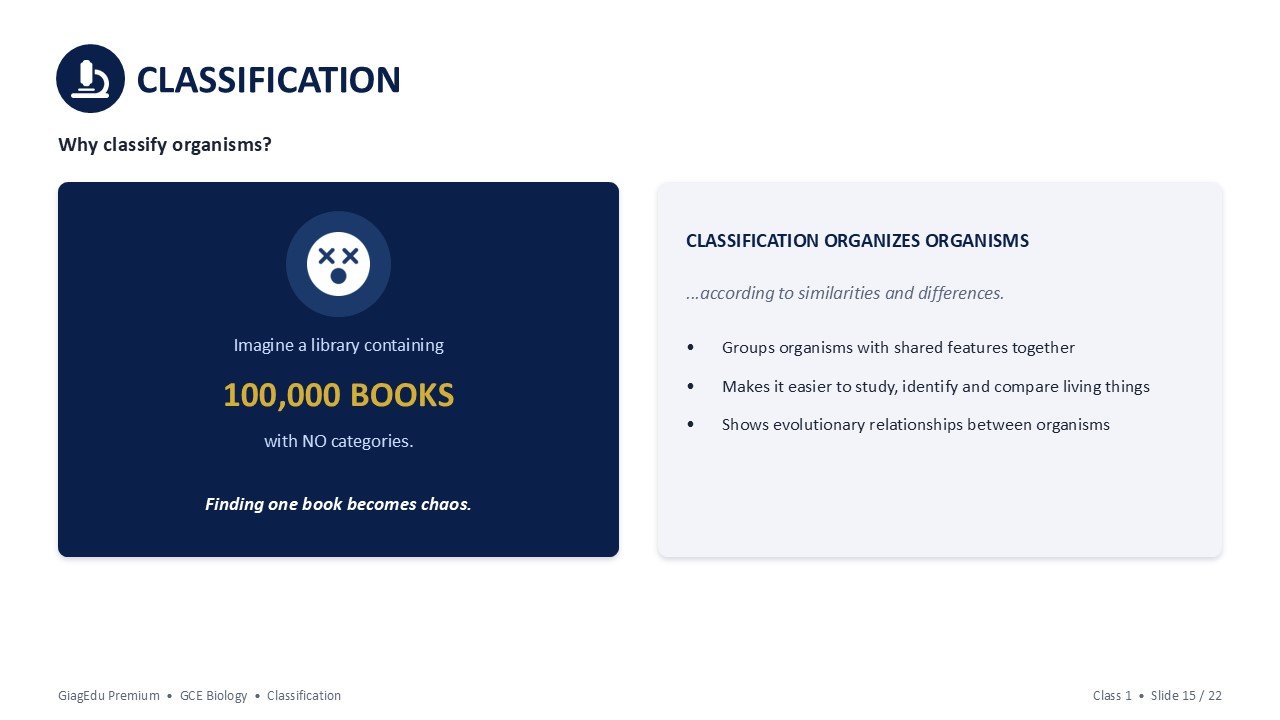
Imagine a library with 100,000 books and no categories. Finding one book would be chaos. Biologists face the same problem with millions of living things, so they classify them: they sort organisms into groups according to their similarities and differences.
Classification:
- groups organisms that share features together
- makes living things easier to study, identify and compare
- shows the evolutionary relationships between organisms
The five kingdoms

1. Monera
- Cell type: prokaryotic (no true nucleus), unicellular
- Nutrition: autotrophic or heterotrophic
- Examples: bacteria
2. Protista
- Cell type: eukaryotic, unicellular
- Nutrition: autotrophic or heterotrophic
- Examples: Amoeba, Paramecium
3. Fungi
- Cell type: eukaryotic, mostly multicellular
- Nutrition: heterotrophic (they absorb nutrients from their surroundings)
- Examples: mushroom, yeast
4. Plantae
- Cell type: eukaryotic, multicellular
- Nutrition: autotrophic (photosynthesis)
- Examples: maize, mango tree
5. Animalia
- Cell type: eukaryotic, multicellular
- Nutrition: heterotrophic
- Examples: lion, human, fish
Worked GCE question
Which organism belongs to Kingdom Fungi?
A. Amoeba B. Mushroom C. Maize D. Paramecium
Answer: B, Mushroom. Mushrooms are fungi: they are heterotrophic and do not photosynthesise. They absorb nutrients from their surroundings, unlike plants. Amoeba and Paramecium are protists, and maize is a plant.

Check yourself
- Give two reasons why organisms are classified.
- Name the five kingdoms.
- Which kingdom contains prokaryotic organisms?
- Why is a mushroom not classified as a plant?
- Name one example each of a protist and a fungus.
Previous topic: Characteristics of Living Things · Next class: Nutrition.
Practise Classification of Living Things: 10 questions in study mode, with an explanation after each answer.
Start Practice