Protecting Ecosystems (Grade 5): Human Impact, Conservation, Restoration and Sustainability
Science · Grade 5 environmental science: how human activities harm ecosystems, why ecosystems matter, conservation vs restoration, renewable and nonrenewable resources, sustainability, the 3 Rs, habitat protection, the ripple effect, and how to plan a solution from cause to effect.
Why this topic matters
A lake once held hundreds of fish. Then people began dumping waste into the water. A few months later there were fewer fish, fewer water plants and fewer birds. What happened? In this lesson you become an environmental problem-solver: you learn how ecosystems get damaged and how people can protect and repair them.
Ecosystems need balance
An ecosystem is made of living things, non-living things (water, soil, air, sunlight) and the relationships between them. When one part changes, the others change too.
Why protect ecosystems?
Healthy ecosystems give us food, clean water, clean air, materials, medicines, pollination and healthy soil. People could not survive without them.
How people harm ecosystems
- Pollution of air, water and land (factory waste, smoke, litter, plastic).
- Deforestation: cutting down forests.
- Habitat destruction: clearing land for roads and houses.
- Overfishing and overhunting.
- Wasting water and creating too much waste.
- Burning fossil fuels, which adds to climate change.
Use a chain to explain it: human activity → environmental change → effect on living things. For example: deforestation → habitat loss → fewer animals.
The ripple effect
Pollution → fewer insects → fewer frogs → less food for snakes and birds → the whole food web changes. Ecosystems are connected systems.
Conservation vs restoration
- Conservation means protecting and carefully using natural resources and ecosystems, so they are not damaged further. Protect what we still have.
- Restoration means helping a damaged ecosystem recover, for example planting native trees, cleaning polluted waterways, restoring fish populations and rebuilding wetlands.
A forest that is still healthy needs conservation; a forest that has been damaged needs restoration.
Protecting habitats
Animals need food, water, shelter, suitable conditions and space. When habitats are destroyed, animals must move away, compete for less food, or die. People protect habitats by:
- creating national parks and protected areas, where special rules protect wildlife;
- planting native trees and protecting wetlands;
- reducing pollution and unnecessary land clearing;
- protecting endangered species.
Renewable and nonrenewable resources
- Renewable resources are naturally replaced quite quickly: sunlight (solar energy), wind, water and trees (if forests are managed well).
- Nonrenewable resources exist in limited amounts and take an extremely long time to form: oil, coal, natural gas and minerals.
Sustainability and the 3 Rs
Sustainability means meeting our needs today while protecting resources for the future. Catching 10 fish a year, when the fish population can replace those 10, is sustainable; catching 90 fish a year, when the population cannot replace them, is not.
- Reduce: use less (for example, less plastic).
- Reuse: use something again (refill a water bottle).
- Recycle: turn used materials into new products (recycle paper).
People affect all of Earth's spheres
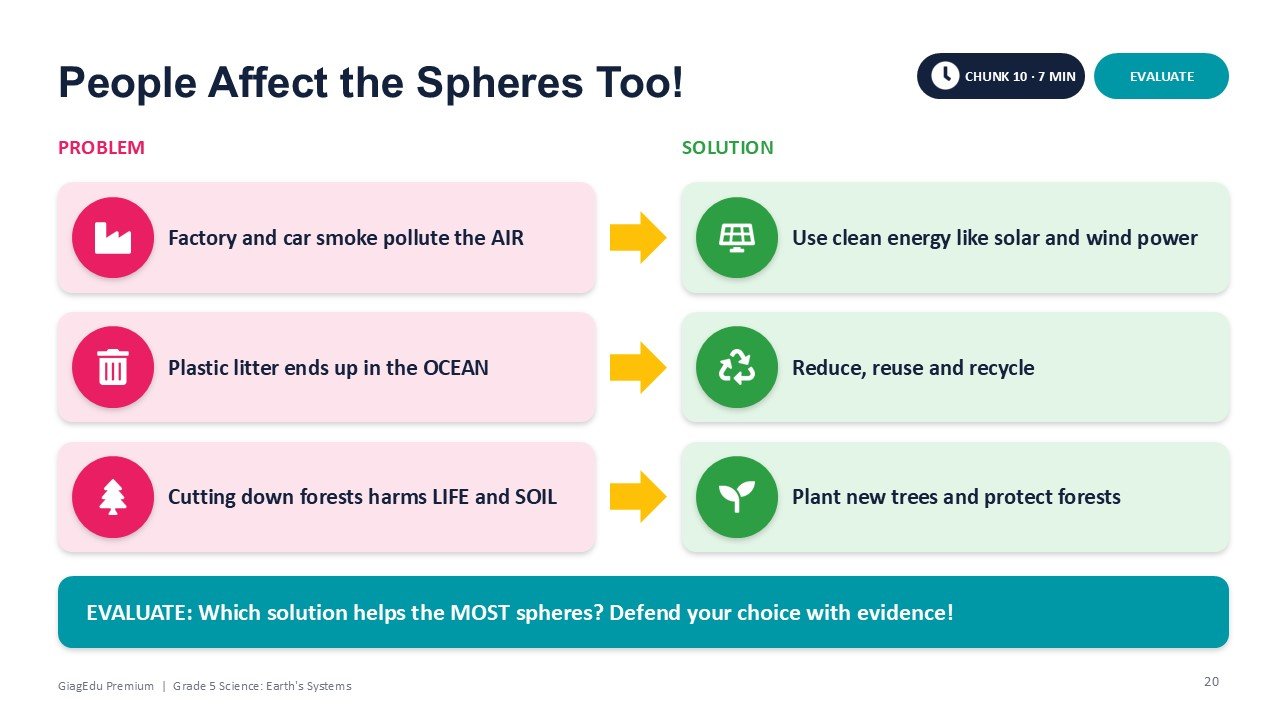
- Factory and car smoke pollute the air → use clean energy such as solar and wind power.
- Plastic litter ends up in the ocean → reduce, reuse and recycle.
- Cutting down forests harms life and soil → plant new trees and protect forests.
From problem to solution
Case study: a polluted river. Scientists find too much litter, dirty water entering the river, fewer fish and fewer birds.
- Cause: factories release pollutants.
- Effect: water quality decreases.
- Effect on living things: fish populations decrease.
- Solution: treat wastewater, enforce environmental rules, clean the river and stop future dumping.
Everyday choices help too: turn off unnecessary lights, waste less food and water, use reusable containers, plant native plants and dispose of waste properly.
Practise Protecting the Environment: 10 questions in study mode, with an explanation after each answer.
Start Practice