Ecosystems and Energy Flow (Grade 5): Food Chains, Food Webs, the 10% Rule and Populations
Science · Grade 5 life science: the Sun as the energy source, producers, consumers and decomposers, food chains and food webs, trophic levels and the energy pyramid, why energy is lost, what happens when an organism disappears, populations, limiting factors and carrying capacity.
Why this topic matters
Every living thing needs energy to grow, move and stay alive. But where does that energy come from, and how does it pass from a blade of grass to a hawk? This lesson follows energy through an ecosystem like the baton in a relay race.
Words to know
- Producer: makes its own food using sunlight (plants, algae).
- Consumer: eats other living things to get energy (animals).
- Predator: an animal that hunts and eats other animals. Prey: an animal that is hunted.
- Decomposer: breaks down dead plants and animals and returns nutrients to the soil (fungi, bacteria).
- Herbivore eats plants; carnivore eats animals; omnivore eats both.
The Sun: where the energy starts
The Sun is the source of energy for most ecosystems on Earth. Plants use sunlight, water and carbon dioxide to make their own food by photosynthesis. That food stores energy. When animals eat plants, they take in that stored energy.
Food chains
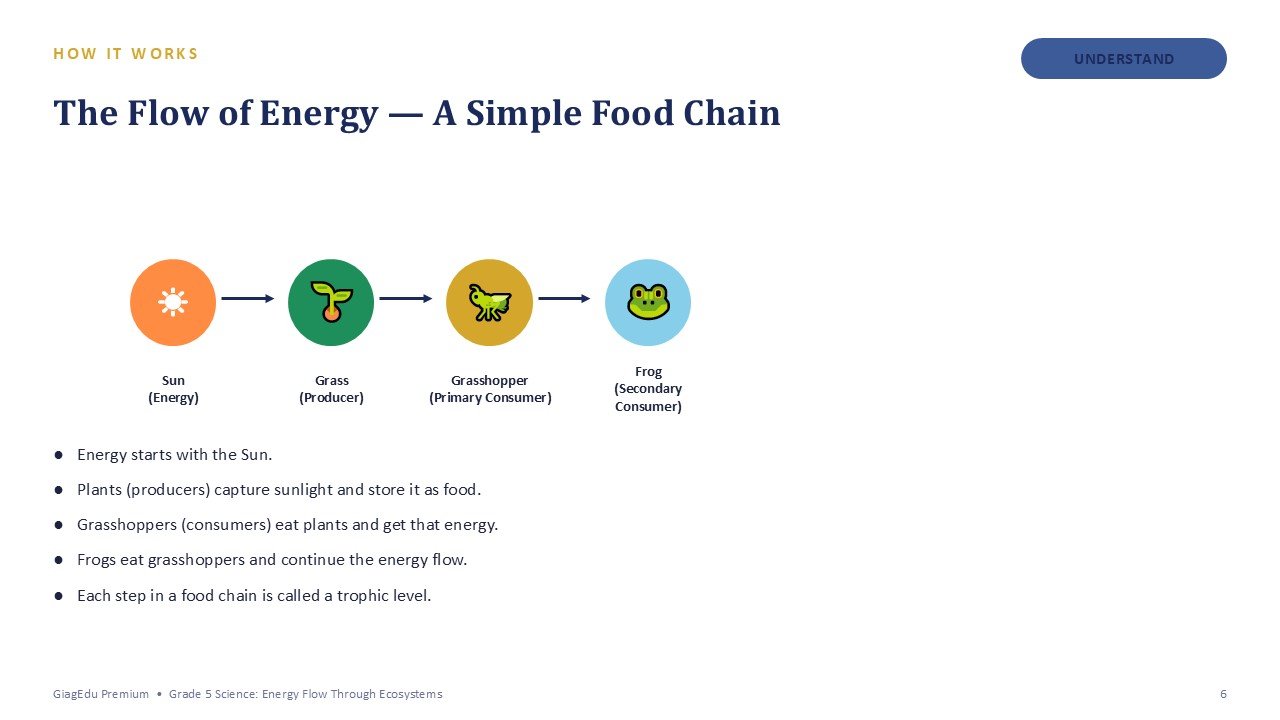
A food chain shows one path of energy: Sun → grass (producer) → grasshopper (primary consumer) → frog (secondary consumer). The arrows point in the direction the energy moves, from the thing eaten to the thing that eats it. Each step is called a trophic level.
Food webs
A food web is many food chains joined together. It is more realistic, because most animals eat more than one thing and are eaten by more than one predator. For example: plants → grasshopper → bird → eagle; plants → rabbit → eagle; plants → grasshopper → lizard → snake.
Trophic levels and the 10% rule
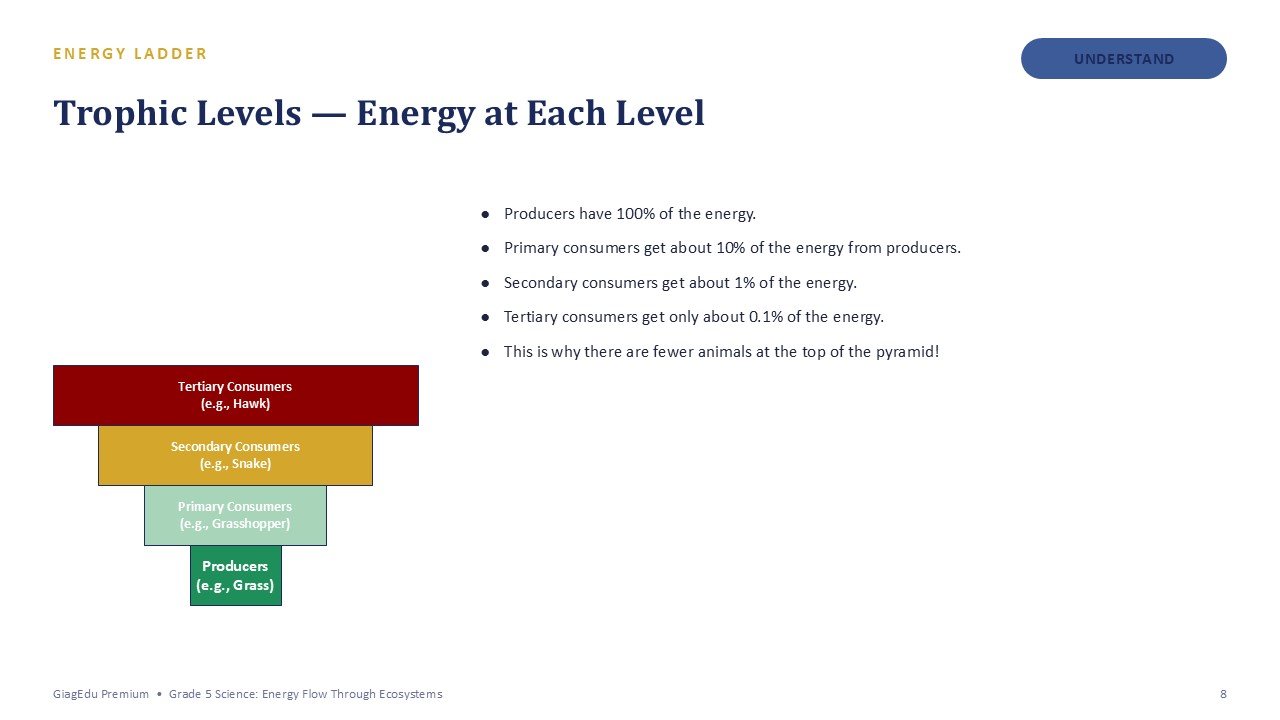
- Producers (grass) are at the bottom and hold the most energy.
- Primary consumers (grasshopper) get only about 10% of that energy.
- Secondary consumers (snake) get about 10% of that, about 1% of the original.
- Tertiary consumers (hawk) get about 0.1%.
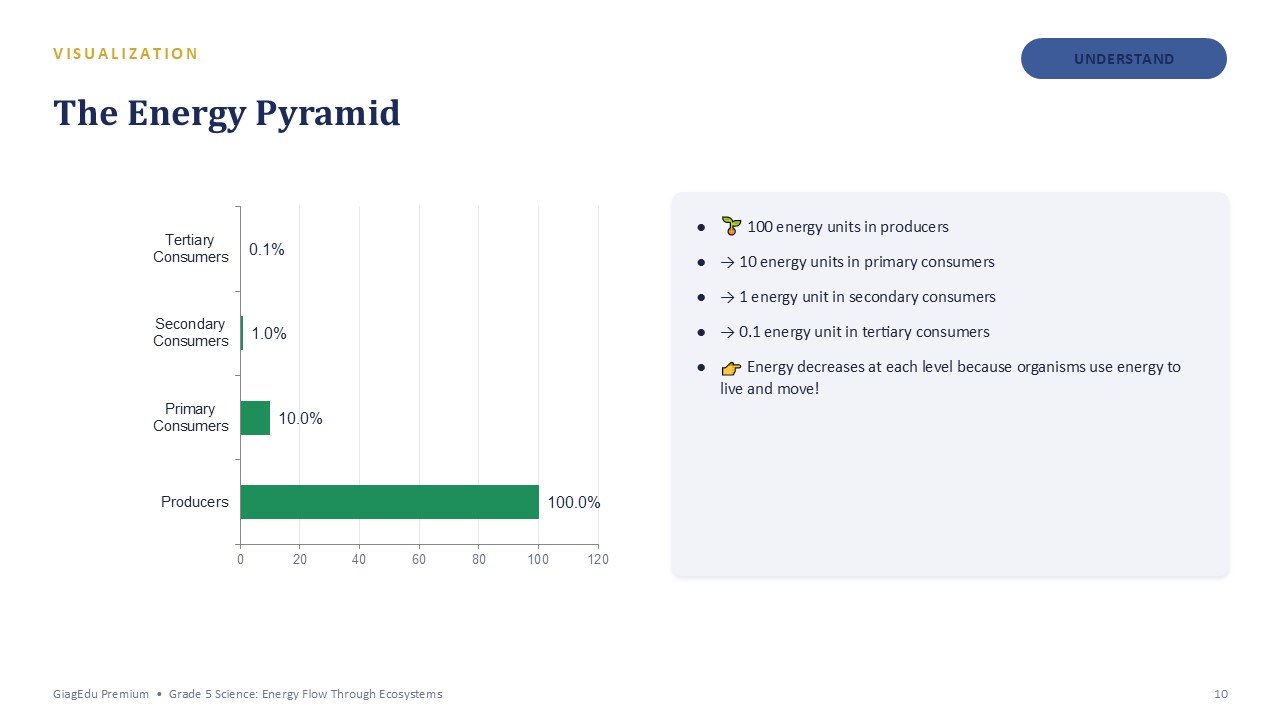
If producers have 100 energy units, primary consumers get about 10, secondary consumers about 1, and tertiary consumers about 0.1. This is why there are many more plants than plant-eaters, and fewer animals at the top of the pyramid.
Why is energy lost at each level?
An animal does not pass on all the energy it eats. Most is used for:
- moving (running, swimming, flying),
- keeping warm (staying at body temperature),
- staying alive (heart, lungs and brain working all the time),
- and some is lost as heat and waste.
What happens if one organism disappears?
Everything in a food web is connected. If frogs disappear from a pond:
- snakes and birds that eat frogs must find other food or starve;
- insects increase, because frogs are no longer eating them;
- plants are damaged by too many insects.
If all the producers disappeared, energy could no longer enter the food web, and the whole web would collapse.
Populations and carrying capacity
A population is a group of the same species living in the same area at the same time, such as the rabbits in one grassland.
- Populations increase with more food, more water, safe habitat, few predators and successful reproduction.
- Populations decrease with less food or water, disease, more predators, competition and natural disasters.
- Limiting factors are the things that stop a population growing forever: food, water, space and shelter.
Carrying capacity is the largest population an environment can support with its available resources. A population grows quickly at first, then levels off at the carrying capacity. If it grows too large, resources run out, competition increases, disease spreads, and some individuals die or move away, so the population falls again.
How people affect energy flow
- Deforestation removes producers and habitats, so less energy enters the ecosystem.
- Pollution harms organisms and breaks food chains.
- Overfishing removes consumers and unbalances the ecosystem.
- Climate change changes where organisms can live.
Practise Ecosystems & Energy Flow: 10 questions in study mode, with an explanation after each answer.
Start Practice