Earth in Space (Grade 5): Rotation, Revolution, the Sun's Path and Shadows
Science · Grade 5 space science: how Earth's rotation causes day and night, how its revolution makes a year and a leap day, why the Sun seems to move across the sky, why shadows change length and direction, and why we see different stars in different seasons.
Why this topic matters
Right now you are moving at about 1,000 miles per hour as Earth spins, and about 67,000 miles per hour as Earth travels around the Sun. So why don't we feel it, and why does the Sun seem to move instead? This lesson answers that big question.
Words to know
- Axis: an imaginary line through Earth from the North Pole to the South Pole.
- Rotation: Earth spinning on its axis. One spin = 24 hours = 1 day.
- Revolution: Earth travelling around the Sun. One trip = about 365 days = 1 year.
- Orbit: the path Earth follows around the Sun.
- Shadow: a dark shape made when an object blocks light.
- Apparent motion: when something seems to move because we are moving.
Rotation causes day and night
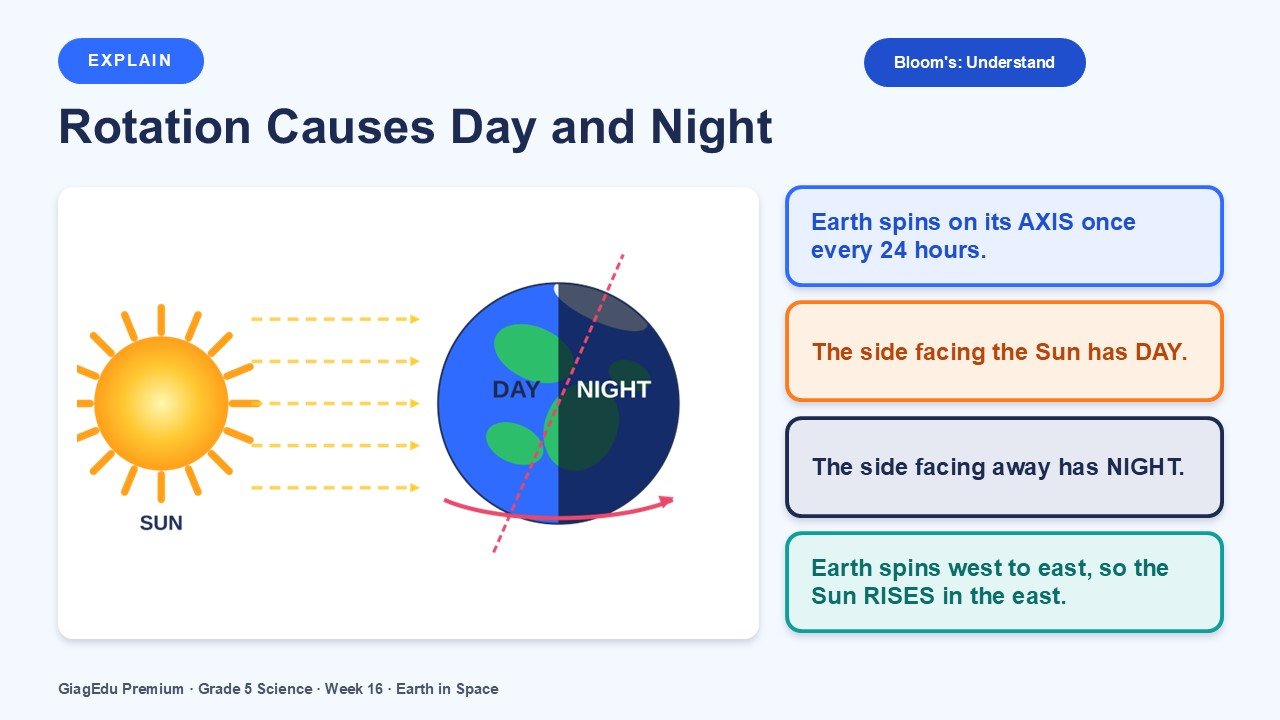
- Earth spins on its axis once every 24 hours.
- The half facing the Sun has day; the half facing away has night.
- Earth spins from west to east, so the Sun rises in the east.
- Because of this, it is not daytime everywhere at once. When it is midday in the USA, it is night in parts of Asia.
Revolution makes a year
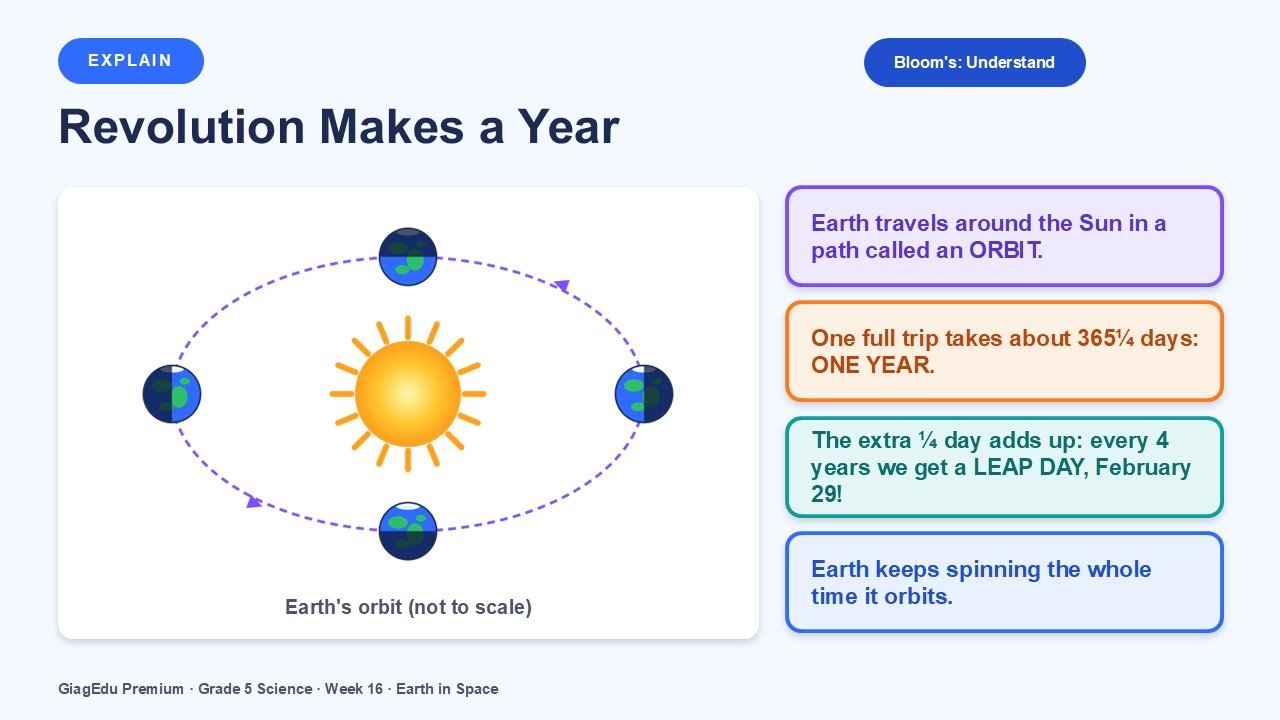
- Earth travels around the Sun along a path called an orbit.
- One full trip takes about 365¼ days: one year.
- The extra ¼ day adds up. Every 4 years we add a leap day, 29 February.
- Earth keeps spinning the whole time it orbits.
Rotation vs revolution
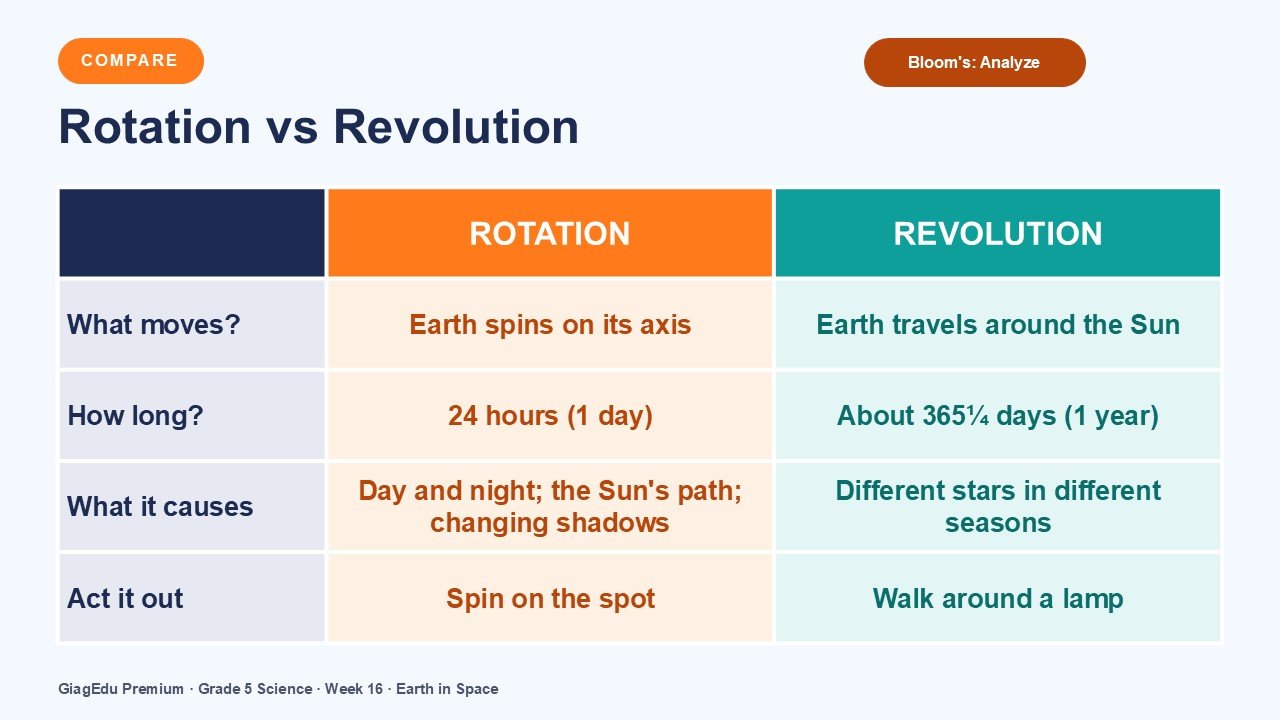
- Rotation: Earth spins on its axis; it takes 24 hours; it causes day and night, the Sun's path across the sky and changing shadows.
- Revolution: Earth travels around the Sun; it takes about 365¼ days; it causes different stars to be seen in different seasons.
Act it out: spin on the spot (rotation), then walk around a lamp (revolution).
The Sun's path across the sky
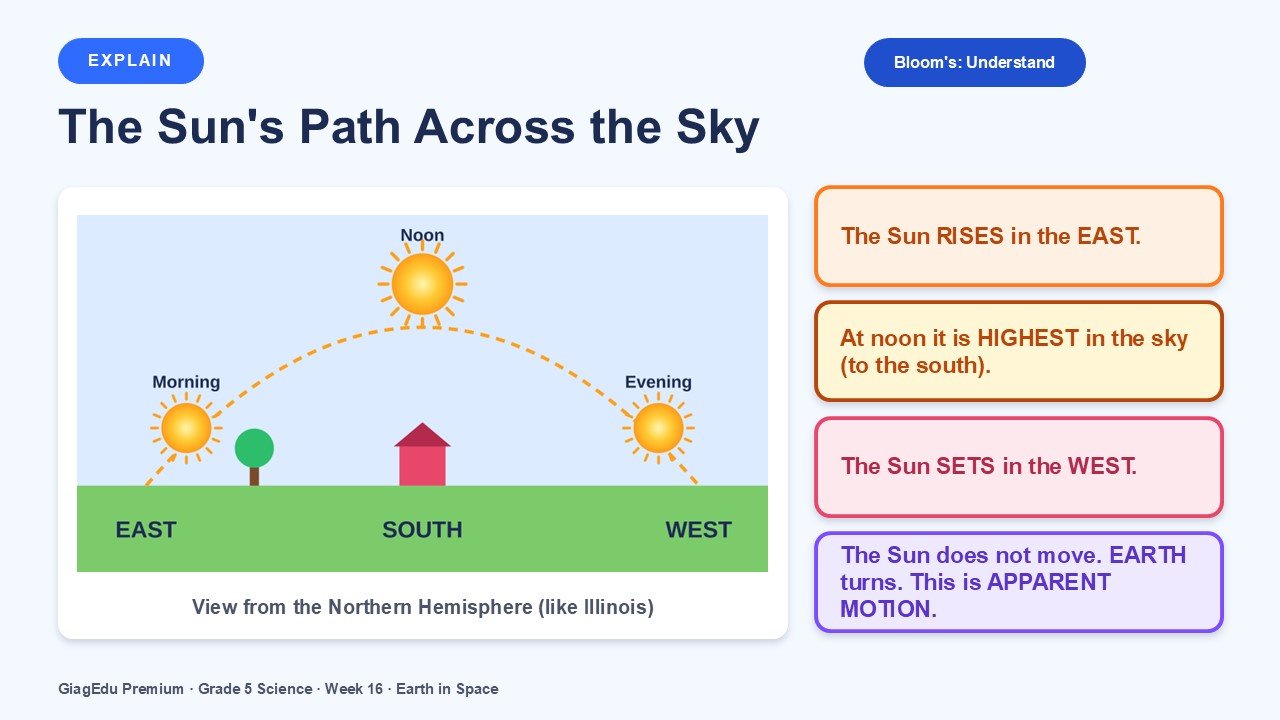
- The Sun rises in the east.
- At noon it is highest in the sky. In the northern half of the world, away from the tropics (for example in the USA), it is then to the south.
- The Sun sets in the west.
- The Sun is not really moving across the sky. Earth turns. This is apparent motion.
Why shadows change
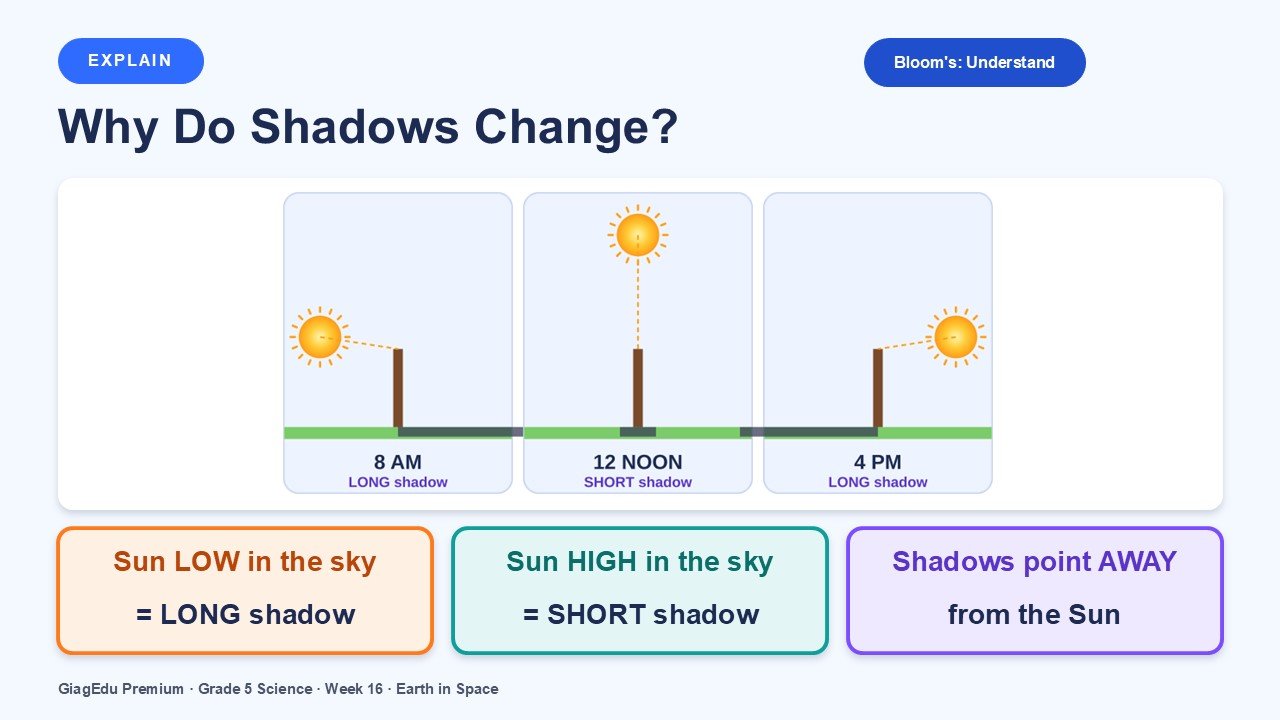
- Sun low in the sky (morning and evening) = long shadow.
- Sun high in the sky (around noon) = short shadow.
- Shadows always point away from the Sun. In the morning the Sun is in the east, so shadows point west; in the afternoon they point east.
So a stick's shadow is long in the morning, shortest at noon, and long again in the evening.
Different stars in different seasons
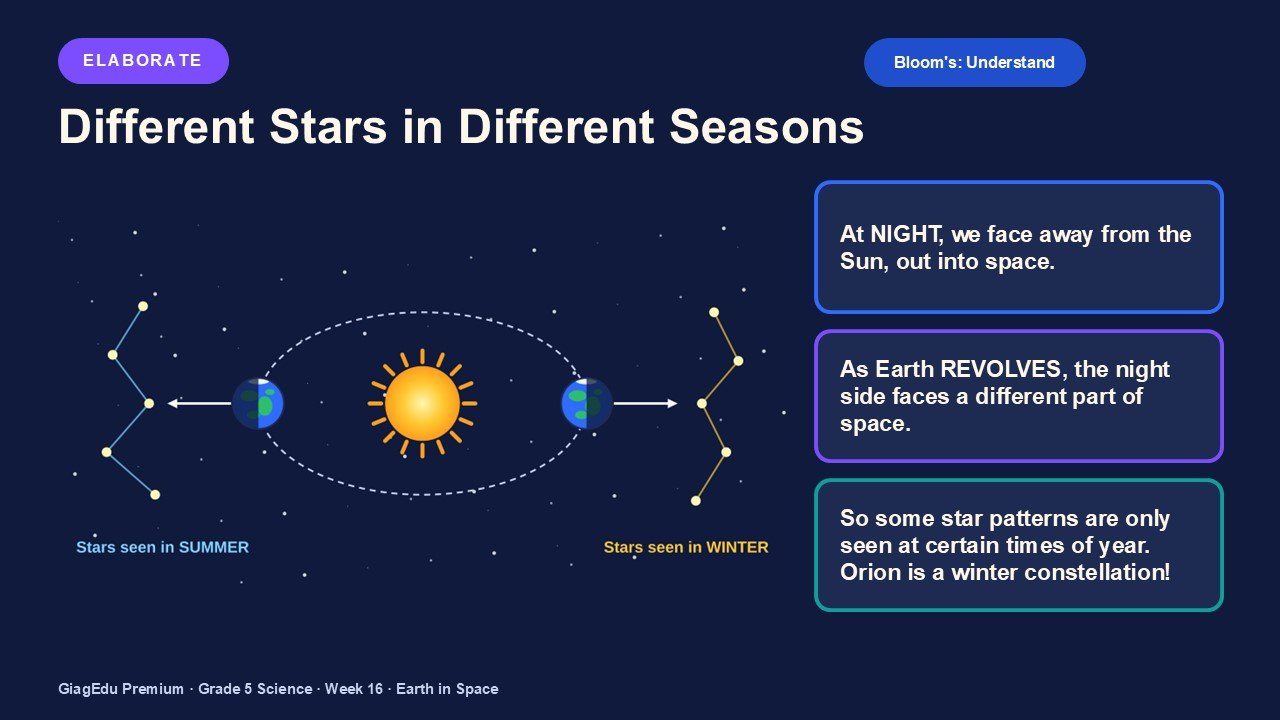
At night we face away from the Sun, out into space. As Earth revolves, the night side faces a different part of space, so some star patterns can only be seen at certain times of year. Orion is a winter constellation in the northern half of the world.
The Sun is a medium-sized star. It looks huge and bright only because it is the closest star, about 93 million miles away. Other stars are much farther away, so they look like tiny dots.
What if…?
- Earth stopped spinning: one side would have endless day (very hot), the other endless night (very cold).
- Earth spun twice as fast: a day would last only 12 hours.
- There was no Sun: no daylight, no shadows, no heat, and plants could not grow.
Myth busters
- "The Sun moves around Earth." False: Earth rotates, and revolves around the Sun.
- "Half of Earth always has daytime." True: the half facing the Sun.
- "Shadows are longest at noon." False: they are shortest at noon.
Videos
Practise Earth & Space: 10 questions in study mode, with an explanation after each answer.
Start Practice