Pressure in Solids, Liquids and Gases, Archimedes' Principle and Flotation
Physics · Pressure in solids, liquid pressure (P = hρg), atmospheric pressure and the barometer, the manometer, Pascal's principle and the hydraulic press, density and relative density, Archimedes' principle, upthrust and flotation.
Why this topic matters
WAEC and NECO set pressure questions every year: liquid pressure at a depth, the hydraulic press, Archimedes' principle and relative density. These questions use a few formulas over and over, so they are easy marks with practice.
Pressure
Pressure = force ÷ area, so P = F ÷ A. The unit is the pascal (Pa) = N m⁻².
- The same force over a smaller area gives a larger pressure.
- This is why knives are sharpened, nails are pointed, and lorries and tractors have wide tyres. A woman in stiletto heels presses harder on the floor than an elephant does with its wide feet.
Pressure in liquids
P = hρg, where h is the depth, ρ the density of the liquid and g the acceleration due to gravity.
Pressure in a liquid:
- increases with depth;
- increases with the density of the liquid;
- acts equally in all directions at a given depth;
- does not depend on the shape or cross-section of the container.
This is why dam walls are thicker at the bottom, and water spurts further from a hole lower down a tank.
Atmospheric pressure
The air above us exerts pressure: about 1.0 × 10⁵ Pa at sea level.
- A mercury barometer holds up a column of about 76 cm (760 mm) of mercury: P = 0.76 × 13 600 × 9.8 ≈ 1.01 × 10⁵ Pa.
- An aneroid barometer has no liquid. It is used in altimeters, because atmospheric pressure falls with height.
- Atmospheric pressure is used by drinking straws, syringes, rubber suckers and lift pumps.
Pascal's principle and hydraulic machines
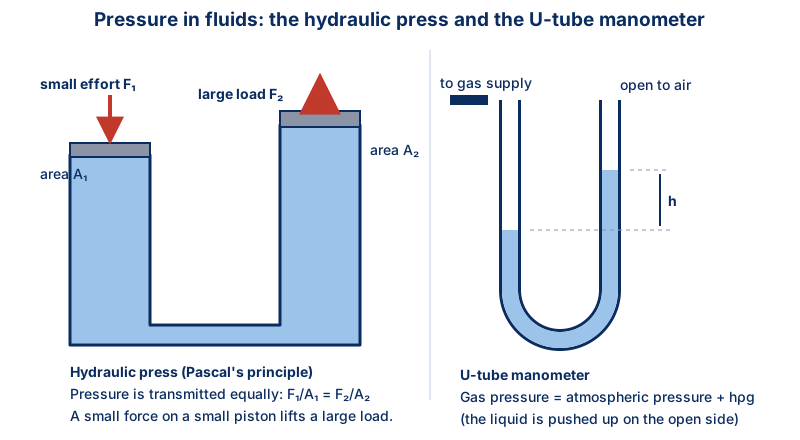
Pascal's principle: pressure applied to an enclosed fluid is transmitted equally throughout the fluid.
In a hydraulic press: F₁ ÷ A₁ = F₂ ÷ A₂. A small force on a small piston gives a large force on a large piston. This is used in car brakes, hydraulic jacks and barber's chairs.
U-tube manometer: measures gas pressure. Gas pressure = atmospheric pressure + hρg, where h is the difference in liquid levels.
Density and relative density
- Density = mass ÷ volume, in kg m⁻³. For water, ρ = 1000 kg m⁻³ (1 g cm⁻³).
- Relative density = density of the substance ÷ density of water. It has no unit, and is measured with a hydrometer or a density bottle.
Archimedes' principle and upthrust
Archimedes' principle: when a body is wholly or partly immersed in a fluid, it experiences an upthrust equal to the weight of fluid displaced.
- Upthrust = weight in air − weight in the liquid (the apparent loss in weight).
- Relative density = weight in air ÷ upthrust in water (the loss in weight in water).
Flotation
Law of flotation: a floating body displaces its own weight of the fluid it floats in.
- A body floats if its average density is less than that of the fluid.
- A steel ship floats because its hollow shape displaces a large weight of water.
- A submarine sinks or rises by letting water into its ballast tanks, or pumping it out.
- A hydrometer floats higher in denser liquids, so its stem can be marked with relative densities.
- Hot-air balloons rise because hot air is less dense than the cold air around them.
Top exam traps
- In P = hρg, h is the depth below the surface, not the height from the bottom.
- Use SI units: convert cm to m and g cm⁻³ to kg m⁻³ (1 g cm⁻³ = 1000 kg m⁻³).
- Upthrust is the loss in weight, not the weight in water.
- Relative density has no unit.
Practise Pressure: 10 questions in study mode, with an explanation after each answer.
Start Practice