Physics Alternative to Practical: Readings, Tables, Graphs, Slopes and Precautions for the 10 Core Experiments
Physics · How Physics Paper 3 is marked: reading instruments, tables, graphs and slopes, and the core experiments (pendulum, spring, moments, heat, glass block, lens, Ohm's law, metre bridge, e.m.f.) with worked results and precautions.
What the practical paper tests
Every practical question follows the same pattern, and you can practise each part:
- (a) Table: complete the derived columns (T, T2, sin i, 1/u…).
- (b) Graph: plot y against x. The graph carries the most marks.
- (c) Slope: draw a large triangle and work out Δy ÷ Δx.
- (d) Deduce: use the slope to find g, k, n, f, R, E or r.
- (e) Precautions: two, specific to this experiment.
- (f) Theory: a definition, a law or a short calculation.
Golden rules for tables, graphs and answers
- Tables: units in every heading, e.g. l (cm), T (s). Give every value in a column to the same number of decimal places. Never leave a cell blank.
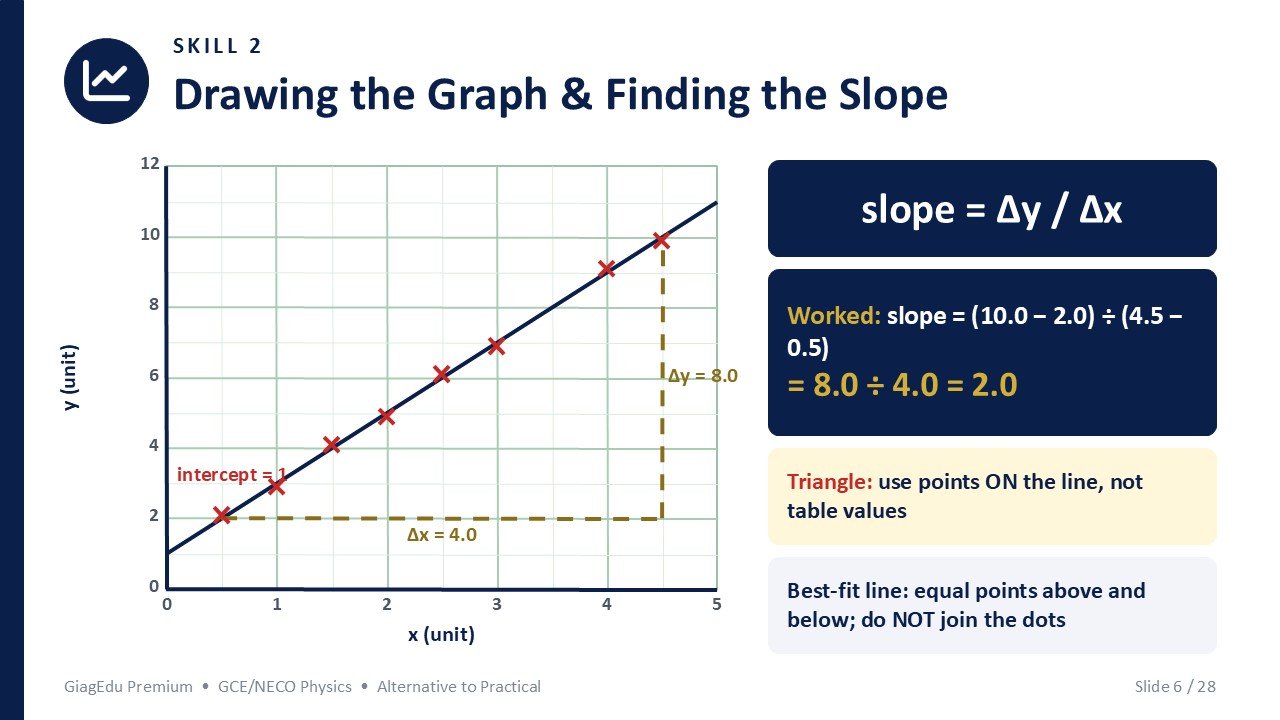
- Graphs: give a title ("Graph of T2 against l") and label both axes with units. Choose a scale that uses more than half the sheet. Plot ⊙ or ×, then draw one straight line of best fit; do not join the dots.
- Answers: make the slope triangle cover at least half the line, show Δy ÷ Δx with the actual numbers, and give the final answer with its unit.
Reading instruments to the right precision
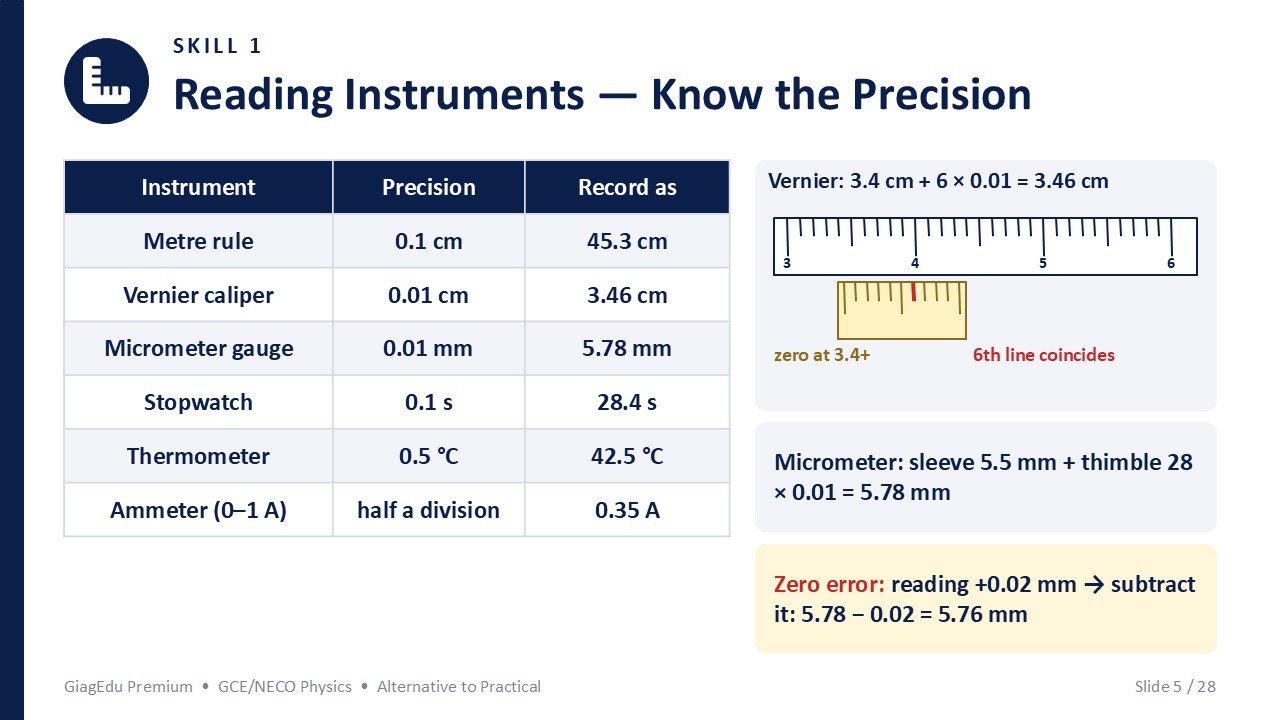
- Metre rule: 0.1 cm (record 45.3 cm)
- Vernier caliper: 0.01 cm (main scale 3.4 cm + 6th line × 0.01 = 3.46 cm)
- Micrometer screw gauge: 0.01 mm (sleeve 5.5 mm + thimble 28 × 0.01 = 5.78 mm)
- Stopwatch: 0.1 s · Thermometer: 0.5 °C · Meters: half a division
Finding the slope
Mechanics practicals
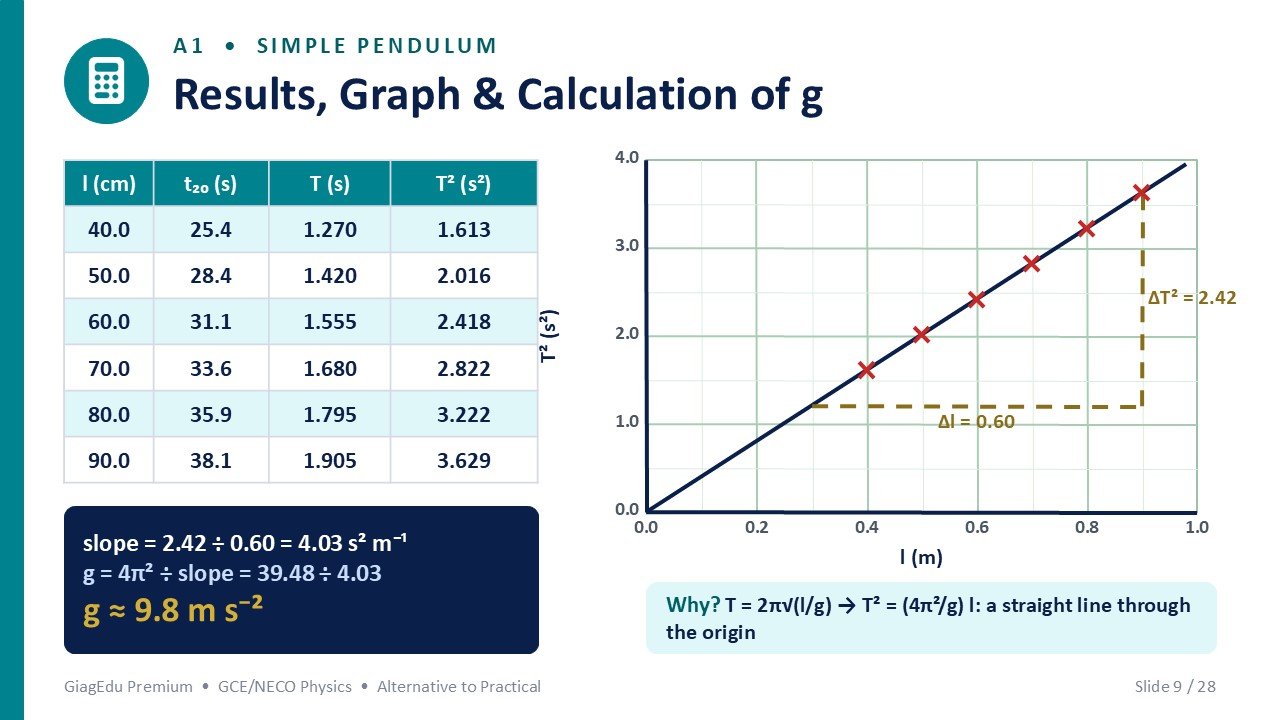
Simple pendulum (find g). Clamp the string in a split cork; time 20 oscillations for l = 40, 50 … 90 cm; T = t/20; plot T2 against l. Since T2 = (4π2/g)l, the graph is a straight line through the origin and g = 4π2 ÷ slope.
Spiral spring (find k). Plot extension e against mass m. With a slope of 10.0 cm ÷ 250 g = 0.040 cm g−1 = 0.40 m kg−1, mg = ke gives k = g ÷ slope = 10 ÷ 0.40 = 25 N m−1.
Principle of moments (mass of a metre rule). Hang a mass m at the 5 cm mark and balance the rule on a knife edge at x. Then m(x − 5) = M(50 − x), so M = m(x − 5) ÷ (50 − x); the average of the class results is about 99.8 g. Precaution: the rule must be horizontal at balance.
Heat practicals
Cooling curve. Heat water to about 80 °C and read θ every 2 minutes. The water cools fast at first and slowly near room temperature; the rate of cooling at any time is the slope of the tangent.
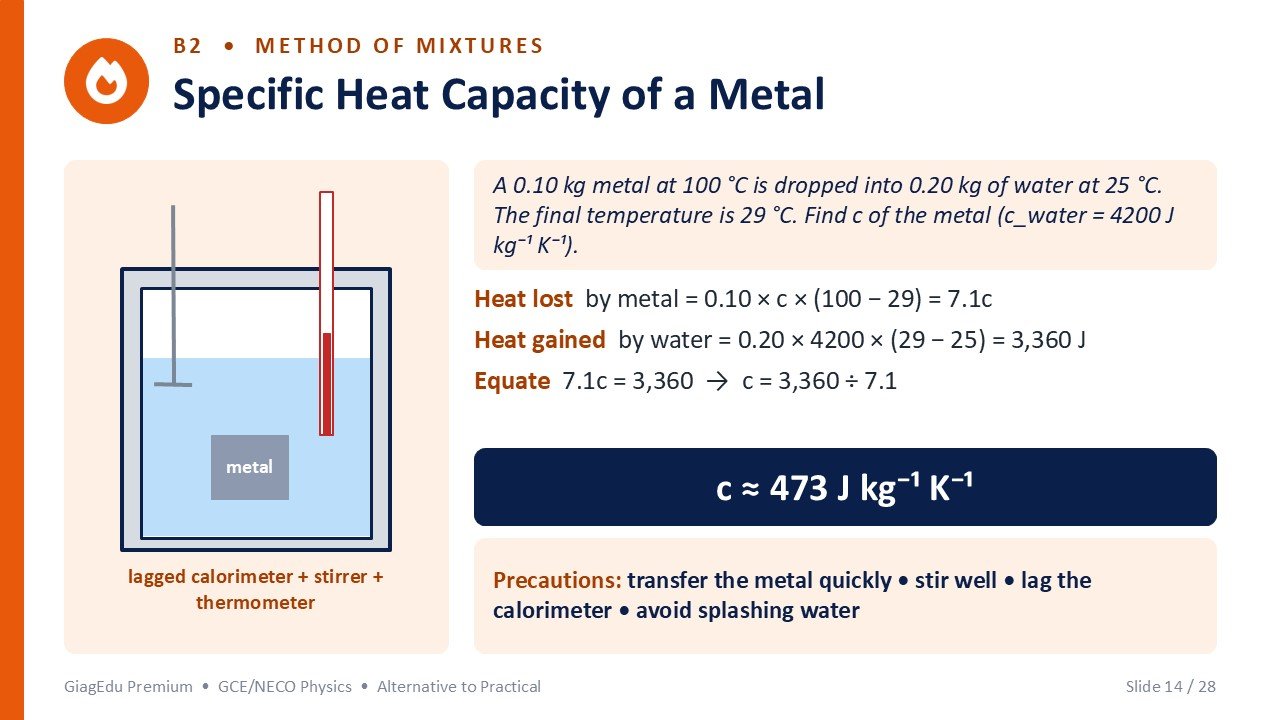
Specific heat capacity by the method of mixtures.
Optics practicals
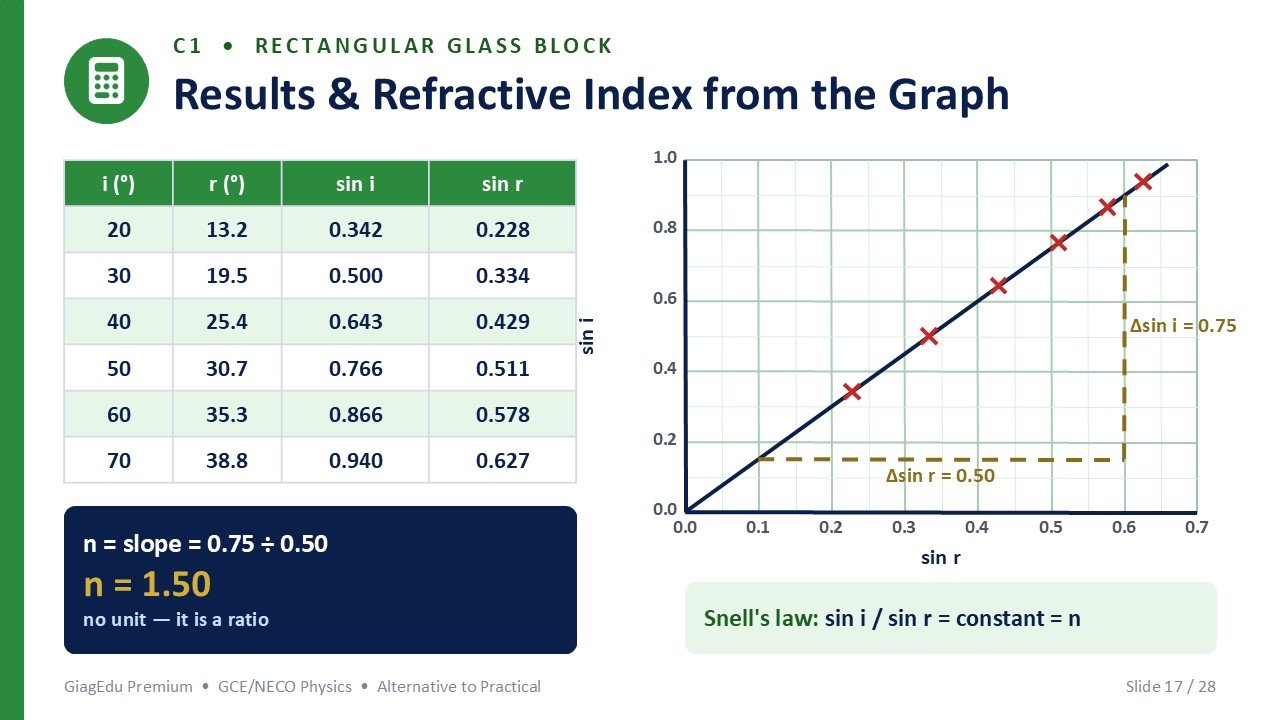
Rectangular glass block. Trace rays with optical pins for i = 20° to 70° and plot sin i against sin r: the slope is the refractive index.
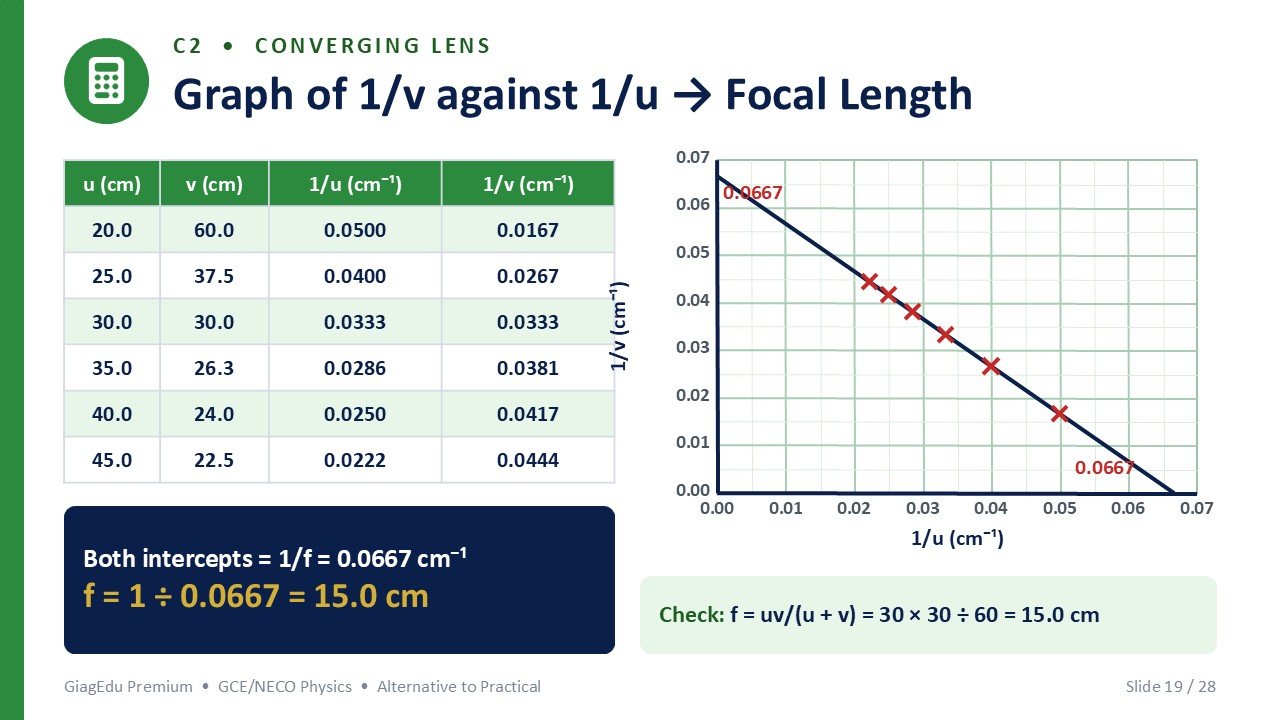
Converging lens. Move the screen until a sharp image forms for u = 20 to 45 cm. Plot 1/v against 1/u: both intercepts equal 1/f.
Electricity practicals
Ohm's law. Connect the ammeter in series and the voltmeter in parallel with the resistor. The slope of V against I is the resistance: 2.5 ÷ 0.50 = 5.0 Ω. Open the key between readings so the resistor does not heat up.
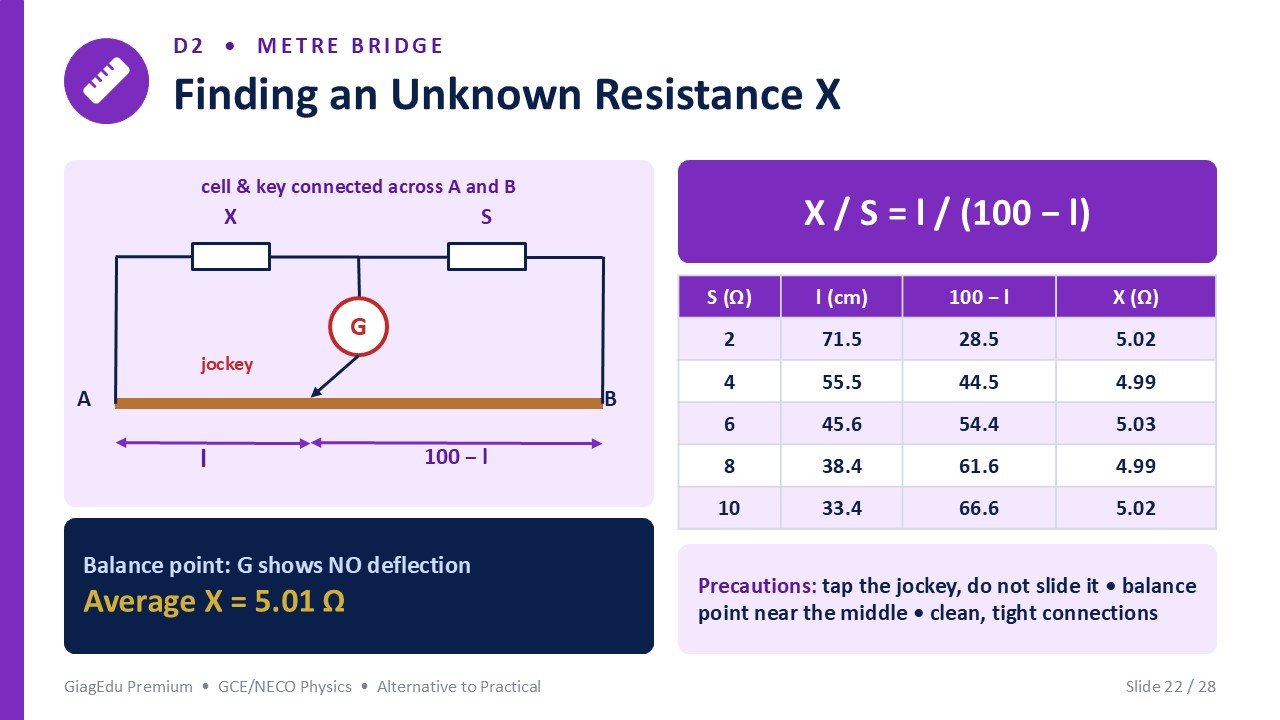
Metre bridge. At the balance point the galvanometer shows no deflection, and X ÷ S = l ÷ (100 − l).
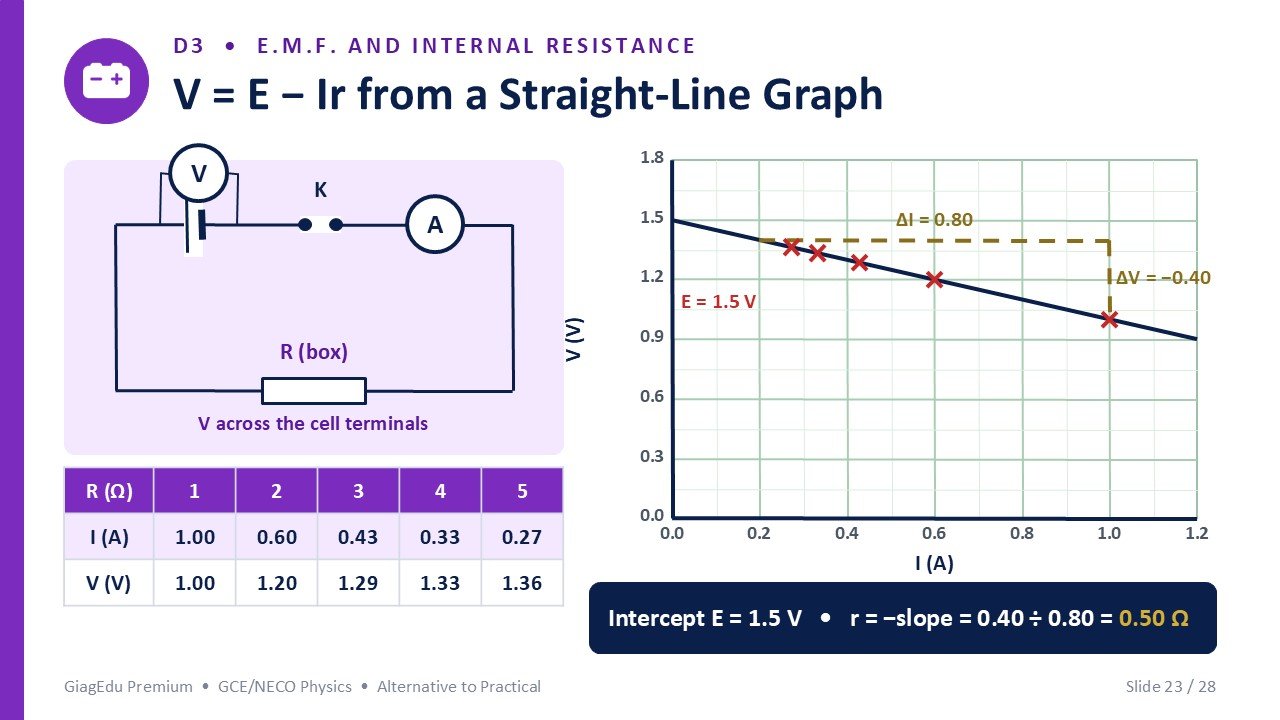
e.m.f. and internal resistance. V = E − Ir, so a graph of V against I has intercept E and slope −r.
Precaution or source of error?
A precaution is something you did ("I ensured the amplitude was small"); a source of error is something that spoils results (reaction time, heat lost to the surroundings). Write precautions in the past tense and make them fit the experiment.
- Pendulum: small amplitude; time 20 oscillations; fixed support.
- Spring: avoid parallax at the pointer; do not overload the spring.
- Heat: stir; lag the calorimeter; transfer quickly; read at eye level.
- Glass block: pins upright, at least 6 cm apart.
- Lens: object, lens and screen on one axis; sharpest image.
- Electricity: open the key between readings; tight connections.
Exam traps
- Plotting the axes the wrong way round ("V against I" means V is vertical).
- A tiny or awkward scale (3 or 7 units per square).
- Joining the dots instead of one best-fit line.
- A small slope triangle, or using table values for the slope.
- Missing units in headings, slopes and answers.
- General precautions such as "I was careful" or "I avoided errors": they score nothing.
Practice
- A pendulum makes 20 oscillations in 36.0 s. Find its period.
- A spring extends by 4.0 cm under a load of 2.0 N. Find the spring constant.
- A micrometer with a zero error of +0.02 mm reads 5.36 mm. Find the corrected reading.
- How many significant figures are in 0.04050?
- A uniform metre rule balances at 50 cm. A 40 g mass hangs at the 20 cm mark. What mass at the 65 cm mark restores balance?
- For a converging lens, u = 30 cm and v = 60 cm. Find f.
Answers: 1. 36.0 ÷ 20 = 1.80 s · 2. 2.0 ÷ 0.040 = 50 N m−1 · 3. 5.34 mm · 4. 4 · 5. 40 × 30 = m × 15, so 80 g · 6. 1/f = 1/30 + 1/60 = 3/60, so f = 20 cm
Videos
Practise Practical Skills (Alternative to Practical): 10 questions in study mode, with an explanation after each answer.
Start Practice