Motion: Distance, Displacement, Speed, Velocity and Acceleration
Physics · Distance vs displacement, speed vs velocity, acceleration, motion graphs and the three equations of motion, with WAEC, NECO and GCE worked examples.
What is motion?
An object is in motion when its position changes with time relative to a reference point.
The reference point matters. A passenger sitting in a moving bus is at rest relative to the seat but moving at 60 km/h relative to the road.
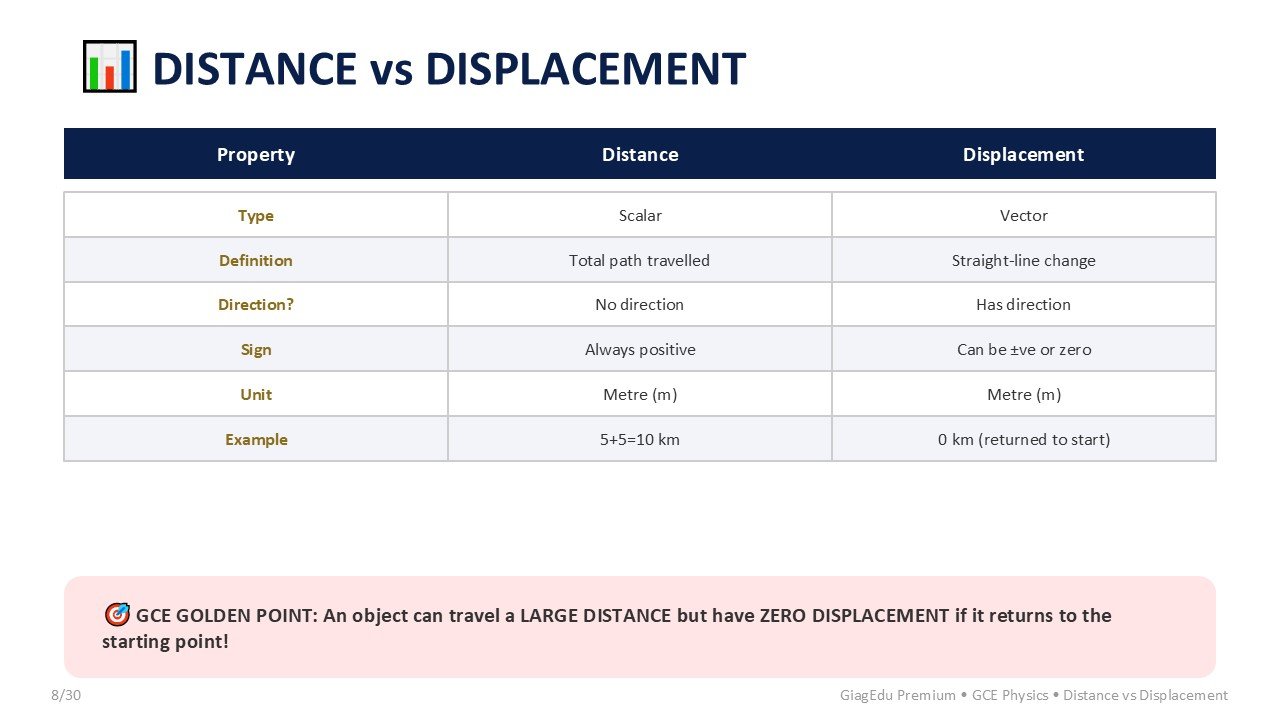
Distance and displacement
Distance is the total length of path travelled. It is a scalar: it has no direction and is never negative.
Displacement is the straight-line change in position from start to finish, in a stated direction. It is a vector and can be positive, negative or zero.
Both are measured in metres (m).
Speed and velocity
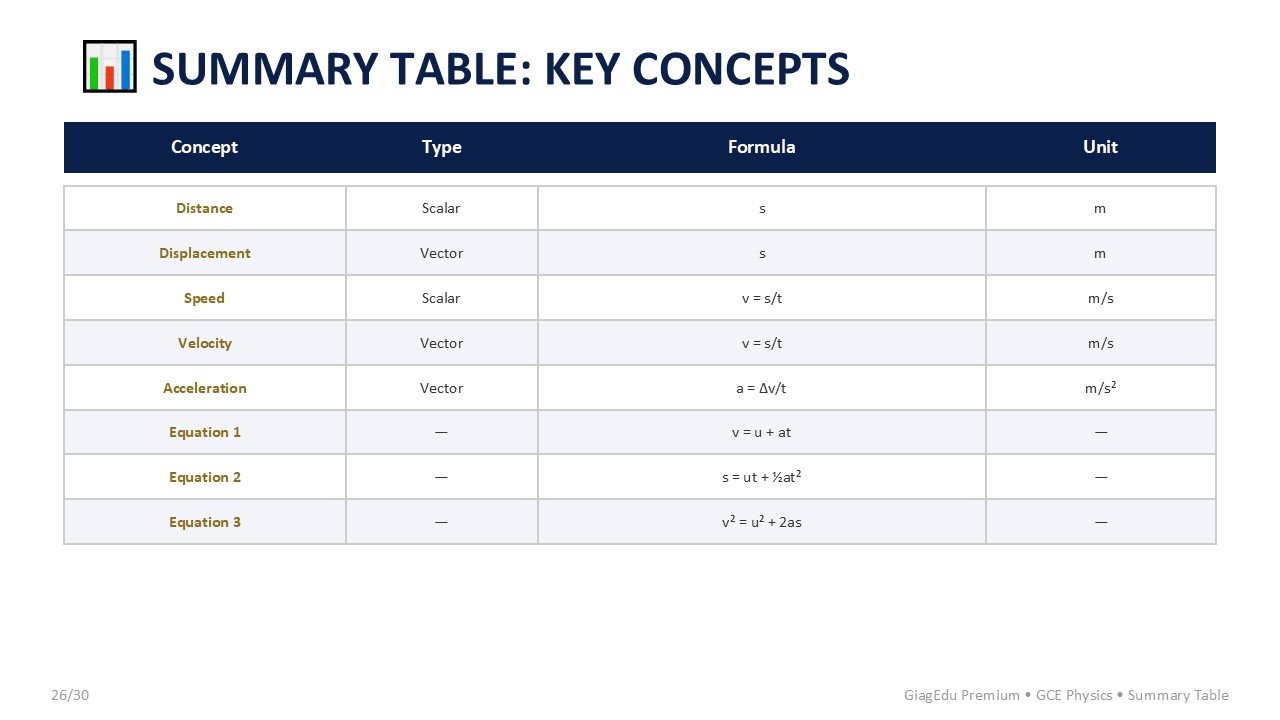
Speed = distance ÷ time. It is a scalar.
Velocity = displacement ÷ time. It is a vector, so it needs a direction (e.g. 20 m/s east).
Unit for both: m/s (m s-1).
Acceleration
Acceleration is the rate of change of velocity:
a = (v − u) ÷ t
where u = initial velocity, v = final velocity and t = time. Unit: m/s2 (m s-2).
- If velocity increases, a is positive (acceleration).
- If velocity decreases, a is negative (deceleration or retardation).
Distance–time graphs
- The gradient (slope) = speed.
- A steeper line means a greater speed.
- A horizontal line means the object is stationary.
Velocity–time graphs
Two golden rules:
- Gradient = acceleration
- Area under the graph = displacement (distance travelled)
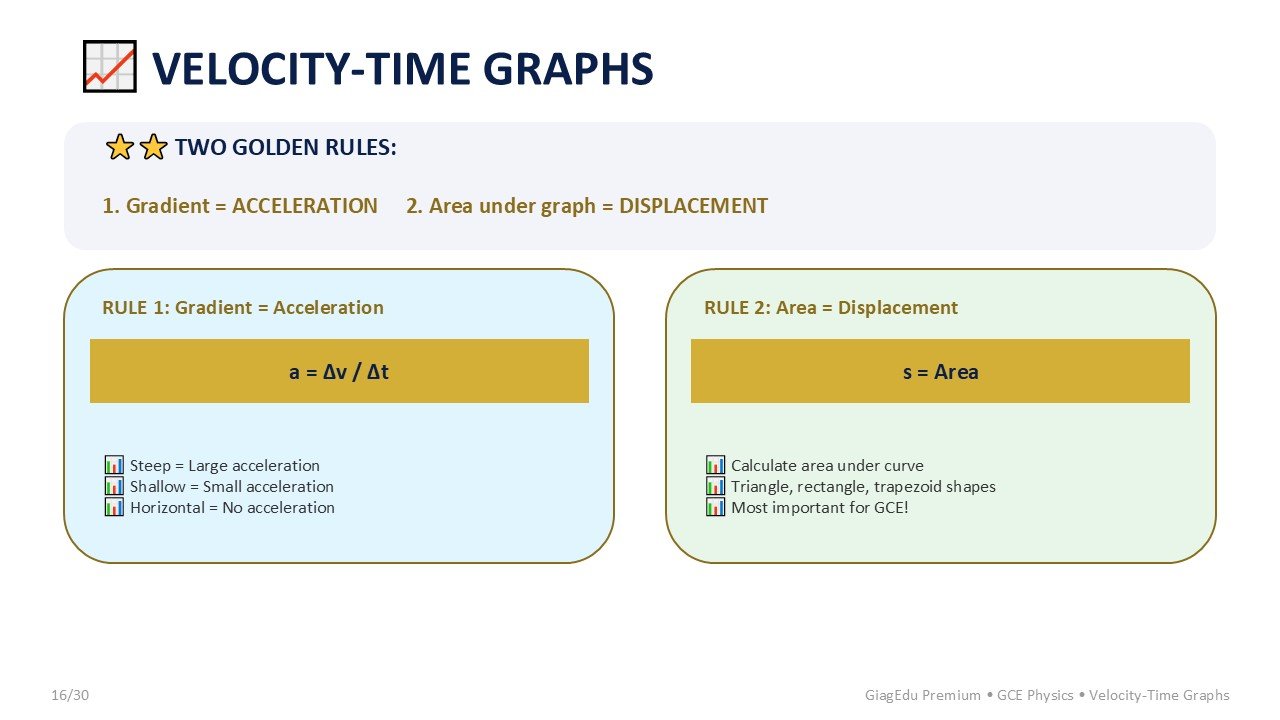
A horizontal line on a velocity–time graph means constant velocity (zero acceleration), not "at rest". Split the area into rectangles, triangles and trapeziums to find the distance.
The equations of motion
For uniform (constant) acceleration:
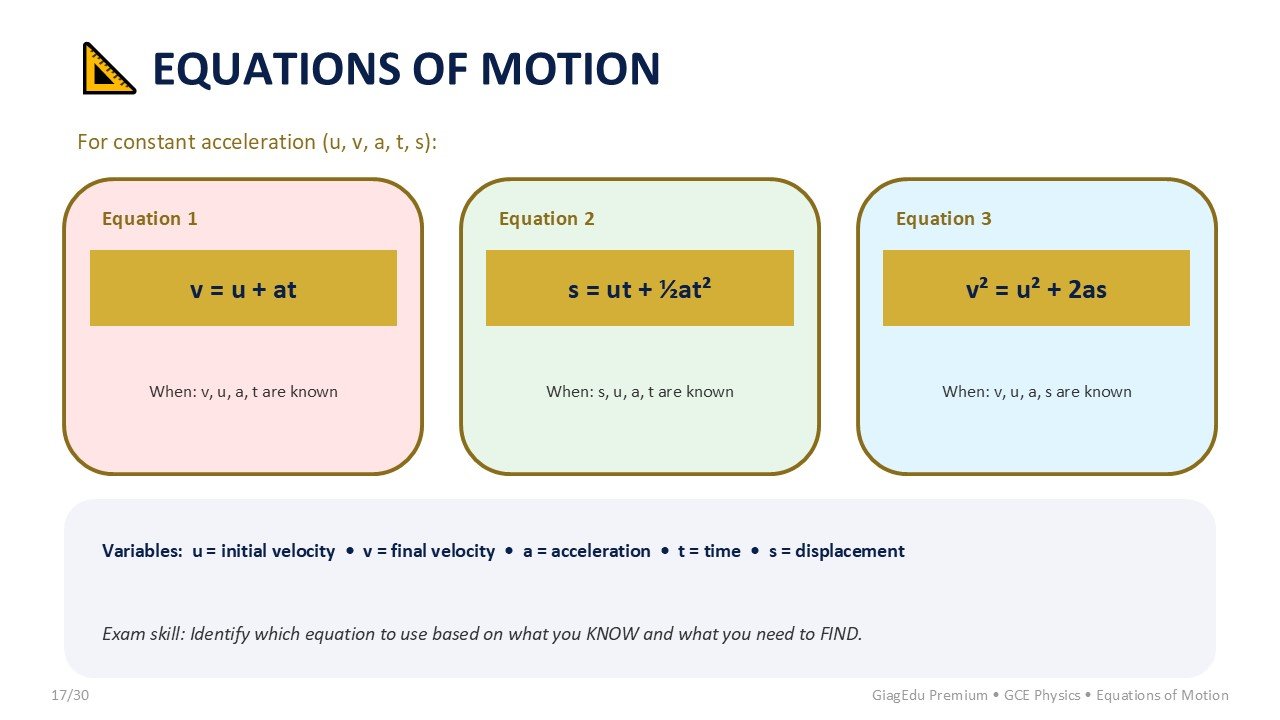
- v = u + at (no s)
- s = ut + ½at2 (no v)
- v2 = u2 + 2as (no t)
A fourth useful one: s = ½(u + v)t (no a).
Measuring speed in the lab (Paper 3)
- Ticker-timer: dots on paper tape at equal time intervals; measure the gaps.
- Light gate: times how long an object of known length blocks a beam.
- Stopwatch and metre rule: time the object over a measured distance.
Summary
Top exam traps
- Confusing distance with displacement.
- Writing "velocity = distance/time".
- Leaving out the direction in a velocity answer.
- Using the wrong equation of motion: check the given values first.
- Misreading graphs: gradient ≠ area.
- Forgetting units (speed in m/s, acceleration in m/s2).
Practice
- A car travels 300 m in 15 s. What is its average speed?
- An object starts from rest. What is u?
- A car accelerates from 5 m/s to 20 m/s in 3 s. Find its acceleration.
- A train moving at 20 m/s decelerates uniformly at 2 m/s2. How far does it travel before stopping?
- What does the area under a velocity–time graph represent?
Answers: 1. 20 m/s · 2. u = 0 · 3. a = 15 ÷ 3 = 5 m/s2 · 4. 0 = 400 − 4s, so s = 100 m · 5. Displacement (distance travelled)
Previous topic: Scalars & Vectors · Next class: Forces and Newton's Laws.
Videos
Practise Motion: 10 questions in study mode, with an explanation after each answer.
Start Practice