Forces and Newton's Laws of Motion
Physics · What a force is, the main types of force, mass vs weight, Newton's three laws, F = ma, free-body diagrams, equilibrium and tension, with WAEC and GCE worked examples.
What is a force?
A force is a push or a pull that can change an object's state of rest or motion, its direction, or its shape.
- SI unit: the newton (N).
- Force is a vector: a 10 N force north is not the same as a 10 N force south.
Types of force
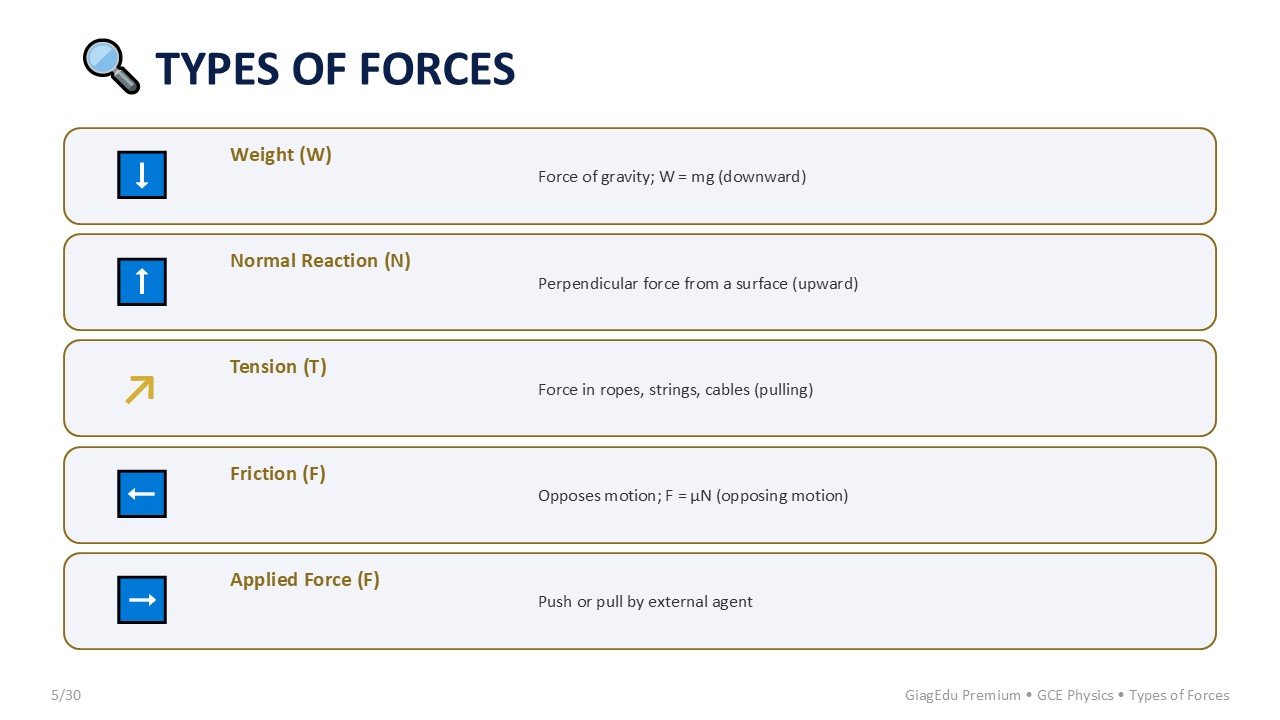
- Weight (W): the pull of gravity, W = mg, acting downwards.
- Normal reaction (R or N): the push of a surface, at right angles to it.
- Tension (T): the pull in a rope, string or cable, acting along it.
- Friction: opposes motion between surfaces in contact.
- Applied force: a push or pull from an outside agent.
Mass and weight
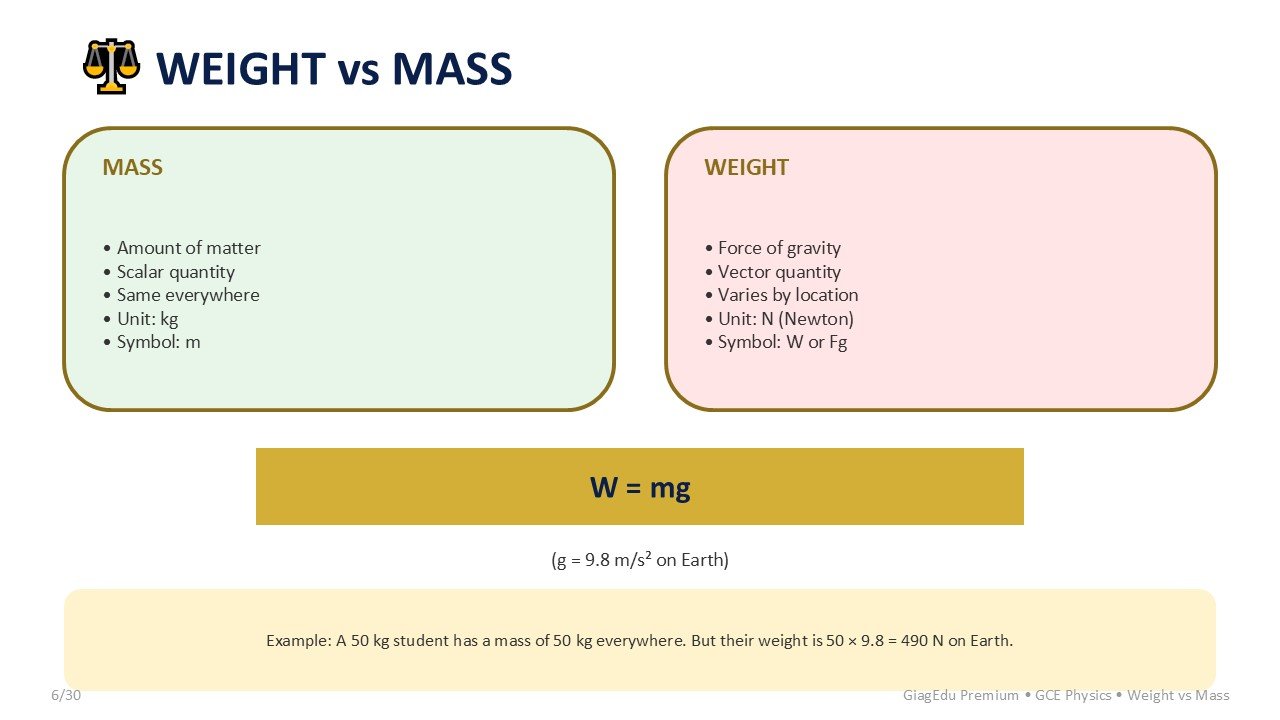
Mass is the amount of matter in a body. It is a scalar, measured in kg, and is the same everywhere.
Weight is the force of gravity on the body. It is a vector, measured in N, and changes from place to place (it is smaller on the Moon).
W = mg (g ≈ 9.8 m/s2 on Earth; WAEC often lets you use g = 10 m/s2)
Newton's first law (the law of inertia)
A body stays at rest, or keeps moving with uniform velocity in a straight line, unless an external (unbalanced) force acts on it.
Inertia is the reluctance of a body to change its state of rest or motion. The more mass, the more inertia.
- Passengers jerk forward when a bus brakes suddenly: their bodies tend to keep moving. Seat belts protect against this.
- A book on a table stays at rest: its weight is balanced by the normal reaction.
Newton's second law
The rate of change of momentum is proportional to the applied force and takes place in the direction of the force. For a constant mass this gives:
F = ma (net force = mass × acceleration)
- A bigger net force gives a bigger acceleration.
- For the same force, a bigger mass gives a smaller acceleration.
- 1 N is the force that gives a 1 kg mass an acceleration of 1 m/s2.
Newton's third law
For every action, there is an equal and opposite reaction. The two forces act on different bodies.
- A rocket pushes hot gas backwards; the gas pushes the rocket forwards.
- Your foot pushes backwards on the ground; the ground pushes you forwards.
- A book pushes down on a table; the table pushes up on the book.
Free-body diagrams
A free-body diagram shows every force acting on one object as a labelled arrow.
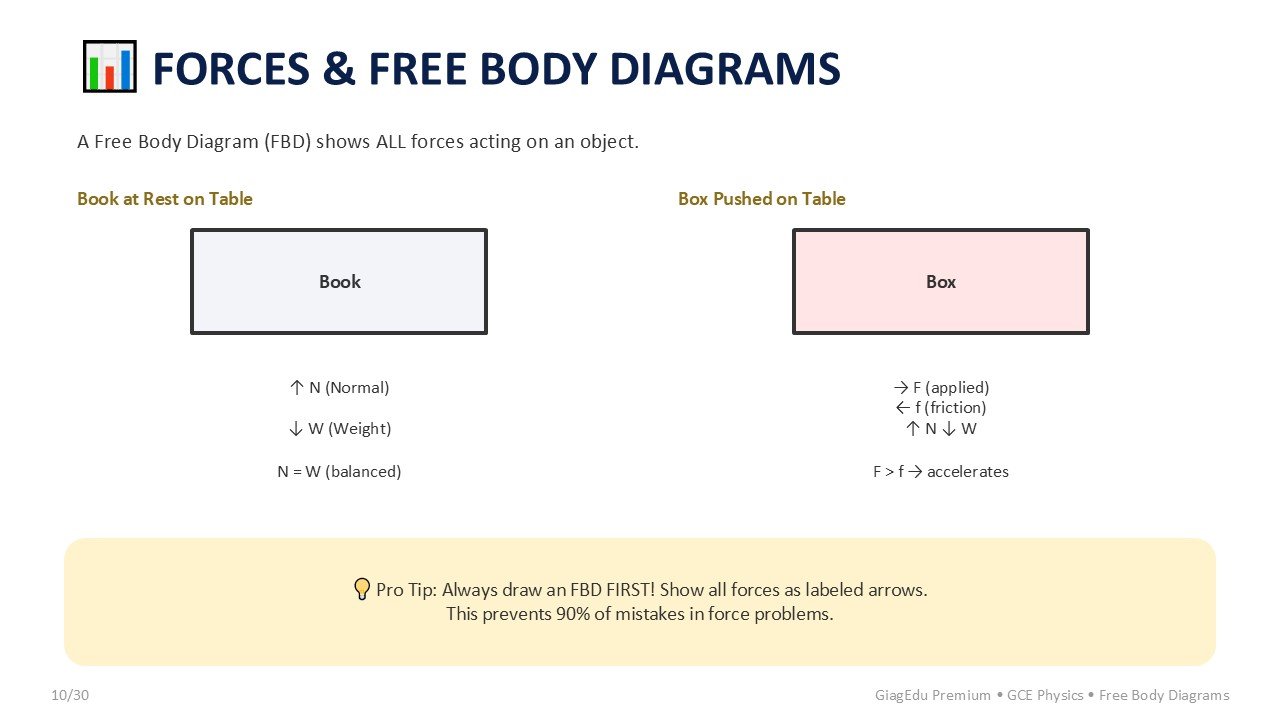
Problems with more than one force
Net force = forces in the direction of motion − forces opposing it. Then use F = ma.
Equilibrium
A body is in equilibrium when the resultant force is zero (ΣF = 0), so its acceleration is zero.
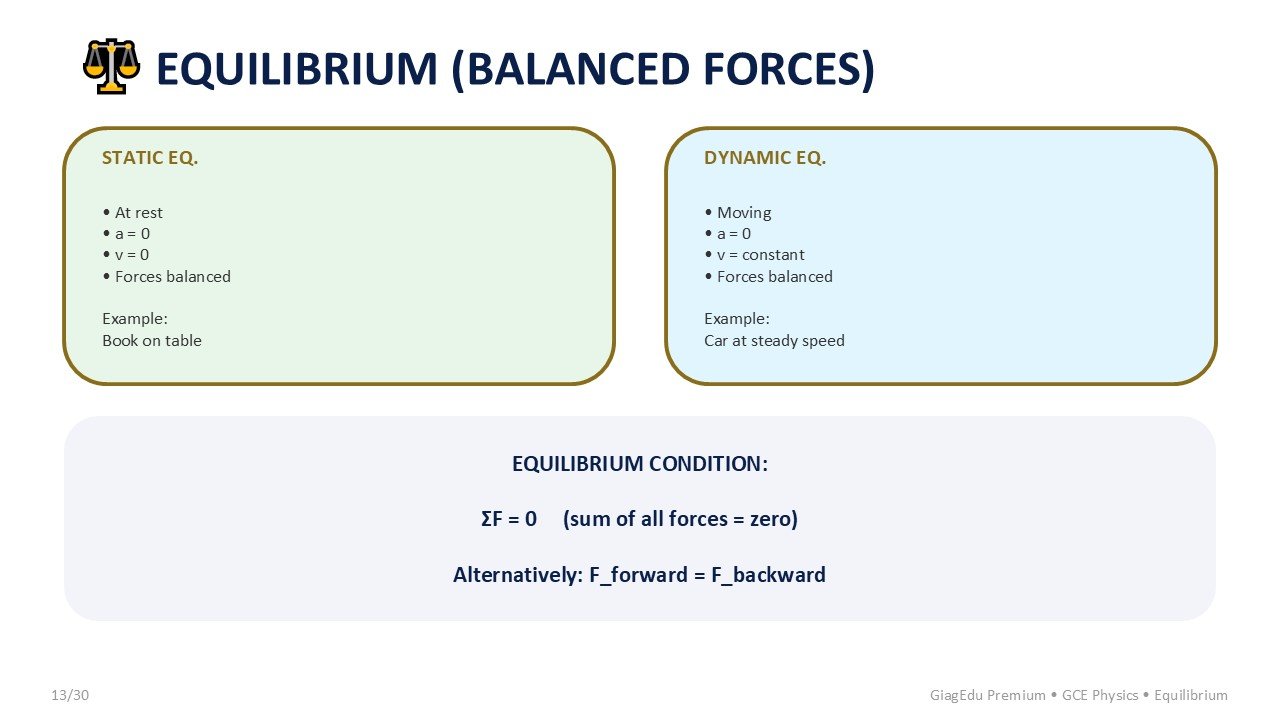
- Static equilibrium: at rest (a book on a table).
- Dynamic equilibrium: moving at constant velocity (a car at steady speed on a straight road).
Tension
Tension acts along a string or rope, pulling on the objects at each end. For an object hanging at rest: T = W = mg.
Top exam traps
- Confusing mass (kg) with weight (N).
- Forgetting to subtract friction or resistance before using F = ma.
- Saying Newton's third-law pairs cancel: they act on different objects.
- Leaving directions off free-body diagrams.
- Giving W = mg without a unit.
Practice
- If ΣF = 0, what is the acceleration?
- Find the weight of a 10 kg mass (g = 10 m/s2).
- Which law explains why passengers lurch forward when a car stops suddenly?
- If the net force on a body doubles and its mass stays the same, what happens to its acceleration?
- A 5 kg box is pushed with 30 N against 10 N of friction. Find (a) the net force and (b) the acceleration.
Answers: 1. Zero · 2. 100 N · 3. Newton's first law (inertia) · 4. It doubles · 5. (a) 20 N (b) 4 m/s2
Previous topic: Motion · Next class: Work, Energy and Power.
Practise Mechanics: 10 questions in study mode, with an explanation after each answer.
Start Practice