Heat and Thermal Physics: Temperature, Expansion, Heat Transfer, Specific and Latent Heat, Gas Laws
Physics · Heat and temperature, thermometers and temperature scales, thermal expansion, conduction, convection and radiation, specific heat capacity and the method of mixtures, latent heat, evaporation and boiling, and the gas laws.
Why this topic matters
WAEC and NECO set calculations on Q = mcΔθ, the method of mixtures, latent heat and the gas laws almost every year. Paper 3 often includes a specific heat capacity or cooling experiment.
Heat and temperature
- Heat is a form of energy that flows from a hotter body to a colder one. It is measured in joules (J).
- Temperature is the degree of hotness: a measure of the average kinetic energy of the particles. It is measured in °C or kelvin (K).
- Kelvin temperature = Celsius temperature + 273. For example, 27 °C = 300 K. Absolute zero is 0 K (−273 °C).
Thermometers
A thermometer uses a property that changes steadily with temperature (a thermometric property):
- liquid-in-glass (mercury or alcohol): the length of the liquid column;
- constant-volume gas thermometer: gas pressure;
- platinum resistance thermometer: electrical resistance;
- thermocouple: e.m.f. It is used for very high temperatures and is quick to respond.
The fixed points are the ice point (0 °C) and the steam point (100 °C).
Mercury is a good thermometric liquid because it:
- is opaque and easy to see;
- expands evenly;
- does not wet the glass;
- conducts heat well.
Alcohol is used for very low temperatures, because it freezes at −115 °C, while mercury freezes at −39 °C.
A clinical thermometer has a constriction so the reading stays after it is removed from the mouth. Its range is about 35–42 °C.
Thermal expansion
Most substances expand when heated.
Linear expansivity: α = ΔL ÷ (L × Δθ), so the change in length ΔL = αLΔθ.
Expansion in everyday life:
- Gaps are left between railway lines and in bridges, and overhead cables sag in hot weather.
- A bimetallic strip (brass and iron) bends when heated, because brass expands more. It is used in thermostats, fire alarms and flashing indicators.
- Hot water is used to loosen a tight metal lid.
Anomalous expansion of water: water contracts when heated from 0 °C to 4 °C, so it is densest at 4 °C. Ponds freeze from the top down, and fish survive in the water at 4 °C at the bottom.
Heat transfer
- Conduction: heat passes through a solid from particle to particle, with no movement of the material. Metals are good conductors; wood, plastic and air are poor conductors (insulators).
- Convection: heat is carried by the movement of a fluid (a liquid or gas). Warm fluid is less dense and rises; cool fluid sinks. Examples: sea and land breezes, and heating water in a pot.
- Radiation: heat travels as infrared waves. It needs no medium and can cross a vacuum, which is how the Sun's heat reaches us. Dull black surfaces are the best absorbers and emitters; shiny white or silver surfaces are the poorest.
The vacuum flask reduces all three:
- the vacuum stops conduction and convection;
- the silvered walls reduce radiation;
- the stopper stops convection and evaporation.
Specific heat capacity
Q = mcΔθ, where c is the specific heat capacity: the heat needed to raise the temperature of 1 kg of a substance by 1 K. Its unit is J kg⁻¹ K⁻¹. For water, c ≈ 4200 J kg⁻¹ K⁻¹.
Water's high specific heat capacity makes it a good coolant in car radiators, and explains why coastal areas have milder climates.
Latent heat
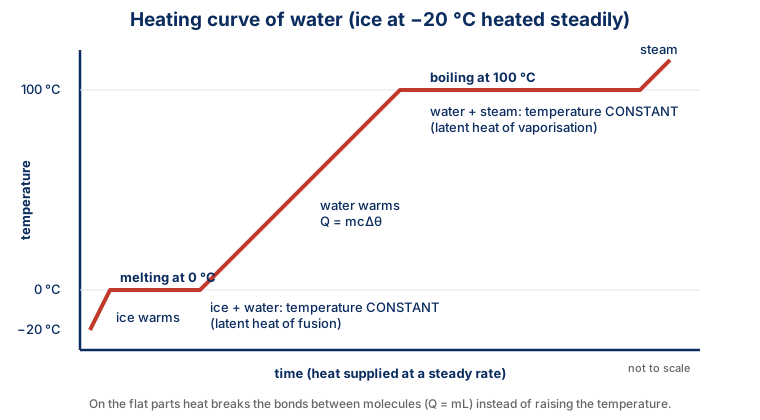
Latent heat is the heat absorbed or given out during a change of state, at constant temperature. Q = mL.
- Latent heat of fusion (melting) of ice: about 3.36 × 10⁵ J kg⁻¹.
- Latent heat of vaporisation (boiling) of water: about 2.26 × 10⁶ J kg⁻¹.
On the flat parts of the heating curve, the energy breaks the bonds between molecules instead of raising the temperature. Steam scalds more badly than boiling water, because it gives out its latent heat as it condenses on the skin.
Evaporation and boiling
Evaporation:
- happens at any temperature;
- happens only at the surface;
- is quiet, and causes cooling.
It is faster when it is warm, windy or dry, or when the surface area is large. Sweating cools us, and a clay pot cools water, because evaporation takes latent heat from the body or the pot.
Boiling:
- happens at a fixed temperature (the boiling point);
- happens throughout the liquid, with bubbles.
Raising the pressure raises the boiling point; this is how a pressure cooker cooks faster. Impurities such as salt also raise the boiling point. On a mountain, where the pressure is lower, water boils below 100 °C.
The gas laws
Always use kelvin temperatures.
- Boyle's law (constant temperature): P₁V₁ = P₂V₂
- Charles's law (constant pressure): V₁ ÷ T₁ = V₂ ÷ T₂
- Pressure law (constant volume): P₁ ÷ T₁ = P₂ ÷ T₂
- General gas law: P₁V₁ ÷ T₁ = P₂V₂ ÷ T₂
Kinetic theory: gas pressure is caused by molecules colliding with the walls of the container. When heated, the molecules move faster and hit the walls harder and more often.
Top exam traps
- Convert °C to kelvin in all gas law questions.
- During melting or boiling, the temperature does not change.
- In mixtures, heat lost = heat gained. Write both sides with the correct temperature changes.
- Radiation needs no medium; conduction and convection do.
Practise Heat & Thermal Physics: 10 questions in study mode, with an explanation after each answer.
Start Practice