Friction: Static, Limiting and Sliding Friction, and the Coefficient of Friction
Physics · What friction is, its types, limiting friction F = μR, friction with Newton's second law and on an inclined plane, plus its advantages, disadvantages and control, with WAEC worked examples.
What is friction?
Friction is a force that opposes relative motion (or the tendency to move) between two surfaces in contact.
It happens because real surfaces are rough at a microscopic level: the tiny bumps catch on each other and the materials also cling together where they touch.
Types of friction
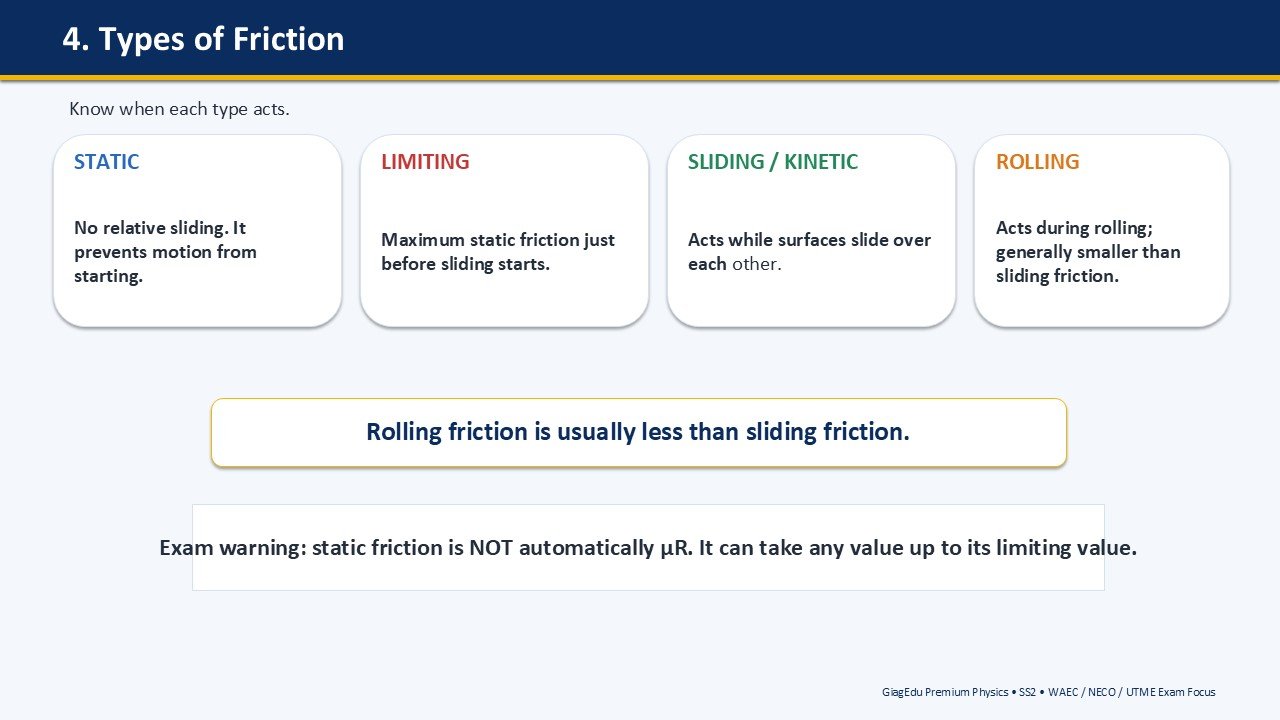
- Static friction: acts when there is no sliding yet. It stops motion from starting.
- Limiting friction: the maximum static friction, reached just before the object starts to slide.
- Sliding (kinetic or dynamic) friction: acts while the surfaces slide over each other. It is slightly less than limiting friction.
- Rolling friction: acts when a body rolls. It is usually much smaller than sliding friction, which is why wheels and ball bearings are used.
Static friction adjusts itself
Static friction is only as big as it needs to be to stop motion, up to its limiting value:
0 ≤ Fs ≤ Fl
If you push a block with 6 N and it doesn't move, static friction is exactly 6 N. Push harder and friction rises to match, until it reaches the limiting value. Beyond that, the block slides.
Limiting friction and the coefficient of friction
For dry surfaces, limiting friction is proportional to the normal reaction:
Fl = μR
- Fl = limiting friction (N)
- R = normal reaction (N)
- μ = coefficient of friction, which has no unit and depends on the nature of the two surfaces
So μ = Fl ÷ R. A larger μ means a rougher, "grippier" pair of surfaces.
On a horizontal surface (no vertical acceleration): R = W = mg, so Fl = μmg.
Friction and Newton's second law
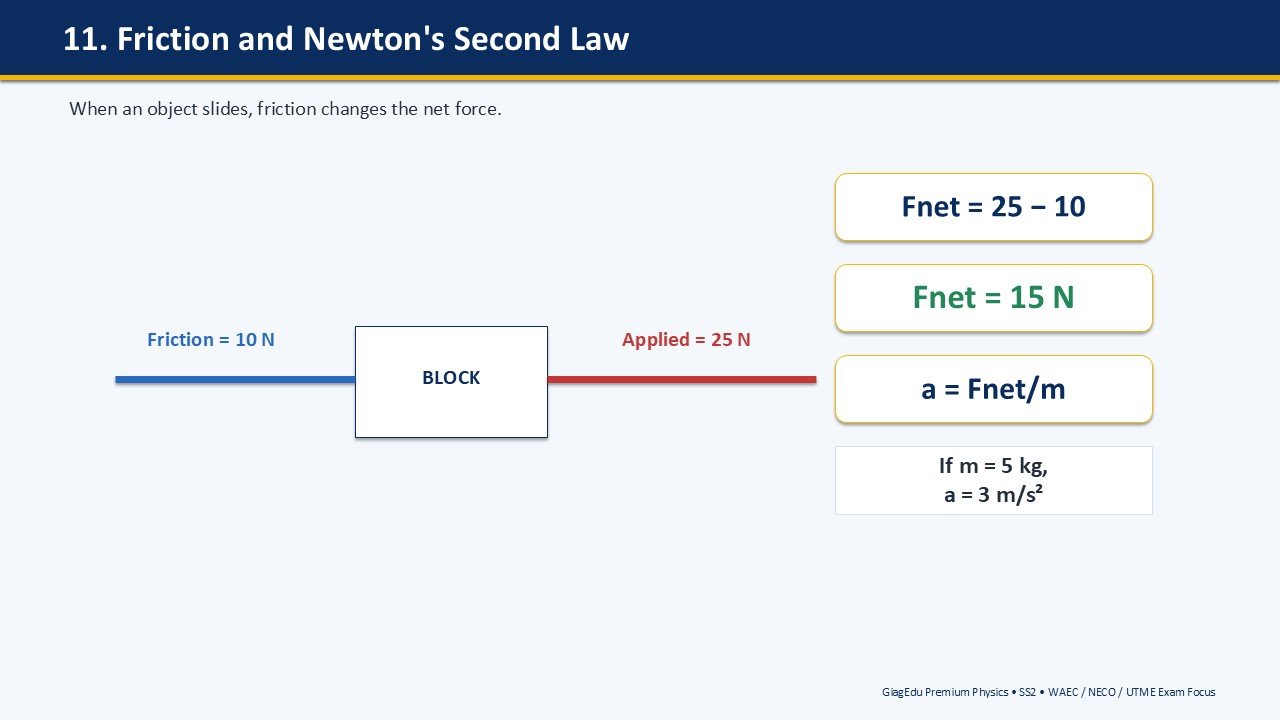
Once an object slides, subtract friction to find the net force, then use F = ma.
Friction on an inclined plane
On a slope at angle θ, resolve the weight into two components:
- mg sin θ acting down the slope;
- mg cos θ acting into the slope, which is balanced by the normal reaction, so R = mg cos θ.
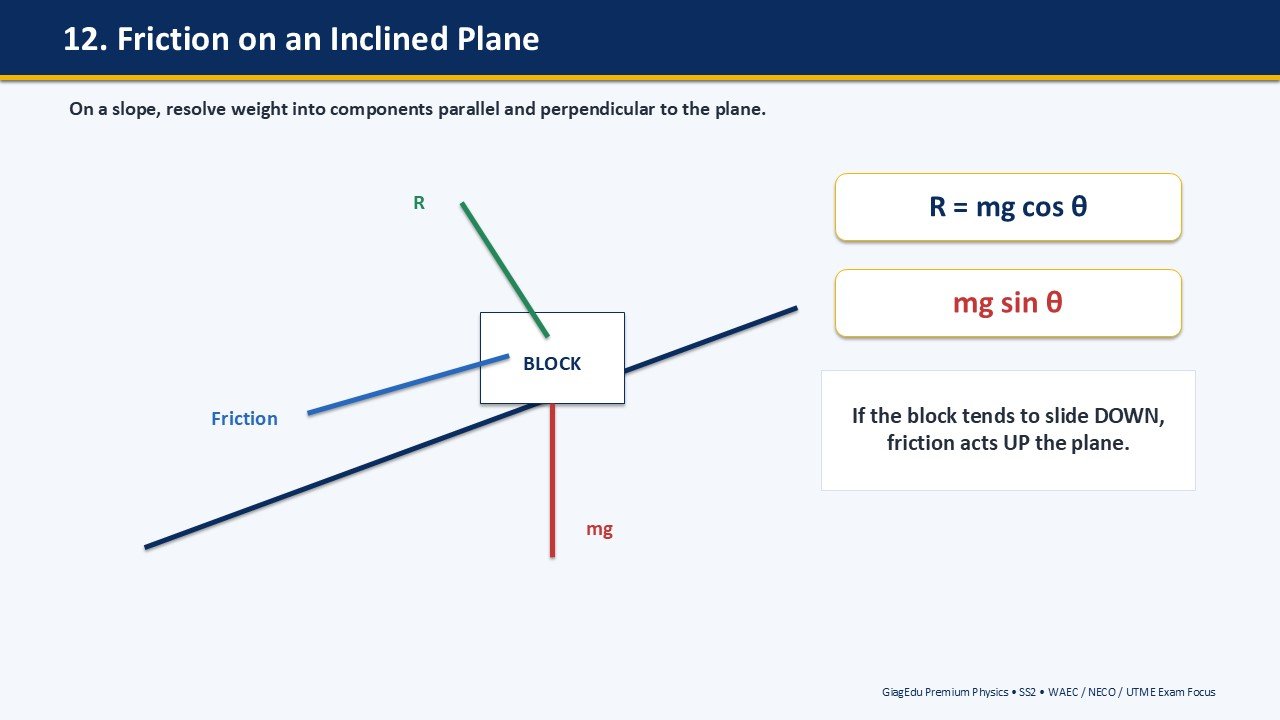
If the block tends to slide down, friction acts up the plane. Limiting friction on the slope = μR = μmg cos θ.
Advantages of friction
- Walking and running: grip between shoes and the ground.
- Braking: brake pads slow wheels down.
- Writing: the pen or pencil leaves a mark because of friction with the paper.
- Grip: tyres on roads, ladders against walls, holding objects.
- Nails and screws stay in wood because of friction.
Disadvantages and control of friction
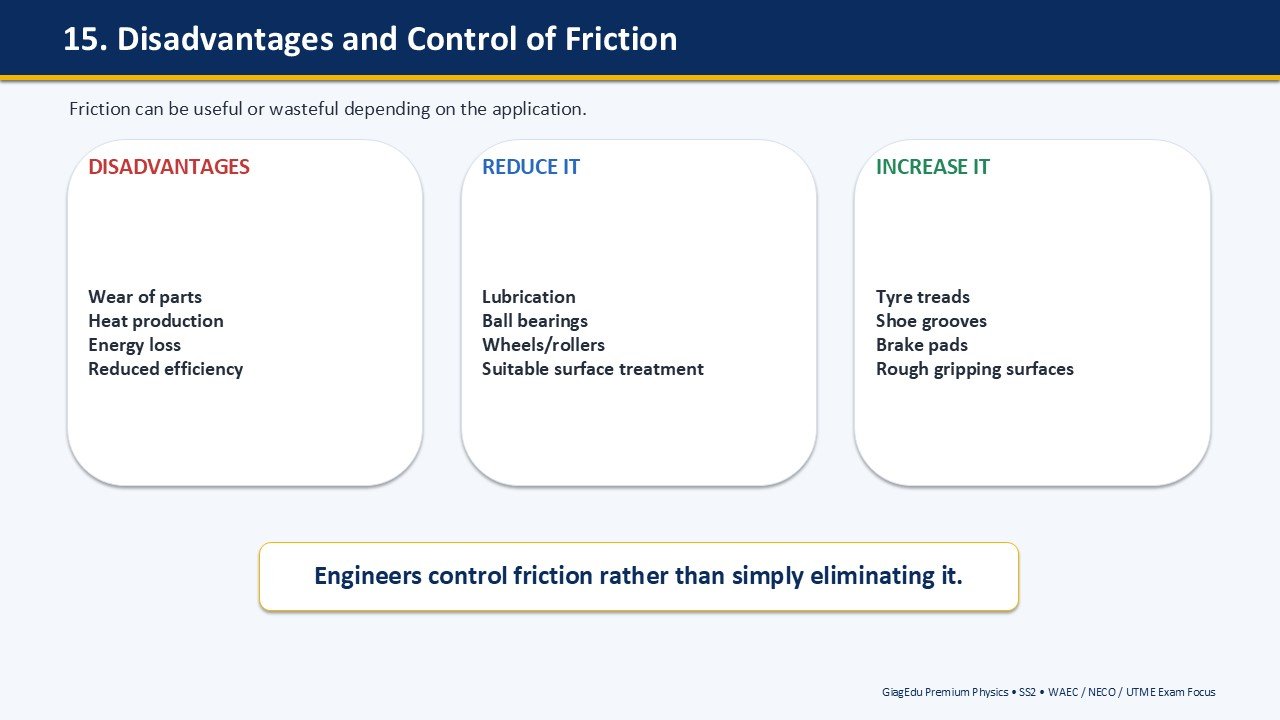
Disadvantages: wear and tear of moving parts, unwanted heat, wasted energy and lower efficiency of machines.
Ways to reduce friction: lubrication (oil, grease), ball bearings and roller bearings, wheels, smoothing or polishing surfaces, streamlining (for air resistance).
Ways to increase friction (where it helps): tyre treads, grooves on shoe soles, brake pads, rough gripping surfaces, sand on slippery roads.
Top exam traps
- Using μR for static friction when the object is not about to slide.
- Drawing friction in the wrong direction: it opposes the actual or attempted motion.
- Taking R = mg on an inclined plane.
- Giving μ a unit: it has none.
Practice
- Define friction and name two types.
- A 6 kg block has μ = 0.25 on a horizontal surface. Find the limiting friction (g = 10 m/s2).
- A 4 kg block is pushed with 18 N on a surface where μ = 0.20. Find its acceleration (g = 10 m/s2).
- A 12 kg box has μ = 0.15. Find its limiting friction (g = 10 m/s2).
- A 5 kg block is pulled with 25 N on a surface where μ = 0.30. Find its acceleration (g = 10 m/s2).
Answers: 1. A force opposing relative motion between surfaces in contact; e.g. static and sliding friction. · 2. R = 60 N, Fl = 15 N · 3. Friction = 8 N, Fnet = 10 N, a = 2.5 m/s2 · 4. 18 N · 5. Friction = 15 N, Fnet = 10 N, a = 2 m/s2
Previous topic: Work, Energy and Power · Next class: Centre of Gravity and Equilibrium.
Practise Friction: 10 questions in study mode, with an explanation after each answer.
Start Practice