Current Electricity: Ohm's Law, Resistors, e.m.f. and Electrical Energy
Physics · Charge and current, potential difference and e.m.f., Ohm's law, resistance and resistivity, resistors in series and parallel, internal resistance, electrical energy and power, the cost of electricity, fuses and safety, and cells.
Why this topic matters
Current electricity gives WAEC and NECO a circuit calculation almost every year: combined resistance, current and p.d. in each branch, internal resistance, and the cost of electricity. Paper 3 often uses an Ohm's law or potentiometer experiment.
Charge, current and potential difference
- Current is the rate of flow of charge: I = Q ÷ t. It is measured in amperes (A) with an ammeter connected in series. 1 A = 1 coulomb per second.
- Potential difference (p.d.) is the work done in moving 1 coulomb of charge between two points: V = W ÷ Q. It is measured in volts (V) with a voltmeter connected in parallel.
- Electromotive force (e.m.f.) is the total energy a cell gives to each coulomb of charge: the p.d. across the cell when no current flows.
Ohm's law and resistance
Ohm's law: the current through a metallic conductor is directly proportional to the p.d. across it, provided the temperature and other physical conditions stay constant.
V = IR, where R is the resistance, in ohms (Ω).
- A graph of V against I for an ohmic conductor is a straight line through the origin, with gradient R.
- A filament lamp is non-ohmic: its resistance rises as it gets hot.
Resistivity: R = ρL ÷ A. Resistance increases with length and decreases with cross-sectional area. Resistivity (ρ) depends on the material and is measured in Ω m.
Resistors in series and in parallel
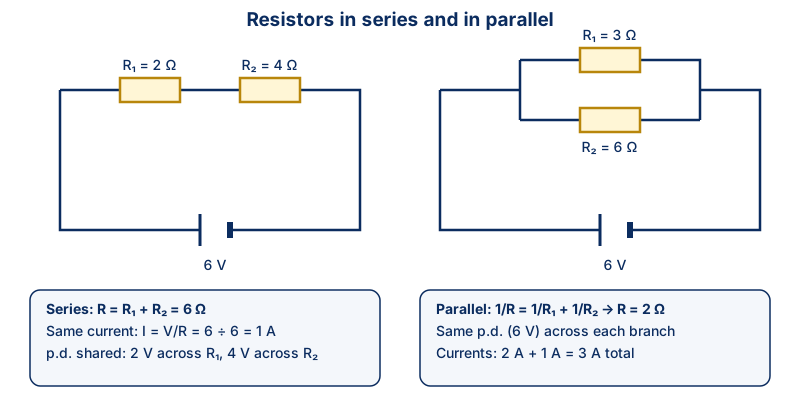
Series:
- R = R₁ + R₂ + …
- The same current flows through each resistor.
- The p.d. is shared between the resistors.
- Example: 2 Ω + 4 Ω = 6 Ω on 6 V gives I = 1 A, with 2 V across R₁ and 4 V across R₂.
Parallel:
- 1/R = 1/R₁ + 1/R₂ + …
- For two resistors, R = (R₁R₂) ÷ (R₁ + R₂).
- Each branch has the same p.d., and the currents add up.
- The combined resistance is smaller than the smallest resistor.
- Example: 3 Ω and 6 Ω in parallel gives R = 18 ÷ 9 = 2 Ω. On 6 V the branch currents are 2 A and 1 A, a total of 3 A.
Household appliances are connected in parallel, so each gets the full mains voltage and can be switched on and off separately.
e.m.f. and internal resistance
A real cell has internal resistance r, so: E = I(R + r). The terminal p.d. = IR = E − Ir. The "lost volts" = Ir.
Cells:
- Primary cells cannot be recharged. Examples: the Leclanché (dry) cell, and the simple cell, which suffers from polarisation and local action.
- Secondary cells can be recharged. Examples: the lead–acid accumulator in cars, and lithium-ion phone batteries.
- Cells in series add their e.m.f.s. Identical cells in parallel give the same e.m.f. but last longer.
Electrical energy and power
- Energy: W = VIt = I²Rt = V²t ÷ R, in joules.
- Power: P = VI = I²R = V² ÷ R, in watts.
The cost of electricity: energy in kilowatt-hours (kWh) = power in kW × time in hours. 1 kWh = 3.6 × 10⁶ J.
Fuses and safety
A fuse is a thin wire that melts when too much current flows, breaking the circuit and protecting the appliance and the wiring. It goes in the live wire.
To choose a fuse, work out I = P ÷ V and pick the next size above.
Other safety measures:
- Earthing carries current safely to earth if a metal case becomes live.
- Circuit breakers trip when too much current flows.
- Never handle electrical appliances with wet hands.
Top exam traps
- An ammeter goes in series and a voltmeter in parallel. The ammeter has very low resistance; the voltmeter has very high resistance.
- In parallel, the combined resistance is less than the smallest resistor.
- Convert minutes to seconds for joules, but use hours and kW for kWh.
- Terminal p.d. is less than the e.m.f. when a current flows, because of the internal resistance.
Practise Current Electricity: 10 questions in study mode, with an explanation after each answer.
Start Practice