Trigonometry: SOHCAHTOA, Special Angles, Elevation, Bearings, Sine and Cosine Rules
Mathematics · Naming the sides and SOHCAHTOA, exact values of 30°, 45° and 60°, angles of elevation and depression, three-figure bearings and back bearings, the sine rule (including the ambiguous case), the cosine rule, and how to choose the right method.
Why this topic matters
Trigonometry appears in every WAEC and NECO Paper 2, usually as a heights and distances question or a bearings question that needs the sine or cosine rule. WAEC awards marks for a labelled diagram (B1), the correct method (M1) and an accurate answer (A1), so always draw the diagram first.
SOHCAHTOA

Name the sides from the angle θ:
- The hypotenuse is the longest side, facing the right angle. It never changes.
- The opposite side faces the angle θ and does not touch it.
- The adjacent side touches θ but is not the hypotenuse.
If θ moves to the other acute angle, the opposite and adjacent sides swap.

sin θ = O ÷ H, cos θ = A ÷ H, tan θ = O ÷ A. Memory hook: Some Old Horses Can Always Hear Their Owners Approach.

- Finding a side: with O and H and an angle of 35°: x = 12 × sin 35° = 6.88 cm. With A and H and an angle of 40°: y = 8 ÷ cos 40° = 10.44 cm.
- Finding an angle: use the inverse function. With O = 5 and A = 7, tan θ = 5 ÷ 7, so θ = tan⁻¹(0.7143) = 35.5°.
Special angles: 30°, 45° and 60°

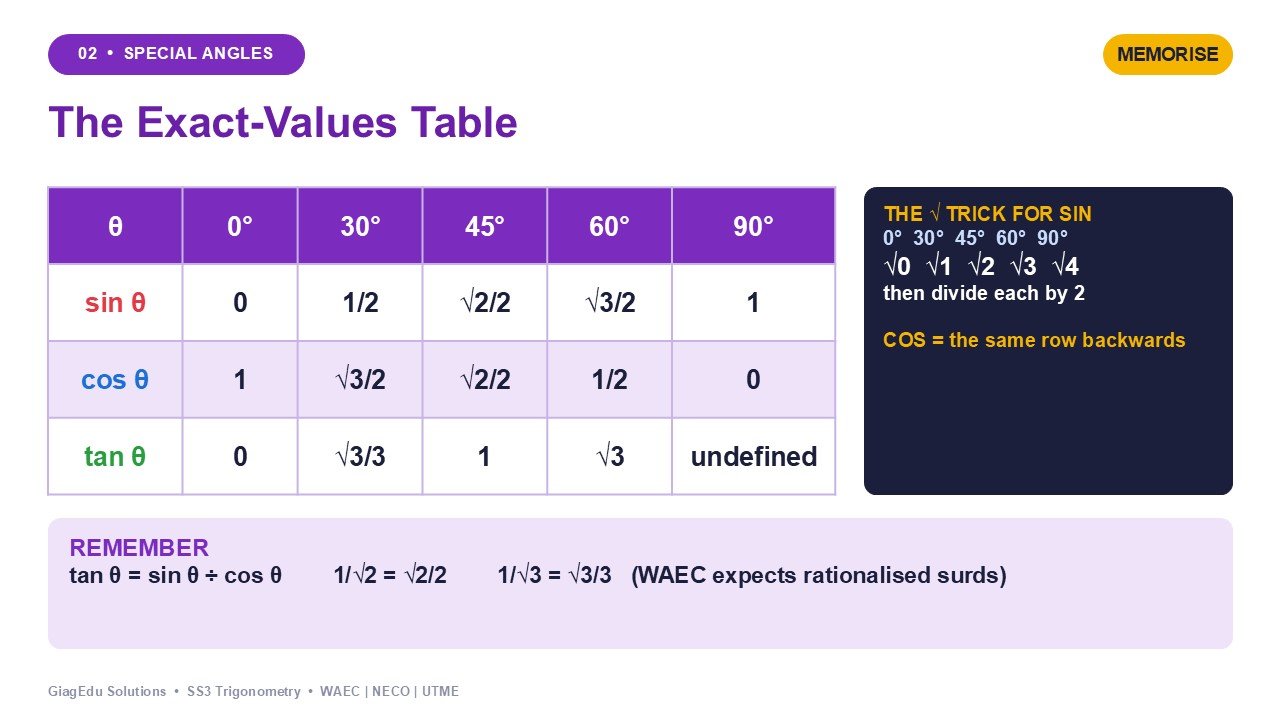
- sin 30° = ½; sin 45° = √2/2; sin 60° = √3/2
- cos 30° = √3/2; cos 45° = √2/2; cos 60° = ½
- tan 30° = √3/3; tan 45° = 1; tan 60° = √3
The cos values are the sin values in reverse order. WAEC expects rationalised surds, e.g. 1/√2 = √2/2.
Angles of elevation and depression

Both angles are measured from the horizontal, never from the vertical.

Golden rule: the angle of elevation from A to B equals the angle of depression from B to A (alternate angles between parallel horizontals).
- Height of a building: a point 40 m from the foot, with an angle of elevation of 52°. h = 40 × tan 52° = 51.2 m.
- Boat seen from a cliff: a cliff 60 m high, with an angle of depression of 28°. d = 60 ÷ tan 28° = 112.8 m.

Bearings

Three-figure bearings are measured from North, clockwise, and always have 3 digits (045°, not 45°). "The bearing of B from A" means: stand at A, draw North at A, and turn to B.

Back bearing = bearing ± 180°. If the bearing of B from A is 060°, the bearing of A from B is 240°.

Distance north and east: a man walks 10 km on a bearing of 040°. North = 10 cos 40° = 7.66 km; East = 10 sin 40° = 6.43 km. For an angle measured from North, the North part uses cos and the East part uses sin.
The sine rule

a ÷ sin A = b ÷ sin B = c ÷ sin C. Use it when you know two angles and a side (AAS or ASA), or two sides and a non-included angle (SSA).

Ambiguous case (SSA): a = 8, b = 10 and A = 40°. Then sin B = 10 sin 40° ÷ 8 = 0.8035, so B = 53.5° or 180° − 53.5° = 126.5°. Check whether the question says B is acute or obtuse.
The cosine rule

- Find a side (SAS): a² = b² + c² − 2bc cos A
- Find an angle (SSS): cos A = (b² + c² − a²) ÷ 2bc
If cos A comes out negative, the angle is obtuse. The largest angle always faces the longest side.
- SAS: b = 7, c = 10 and A = 52°. Then a² = 49 + 100 − 140 cos 52° = 62.81, so a = 7.93 cm.
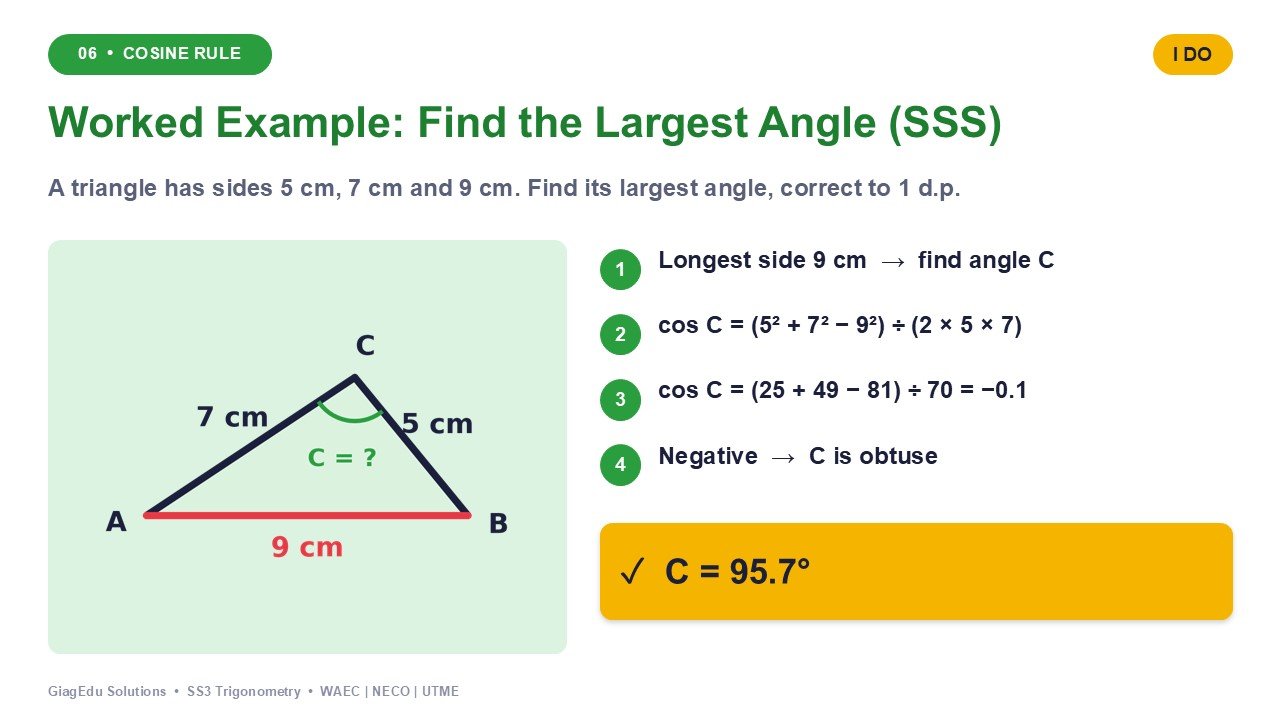
- SSS: sides 5, 7 and 9. cos C = (25 + 49 − 81) ÷ 70 = −0.1, so C = 95.7° (obtuse).

Which method?

- Right angle? Use SOHCAHTOA.
- All three sides (SSS)? Use the cosine rule to find an angle.
- Two sides and the angle between them (SAS)? Use the cosine rule to find the third side.
- Two angles and a side (AAS or ASA)? Use the sine rule.
- Two sides and an angle not between them (SSA)? Use the sine rule, and watch for two answers.
Exam habits that earn every mark
- Draw and label a diagram every time.
- Write the formula before substituting.
- Keep 4 decimal places until the last line, then round only as asked.
- Include units, and give bearings with 3 digits.
Videos
Practise Trigonometry: 10 questions in study mode, with an explanation after each answer.
Start Practice