Sets, Venn Diagrams and Variation
Mathematics · Set notation, subsets, Venn diagram regions, two-set and three-set word problems, and direct, inverse, joint and partial variation with their graphs and WAEC worked examples.
Why this topic matters
WAEC and NECO set a Venn diagram word problem and a variation question almost every year, in both Paper 1 and Paper 2. Both follow fixed methods, so they are reliable marks once you know the steps.
Set language
- ∈ means "is an element of"; ⊂ means "is a subset of".
- A ∪ B (union) is everything in A or B or both.
- A ∩ B (intersection) is what is in A and B.
- A′ (complement) is everything not in A.
- ∅ or { } is the empty set; U or ξ is the universal set.
- n(A) is the number of elements in A.
Subsets: a set with k elements has 2ᵏ subsets (including ∅ and the set itself), and 2ᵏ − 1 proper subsets. For example, B = {3, 6, 9} has 2³ = 8 subsets.
Reading Venn diagram regions
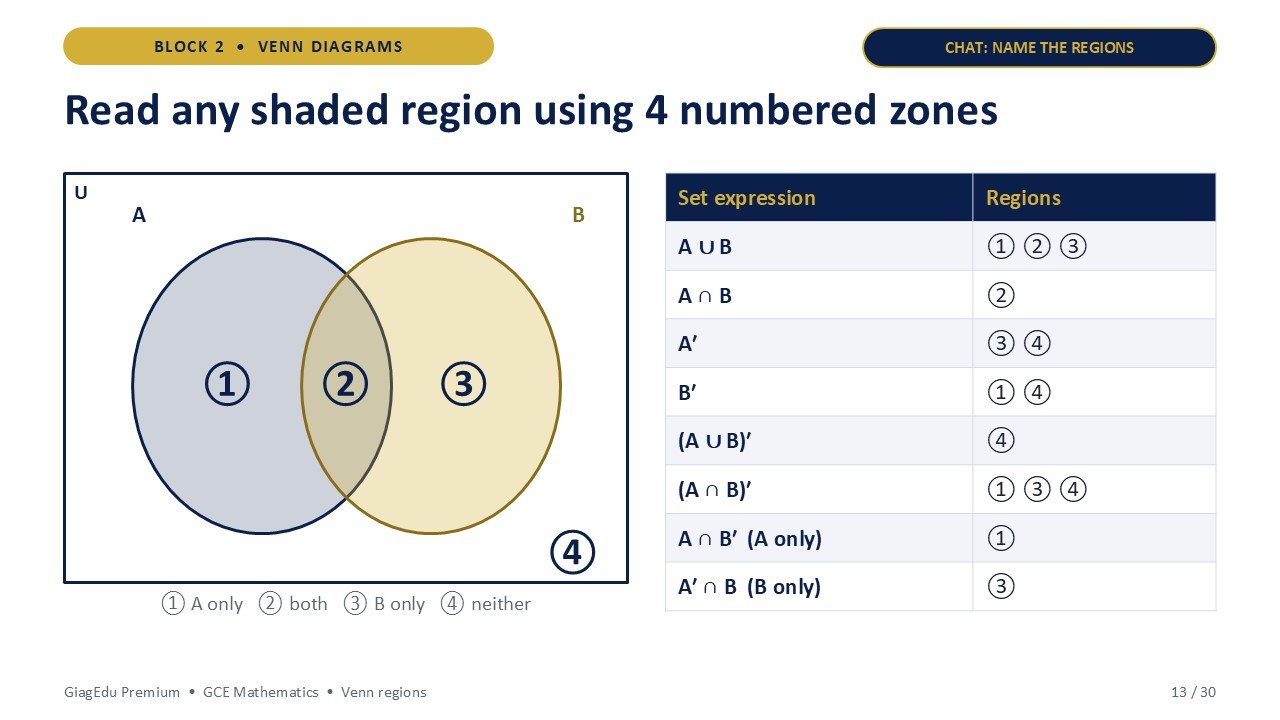
Number the four regions: ① A only, ② both, ③ B only, ④ neither. Then:
- A ∪ B = ①②③
- A ∩ B = ②
- A′ = ③④
- (A ∪ B)′ = ④
- A ∩ B′ = ① (A only)
Two-set word problems

Key formula: n(A ∪ B) = n(A) + n(B) − n(A ∩ B)
Always check that all the regions add up to n(U).
Three-set word problems: work from the centre outwards

- Centre: all three = 3.
- Pairs only: C and P = 7 − 3 = 4; C and B = 6 − 3 = 3; P and B = 5 − 3 = 2.
- One subject only: C = 20 − 4 − 3 − 3 = 10; P = 18 − 4 − 2 − 3 = 9; B = 16 − 3 − 2 − 3 = 8.
- Total inside the circles = 10 + 9 + 8 + 4 + 3 + 2 + 3 = 39, so none = 40 − 39 = 1.
Variation

Each type of variation has its own equation:
- Direct: y ∝ x, so y = kx
- Direct (square): y ∝ x², so y = kx²
- Inverse: y ∝ 1/x, so y = k ÷ x
- Inverse (root): y ∝ 1/√x, so y = k ÷ √x
- Joint: z ∝ xy, so z = kxy
- Combined: y ∝ x and inversely as z², so y = kx ÷ z²
- Partial: partly fixed and partly varying, so C = a + bn
The 4-step method:
- Write the relation with ∝.
- Replace ∝ with "= k".
- Use the given pair of values to find k.
- Write out the law, then substitute.
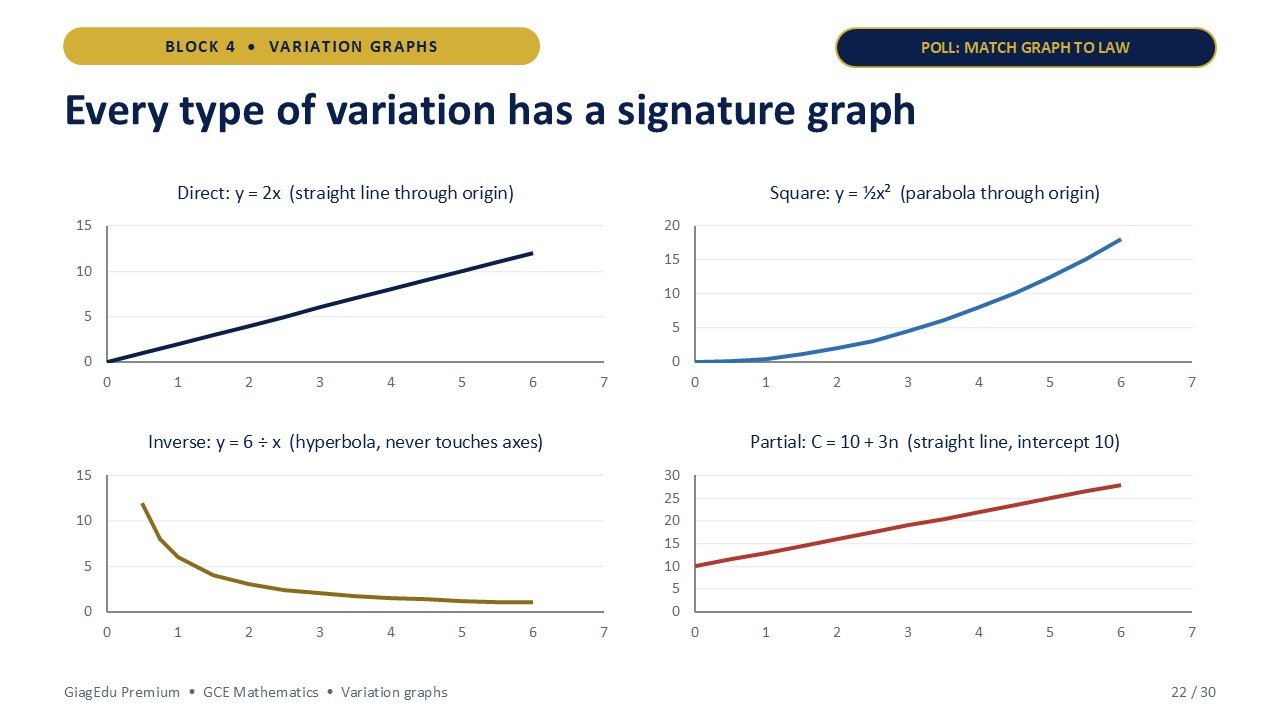
What the graphs look like:
- Direct: a straight line through the origin.
- Square: a parabola.
- Inverse: a curve that never touches the axes.
- Partial: a straight line that does not pass through the origin.
Worked examples
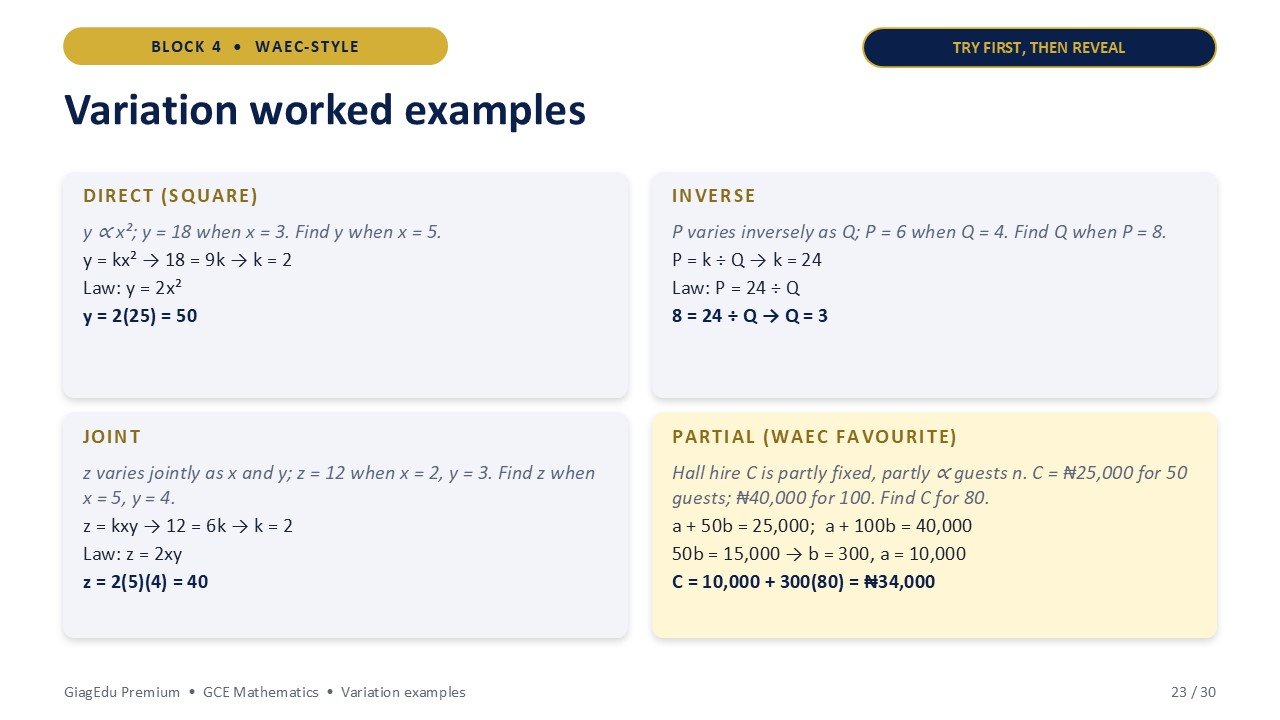
- Direct (square): y ∝ x², and y = 18 when x = 3. Then 18 = 9k, so k = 2 and the law is y = 2x². When x = 5, y = 50.
- Inverse: P varies inversely as Q, and P = 6 when Q = 4. Then k = 24 and the law is P = 24 ÷ Q. When P = 8, Q = 3.
- Joint: z varies jointly as x and y, and z = 12 when x = 2 and y = 3. Then 12 = 6k, so k = 2. When x = 5 and y = 4, z = 40.
- Partial (a WAEC favourite): the cost C of hiring a hall is partly fixed and partly varies as the number of guests n. C = ₦25,000 for 50 guests and ₦40,000 for 100 guests. Then a + 50b = 25,000 and a + 100b = 40,000, so 50b = 15,000, giving b = 300 and a = 10,000. For 80 guests, C = 10,000 + 300 × 80 = ₦34,000.
Top exam traps
- Ignoring "only" in Venn problems. Fill the middle first.
- Forgetting the "neither" region outside the circles.
- Not writing down the law (e.g. y = 2x²) before substituting.
- Confusing direct and inverse: in inverse variation, x × y stays constant.
Practise Sets & Variation: 10 questions in study mode, with an explanation after each answer.
Start Practice