Quadratic Equations: Factorisation, Completing the Square, the Formula and the Discriminant
Mathematics · Solving ax² + bx + c = 0 three ways, the discriminant and nature of roots, sum and product of roots, forming equations from roots, word problems, and linear–quadratic simultaneous equations, with WAEC worked examples.
Why quadratics matter
Quadratic equations are tested almost every year. Paper 1 asks about factorisation, the discriminant and the sum and product of roots; Paper 2 asks for full solutions, word problems and linear–quadratic simultaneous equations. The methods are procedural, so careful practice earns full marks.
What is a quadratic equation?
A quadratic equation has x2 as its highest power. Its standard form is:
ax2 + bx + c = 0 (a, b, c are constants and a ≠ 0)
- x2 − 5x + 6 = 0 (a = 1, b = −5, c = 6) ✓
- 2x2 + 5x − 3 = 0 ✓
- x2 = 9 (b = 0) ✓
- 3x − 7 = 0 ✗ (linear: no x2 term)
Method 1: factorisation
If PQ = 0, then P = 0 or Q = 0. So write the quadratic as two brackets and set each one to zero.
When a = 1: find two numbers that multiply to c and add to b.
When a ≠ 1 (the "ac method"): find two numbers that multiply to a × c and add to b, split the middle term, then group.
Method 2: completing the square
Use this when the equation won't factorise neatly, or when the question asks for it.
- Make the coefficient of x2 equal to 1 (divide through if needed).
- Move the constant to the right-hand side.
- Add (half the coefficient of x)2 to both sides.
- Write the left side as a perfect square.
- Square-root both sides (remember ±) and solve.
Method 3: the quadratic formula
The formula solves every quadratic equation.
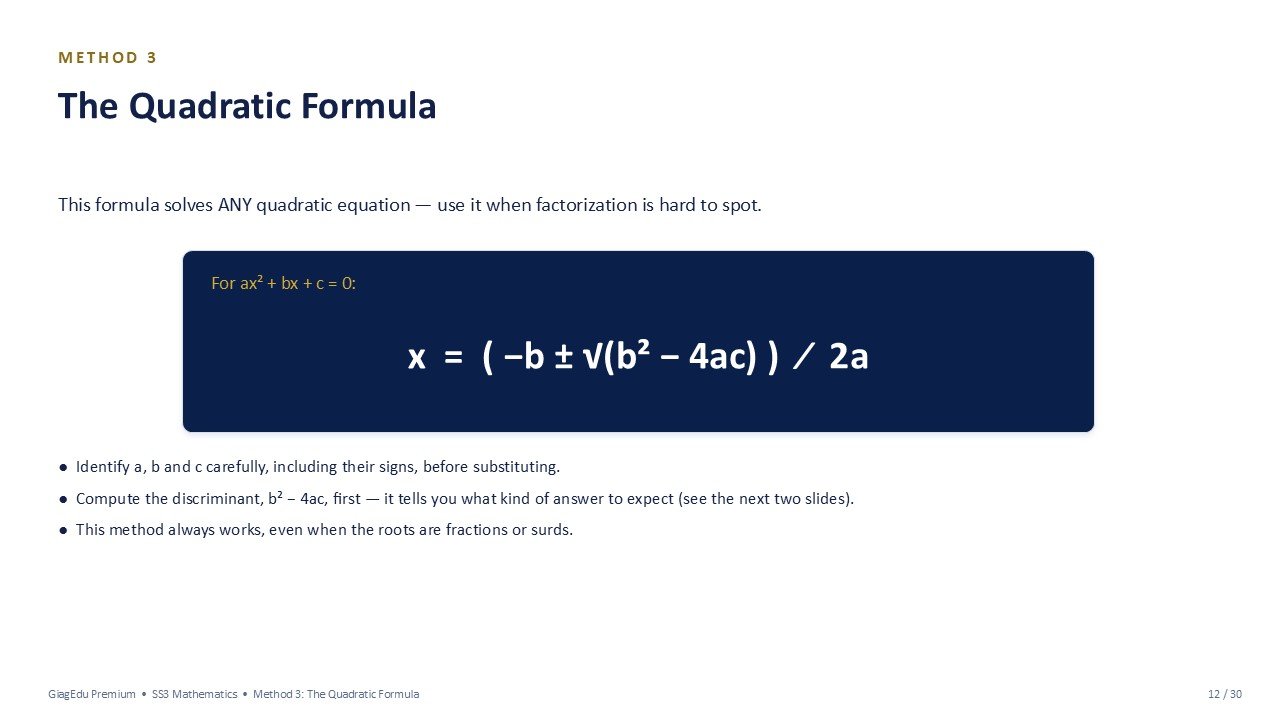
x = (−b ± √(b2 − 4ac)) ÷ 2a
The discriminant: nature of the roots
The discriminant Δ = b2 − 4ac tells you what kind of roots an equation has without solving it.

- Δ > 0: two distinct (different) real roots. If Δ is a perfect square, the roots are rational.
- Δ = 0: two equal (repeated) roots.
- Δ < 0: no real roots.
Sum and product of roots
If α and β are the roots of ax2 + bx + c = 0:
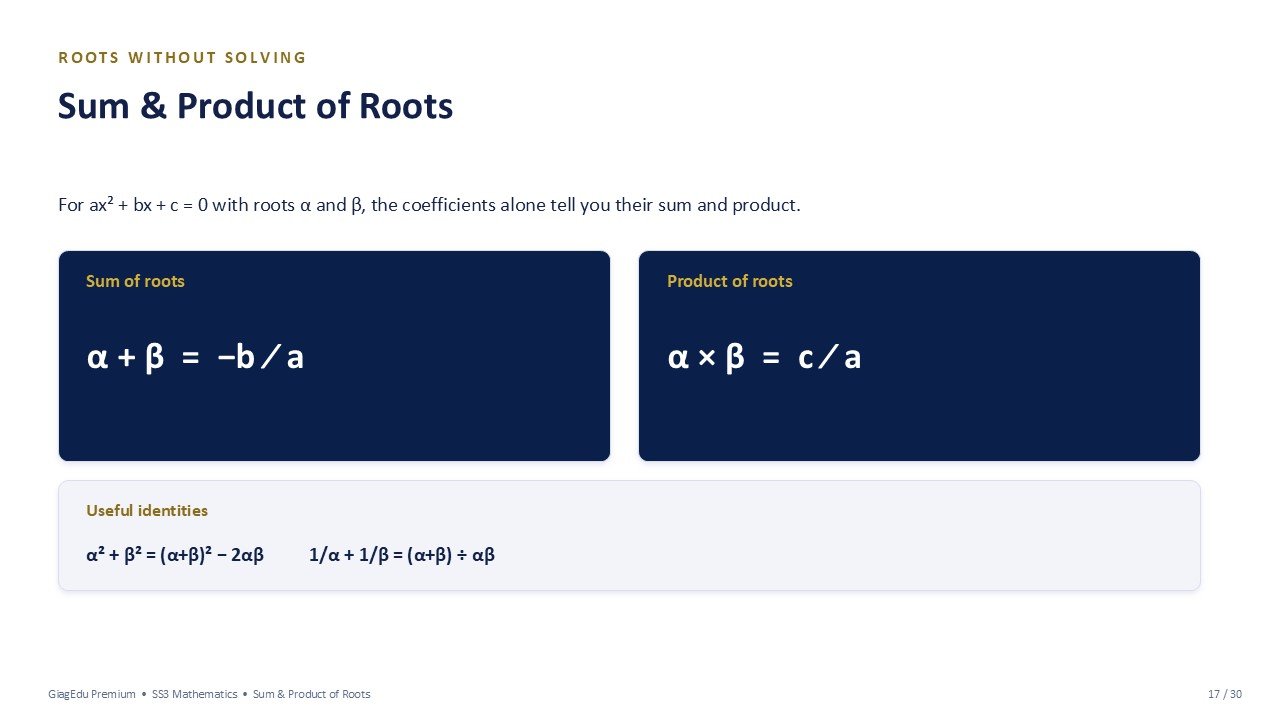
- α + β = −b/a
- αβ = c/a
- Useful identities: α2 + β2 = (α + β)2 − 2αβ and 1/α + 1/β = (α + β)/αβ
Forming an equation from its roots
x2 − (sum of roots)x + (product of roots) = 0
Word problems
Let x be the unknown, form a quadratic, solve it, and reject any answer that doesn't make sense (e.g. a negative length).
Linear and quadratic simultaneous equations
When one equation is linear and the other quadratic, use substitution (elimination won't work).
- Make x or y the subject of the linear equation.
- Substitute into the quadratic equation and solve.
- Find the matching value for each root, and give the answers as pairs.
Choosing the right method

Top exam traps
- Forgetting the ± when taking a square root.
- Sign errors in −b/a (b already carries its own sign).
- Not rejecting an impossible root in a word problem.
- Finding x in a simultaneous system and forgetting to find y.
- Trying to factorise when Δ isn't a perfect square: use the formula instead.
Practice
- Solve 3x2 − x − 2 = 0 by factorisation.
- State the nature of the roots of x2 + 2x + 5 = 0.
- The sum of a number and its square is 30. Find the number.
- Solve 3x2 + 2x − 8 = 0.
- Two positive numbers differ by 4 and their product is 96. Find them.
- Solve simultaneously: y = 3 − x and x2 + y2 = 5.
Answers: 1. (3x + 2)(x − 1) = 0, so x = 1 or x = −2/3 · 2. Δ = 4 − 20 = −16 < 0: no real roots · 3. x2 + x − 30 = 0, so x = 5 or x = −6 · 4. (3x − 4)(x + 2) = 0, so x = 4/3 or x = −2 · 5. x(x + 4) = 96 → (x + 12)(x − 8) = 0, so 8 and 12 · 6. x2 − 3x + 2 = 0, so (1, 2) or (2, 1)
Previous topic: Algebra · Next class: Calculus: Integration.
Videos
Practise Quadratic Equations: 10 questions in study mode, with an explanation after each answer.
Start Practice