Number and Numeration: Bases, Standard Form, Percentages, Interest and Sequences
Mathematics · Number bases, modular arithmetic, standard form, significant figures and percentage error, ratio and proportion, percentages, simple and compound interest, profit, loss and business arithmetic, and arithmetic and geometric progressions.
Why this topic matters
Number and numeration gives WAEC and NECO a steady supply of quick Paper 1 objectives (bases, standard form, percentages) and Paper 2 questions on interest, profit and loss, and sequences. These are marks you can collect with practice.
Number bases
In base b, each place value is a power of b: …, b², b¹, b⁰.
Converting to base 10: multiply each digit by its place value, then add.
- 234₅ = 2 × 5² + 3 × 5 + 4 = 50 + 15 + 4 = 69₁₀
- 1011₂ = 8 + 0 + 2 + 1 = 11₁₀
Converting from base 10: divide repeatedly by the new base, then read the remainders from the bottom up.
- 23 ÷ 2 = 11 r 1; 11 ÷ 2 = 5 r 1; 5 ÷ 2 = 2 r 1; 2 ÷ 2 = 1 r 0; 1 ÷ 2 = 0 r 1
- So 23₁₀ = 10111₂
Adding in base 2: remember that 1 + 1 = 10₂. For example, 1011₂ + 111₂ = 10010₂ (check: 11 + 7 = 18).
Modular arithmetic
a mod n is the remainder when a is divided by n. For example, 17 mod 5 = 2.
Standard form, significant figures and approximation
Standard form is A × 10ⁿ, where 1 ≤ A < 10 and n is a whole number.
- 3 450 000 = 3.45 × 10⁶
- 0.000452 = 4.52 × 10⁻⁴
Significant figures: start counting at the first non-zero digit.
- 0.0040562 to 3 s.f. = 0.00406
- 45 678 to 2 s.f. = 46 000
Percentage error = (error ÷ actual value) × 100%.
- A length of 5.0 cm is measured as 4.8 cm. Percentage error = 0.2 ÷ 5.0 × 100% = 4%.
Ratio and proportion
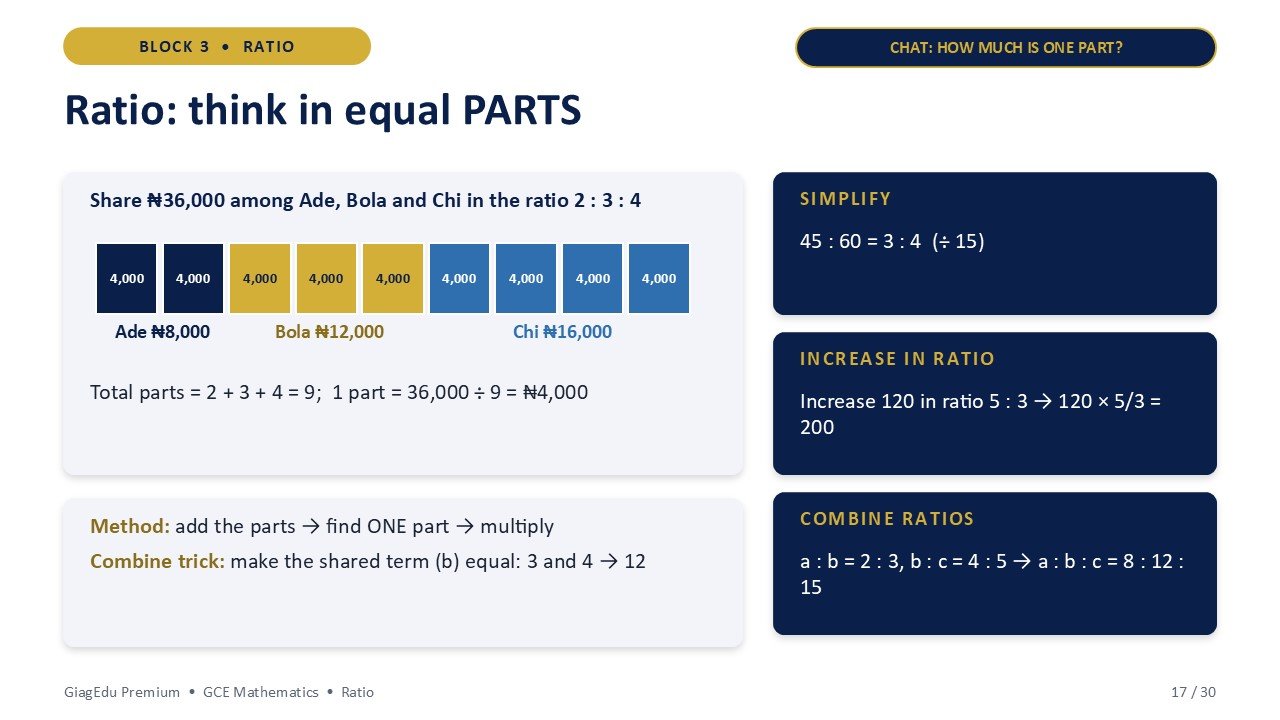
Sharing in a ratio: add the parts → find one part → multiply.
- Share ₦36,000 in the ratio 2 : 3 : 4. Total parts = 9, so 1 part = ₦4,000. The shares are ₦8,000, ₦12,000 and ₦16,000.
Combining ratios: make the shared term equal.
- a : b = 2 : 3 and b : c = 4 : 5. Make b equal to 12 in both, so a : b : c = 8 : 12 : 15.
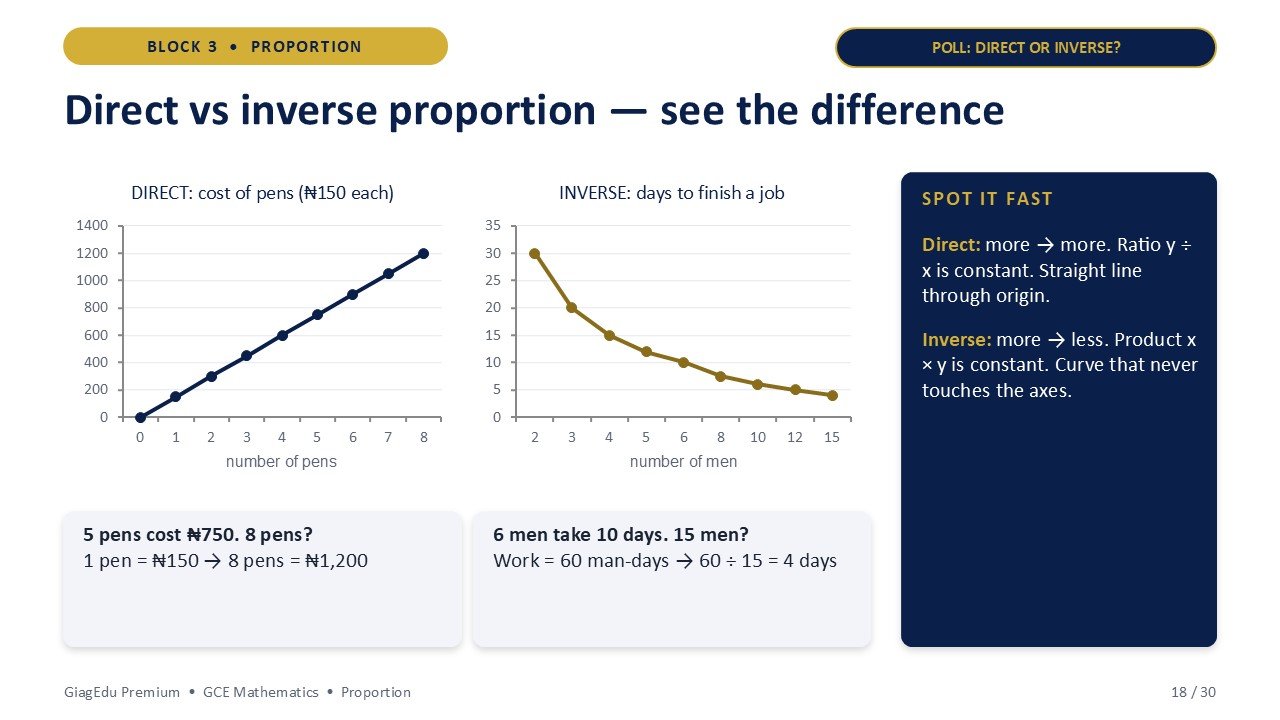
- Direct proportion: more → more. 5 pens cost ₦750, so 1 pen costs ₦150 and 8 pens cost ₦1,200.
- Inverse proportion: more → less. 6 men take 10 days, so the work is 60 man-days, and 15 men take 60 ÷ 15 = 4 days.
Percentages
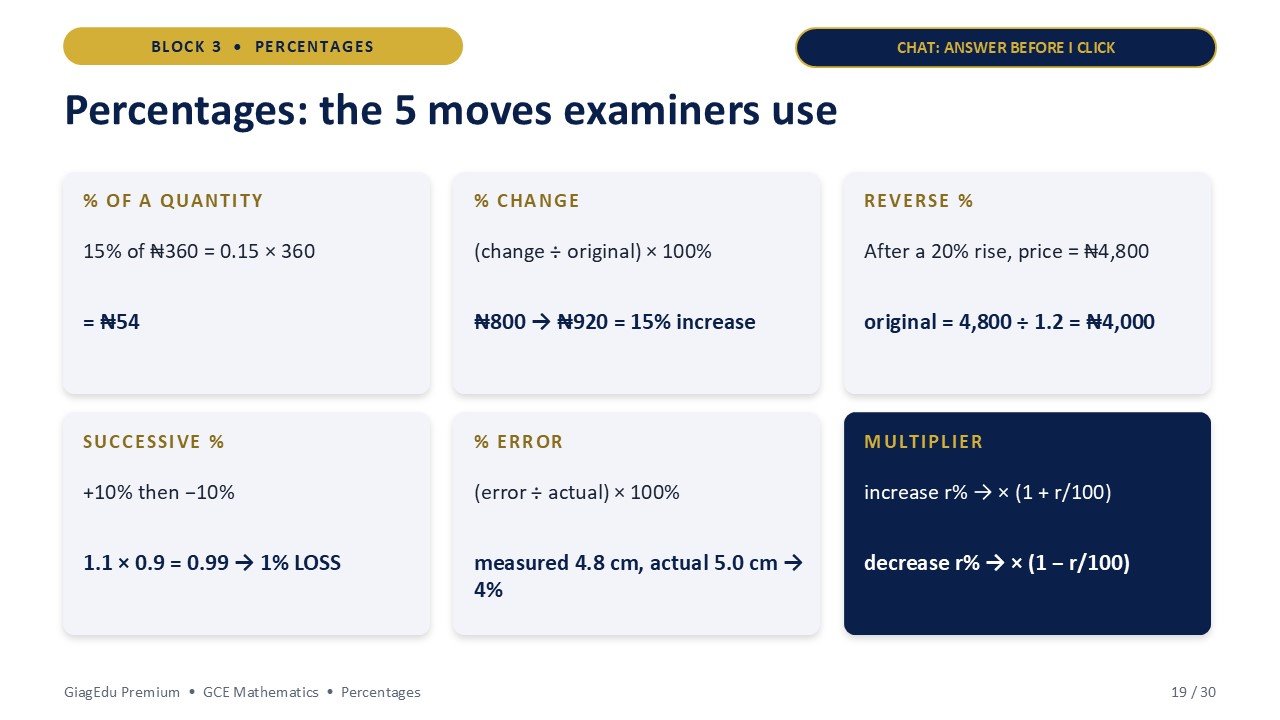
- Percentage of a quantity: 15% of ₦360 = 0.15 × 360 = ₦54
- Percentage change = change ÷ original × 100%. ₦800 → ₦920 is a 15% increase.
- Reverse percentage: after a 20% rise the price is ₦4,800, so the original price = 4,800 ÷ 1.2 = ₦4,000. Do not just subtract 20%.
- Successive percentages: +10% then −10% gives 1.1 × 0.9 = 0.99, a 1% loss, not zero.
- Multipliers: an increase of r% means × (1 + r/100); a decrease of r% means × (1 − r/100).
Simple and compound interest
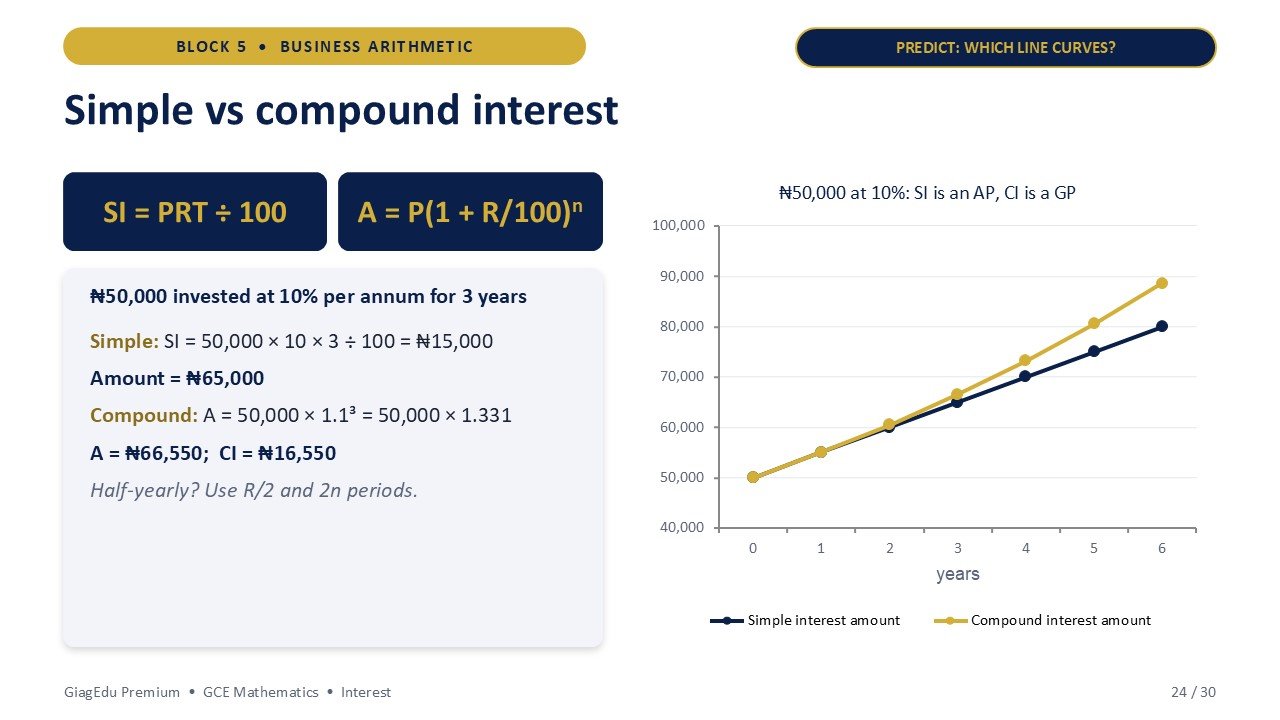
- Simple interest: SI = PRT ÷ 100
- Compound interest: amount A = P(1 + R/100)ⁿ; interest = A − P
₦50,000 at 10% per annum for 3 years:
- Simple: SI = 50,000 × 10 × 3 ÷ 100 = ₦15,000, so the amount is ₦65,000.
- Compound: A = 50,000 × 1.1³ = 50,000 × 1.331 = ₦66,550, so CI = ₦16,550.
For half-yearly compounding, use R ÷ 2 and 2n periods.
Depreciation uses V = P(1 − R/100)ⁿ. A ₦4,000,000 car depreciating at 20% a year is worth 4,000,000 × 0.8² = ₦2,560,000 after 2 years.
Profit, loss and business arithmetic
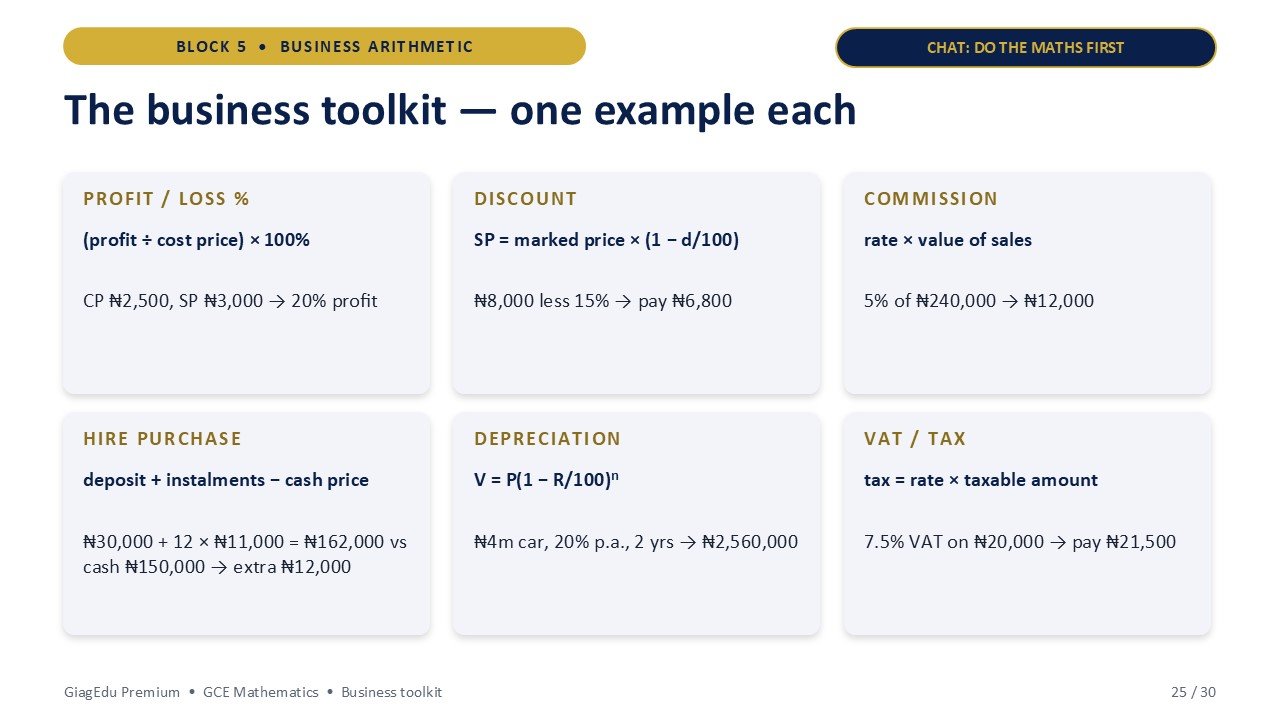
- Profit or loss % = profit ÷ cost price × 100%. Cost ₦2,500, selling price ₦3,000 → 20% profit.
- Discount: ₦8,000 less 15% → pay 8,000 × 0.85 = ₦6,800.
- Commission: 5% of ₦240,000 sales = ₦12,000.
- Hire purchase: deposit ₦30,000 + 12 × ₦11,000 = ₦162,000, against a cash price of ₦150,000, so it costs ₦12,000 extra.
- VAT: 7.5% on ₦20,000 → pay ₦21,500.
- Reverse profit: selling for ₦6,600 gives a 10% gain, so the cost price = 6,600 ÷ 1.1 = ₦6,000.
Sequences: arithmetic and geometric progressions
Arithmetic progression (AP): add the same common difference d each time.
- nth term: Tₙ = a + (n − 1)d
- Sum of n terms: Sₙ = ½n[2a + (n − 1)d], or ½n(a + l), where l is the last term.
- Example: for 3, 7, 11, … (a = 3, d = 4), T₂₀ = 3 + 19 × 4 = 79 and S₂₀ = 10[6 + 76] = 820.
Geometric progression (GP): multiply by the same common ratio r each time.
- nth term: Tₙ = arⁿ⁻¹
- Sum of n terms: Sₙ = a(rⁿ − 1) ÷ (r − 1)
- Sum to infinity: S∞ = a ÷ (1 − r), which exists only when −1 < r < 1.
- Example: for 3, 6, 12, … (a = 3, r = 2), T₆ = 3 × 2⁵ = 96 and S₆ = 3(2⁶ − 1) = 189.
WAEC-style worked examples
- Two terms of an AP given. The 3rd term is 7 and the 7th term is 19. Then a + 2d = 7 and a + 6d = 19, so 4d = 12. This gives d = 3, a = 1, and S₁₀ = 5[2 + 27] = 145.
- How many terms? For 5, 8, 11, …, 95: 5 + (n − 1)3 = 95, so n = 31.
- Two terms of a GP given. The 2nd term is 6 and the 5th term is 162. Then ar = 6 and ar⁴ = 162, so r³ = 27. This gives r = 3, a = 2, and T₇ = 2 × 3⁶ = 1458.
- Sum to infinity. For 18 + 6 + 2 + …, r = ⅓, so S∞ = 18 ÷ ⅔ = 27.
- Unknown in a GP. If x − 1, x + 1 and x + 7 are in GP, then (x + 1)² = (x − 1)(x + 7), which gives 4x = 8 and x = 2.
- Recurring decimal. 0.444… = 0.4 + 0.04 + … with a = 0.4 and r = 0.1, so S∞ = 0.4 ÷ 0.9 = 4/9.
Arithmetic mean of a and b = (a + b) ÷ 2. Geometric mean = √(ab). Between 4 and 16, the AM is 10 and the GM is 8.
Top exam traps
- Tₙ = a + (n − 1)d, not a + nd. T₁₀ = a + 9d.
- The common ratio r = T₂ ÷ T₁, never T₁ ÷ T₂.
- Profit % is worked out on the cost price unless the question says otherwise.
- For a reverse percentage, divide by the multiplier (÷ 1.2). Do not subtract 20%.
- Keep the minus sign: for 7, 4, 1, …, d = −3.
Practise Number & Numeration: 10 questions in study mode, with an explanation after each answer.
Start Practice