Geometry and Mensuration: Angles, Polygons, Circle Theorems, Areas and Volumes
Mathematics · Angles and parallel lines, triangles and Pythagoras, polygons, circle theorems, chords and tangents, arc length and sector area, and the surface areas and volumes of cylinders, cones, spheres and prisms, with WAEC worked examples.
Why this topic matters
Geometry and mensuration give WAEC and NECO many Paper 1 objectives and at least one Paper 2 question, usually on circle theorems or the volume and surface area of a solid. Learn the formulas and state the theorem you use: the reason earns marks too.
Angles and parallel lines
- Angles on a straight line add up to 180°; angles at a point add up to 360°; vertically opposite angles are equal.
- When a line crosses two parallel lines, alternate angles (Z shape) are equal.
- Corresponding angles (F shape) are equal.
- Co-interior angles (C shape) add up to 180°.
Triangles and Pythagoras
- The angles of a triangle add up to 180°. An exterior angle equals the sum of the two interior opposite angles.
- An isosceles triangle has two equal sides and two equal base angles.
- Pythagoras' theorem (right-angled triangles only): c² = a² + b², where c is the hypotenuse. Common triples: 3, 4, 5; 5, 12, 13; 8, 15, 17.
Polygons
- The interior angles of an n-sided polygon add up to (n − 2) × 180°.
- The exterior angles of any polygon add up to 360°, so each exterior angle of a regular polygon = 360° ÷ n.
- Interior angle + exterior angle = 180°.
Circle theorems
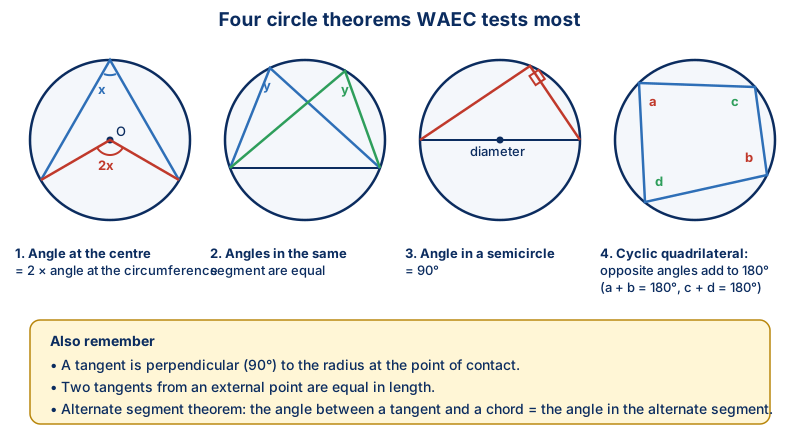
- The angle at the centre is twice the angle at the circumference standing on the same arc.
- Angles in the same segment are equal.
- The angle in a semicircle is 90°.
- Opposite angles of a cyclic quadrilateral add up to 180°.
Also:
- A tangent is perpendicular to the radius at the point of contact.
- Tangents from an external point are equal in length.
- The perpendicular from the centre to a chord bisects the chord.
- Alternate segment theorem: the angle between a tangent and a chord equals the angle in the alternate segment.
Mensuration: lengths, areas and volumes
Arcs and sectors
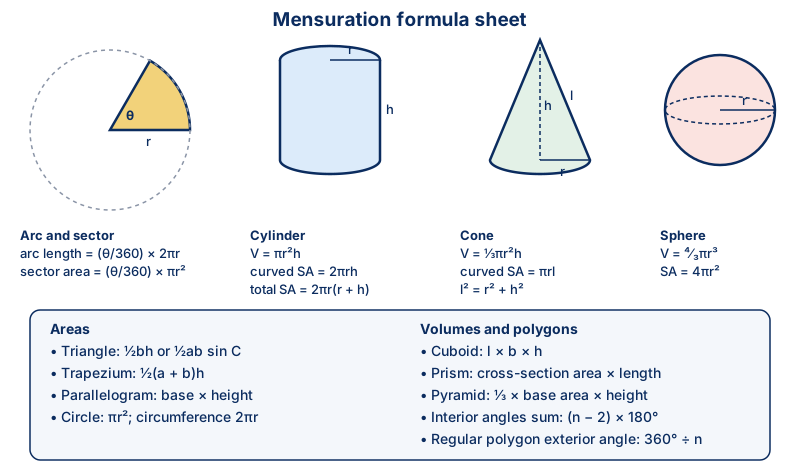
- Arc length = (θ ÷ 360) × 2πr
- Sector area = (θ ÷ 360) × πr²
Solids
Cylinder:
- Volume = πr²h
- Curved surface area = 2πrh
- Total surface area = 2πr(r + h)
Cone:
- Volume = ⅓πr²h
- Curved surface area = πrl, where the slant height l = √(r² + h²)
Sphere: volume = ⁴⁄₃πr³; surface area = 4πr². For r = 3 cm, V = 36π cm³ and SA = 36π cm².
Other solids:
- Prism: volume = area of cross-section × length.
- Pyramid: volume = ⅓ × base area × height.
- Cuboid: volume = l × b × h; surface area = 2(lb + bh + lh).
Similar shapes
If the lengths are in the ratio k, then the areas are in the ratio k² and the volumes in the ratio k³.
Top exam traps
- Use the slant height l (not the vertical height) for the curved surface of a cone.
- A hemisphere's total surface area = 2πr² (curved) + πr² (flat face) = 3πr².
- Check which value of π the question gives (22/7 or 3.142).
- Convert units before you calculate: 1 m³ = 1 000 000 cm³ and 1 litre = 1000 cm³.
- In circle questions, state the theorem as your reason.
Practise Geometry & Mensuration: 10 questions in study mode, with an explanation after each answer.
Start Practice