Coordinate Geometry: Gradient, Distance, Midpoint and the Equation of a Line
Mathematics · Plotting points, the gradient of a line, the distance between two points, the midpoint, equations of straight lines (y = mx + c and y − y₁ = m(x − x₁)), parallel and perpendicular lines, and intercepts, with WAEC worked examples.
Why this topic matters
Coordinate geometry questions in WAEC, NECO and JAMB use a small set of formulas: gradient, distance, midpoint and the equation of a line. Learn these four and you can answer almost every question.
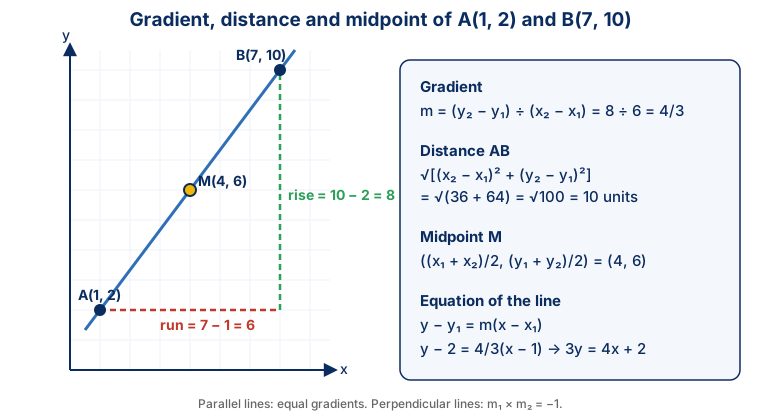
Gradient (slope)
m = (y₂ − y₁) ÷ (x₂ − x₁), which is rise ÷ run.
- For A(1, 2) and B(7, 10): m = (10 − 2) ÷ (7 − 1) = 8 ÷ 6 = 4/3.
- A positive gradient slopes up to the right; a negative gradient slopes down.
- A horizontal line has gradient 0; a vertical line's gradient is undefined.
- The gradient is also tan θ, where θ is the angle the line makes with the positive x-axis.
Distance between two points
AB = √[(x₂ − x₁)² + (y₂ − y₁)²]. This is Pythagoras' theorem on the run and the rise.
- For A(1, 2) and B(7, 10): AB = √(6² + 8²) = √100 = 10 units.
Midpoint
M = ((x₁ + x₂) ÷ 2, (y₁ + y₂) ÷ 2), the average of the x-values and the average of the y-values.
- For A(1, 2) and B(7, 10): M = (4, 6).
Equation of a straight line
- Gradient–intercept form: y = mx + c, where m is the gradient and c is the y-intercept.
- Point–gradient form: y − y₁ = m(x − x₁)
- Through two points: find m first, then use the point–gradient form.
Intercepts: to find where a line crosses the x-axis, put y = 0; to find where it crosses the y-axis, put x = 0.
- For 3x + 4y = 12: x-intercept = 4 and y-intercept = 3, so the line cuts the axes at (4, 0) and (0, 3).
Parallel and perpendicular lines
- Parallel lines have equal gradients: m₁ = m₂.
- Perpendicular lines: m₁ × m₂ = −1. The second gradient is the negative reciprocal of the first.
Collinear points
Three points are collinear (on the same straight line) if the gradient from the first to the second equals the gradient from the second to the third.
Top exam traps
- Keep the order the same: (y₂ − y₁) on top and (x₂ − x₁) underneath.
- Watch the signs when you subtract negatives: 3 − (−2) = 5.
- Rearrange to y = mx + c before reading off the gradient. The gradient of 2y = 6x − 4 is 3, not 6.
- For a perpendicular gradient, flip and change the sign: 2 becomes −½, and −3/4 becomes 4/3.
Videos
Practise Coordinate Geometry: 10 questions in study mode, with an explanation after each answer.
Start Practice