Powers of 10 (Grade 5): Exponents, Multiplying and Dividing Whole Numbers and Decimals by 10, 100 and 1,000
Grade 4-6 Mathematics · Grade 5 powers of 10: writing 10, 100, 1,000 with exponents, shifting digits left to multiply and right to divide by 10, 100 and 1,000, whole numbers and decimals, metric conversions and story problems.
Why this topic matters
Our number system is built on tens. Every place on the place value chart is 10 times the place to its right. Once you see how digits shift when you multiply or divide by 10, 100 or 1,000, you can do these calculations in your head, and you can change metres to centimetres or grams to kilograms in seconds.
Words to know
- Power of 10: a number made by multiplying 10 by itself: 10, 100, 1,000, 10,000…
- Base: the big number that is multiplied. In 103 the base is 10.
- Exponent: the small raised number. It tells how many 10s are multiplied.
- Product: the answer to a multiplication. Quotient: the answer to a division.
Exponents show powers of 10
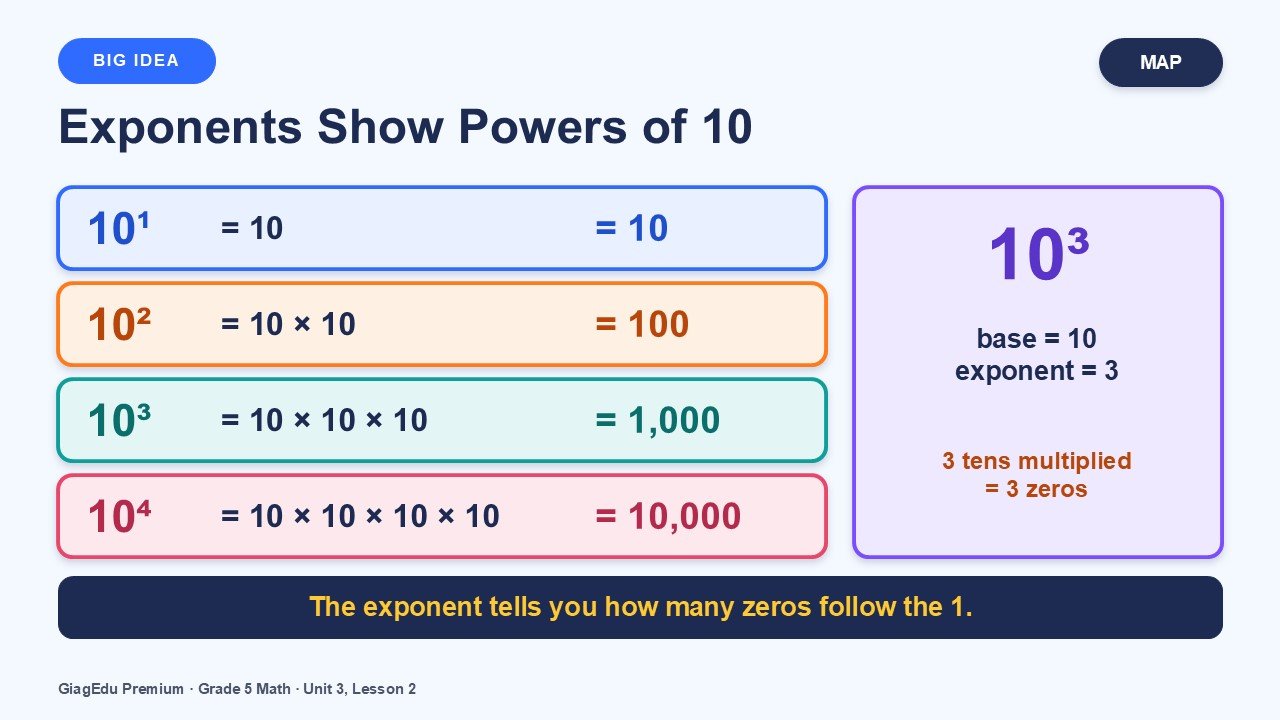
- 101 = 10
- 102 = 10 × 10 = 100
- 103 = 10 × 10 × 10 = 1,000
- 104 = 10 × 10 × 10 × 10 = 10,000
Multiplying by 10, 100 and 1,000
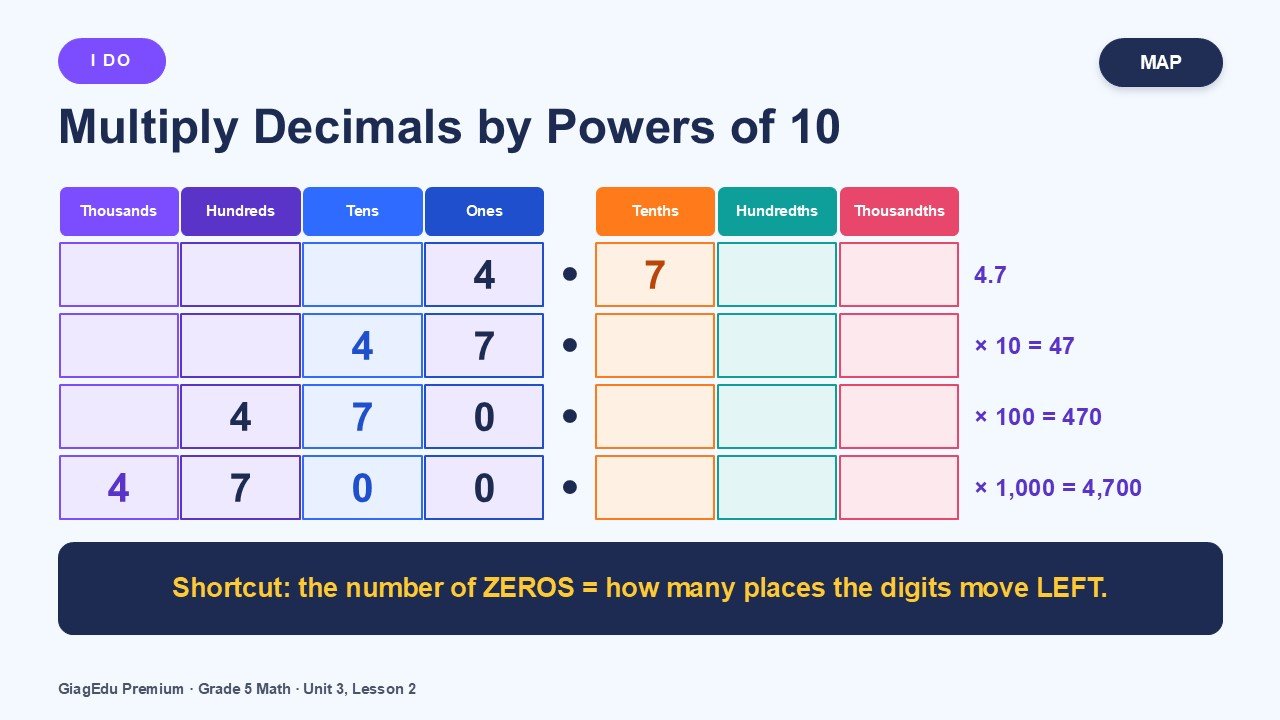
Multiplying by 10 moves every digit one place to the left. With a whole number, a zero fills the empty ones place.
- 35 × 10 = 350
- 35 × 100 = 3,500
- 35 × 1,000 = 35,000
With a decimal, the digits move left past the decimal point:
Dividing by 10, 100 and 1,000
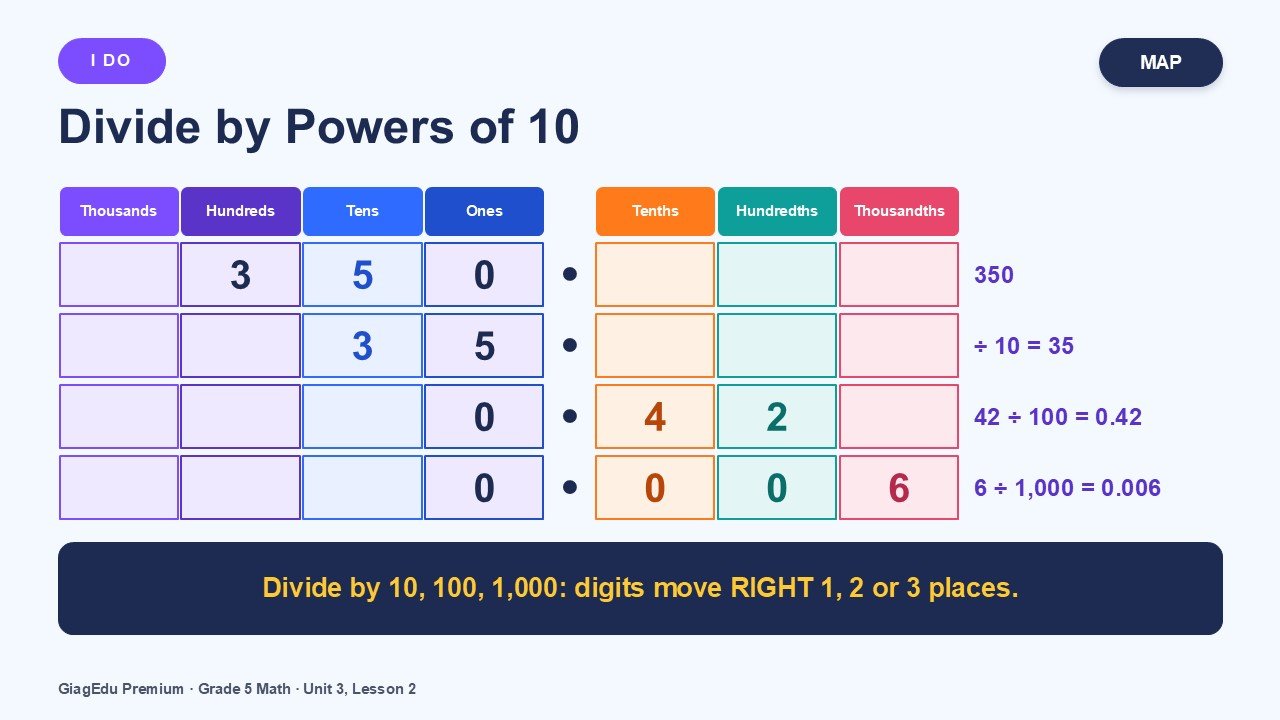
Dividing moves every digit to the right: 1, 2 or 3 places.
The powers of 10 rules
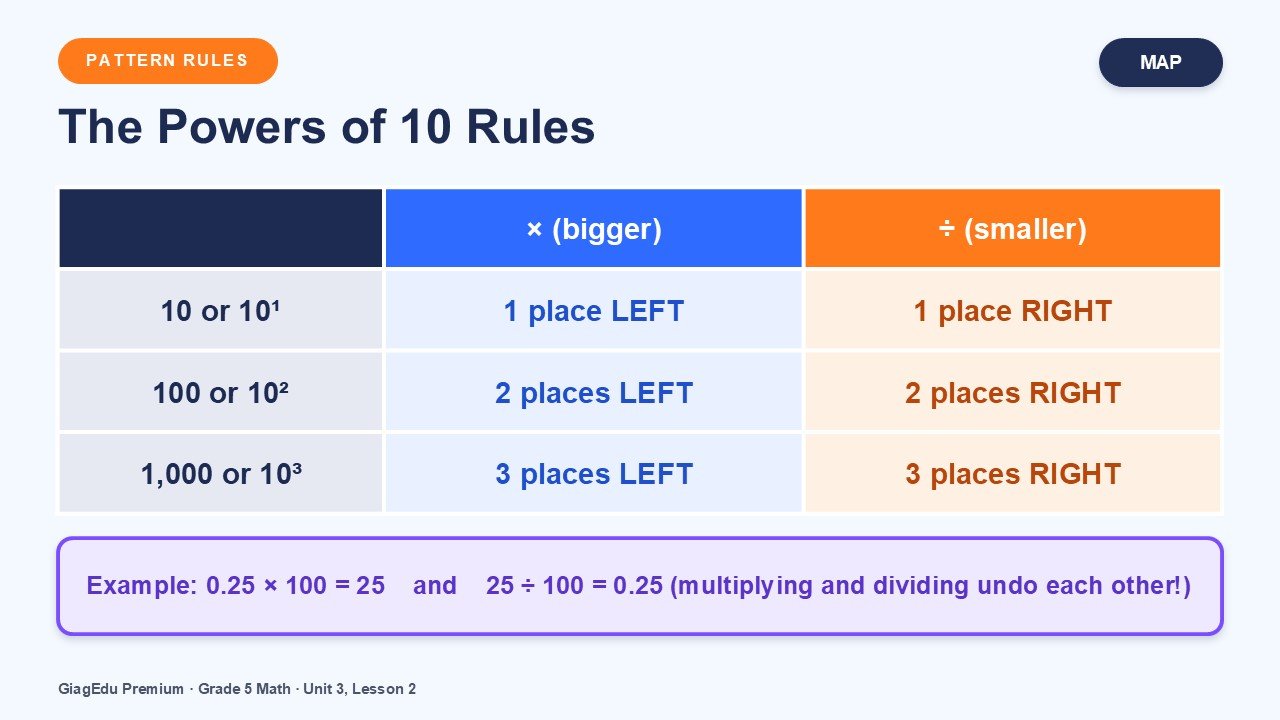
- × 10, 100, 1,000: the number gets bigger; digits move left 1, 2 or 3 places.
- ÷ 10, 100, 1,000: the number gets smaller; digits move right 1, 2 or 3 places.
- Multiplying and dividing undo each other: 0.25 × 100 = 25 and 25 ÷ 100 = 0.25.
Powers of 10 in measurement
- 1 metre = 100 cm, so 2.5 m = 2.5 × 100 = 250 cm.
- 1 kilogram = 1,000 g, so 0.75 kg = 0.75 × 1,000 = 750 g.
- 1 litre = 1,000 mL, so 3,200 mL = 3,200 ÷ 1,000 = 3.2 L.
Story problems
- A pack of paper has 100 sheets. Each sheet is 0.09 mm thick. The pack is 0.09 × 100 = 9 mm thick.
- A school buys 1,000 pencils for $250. One pencil costs $250 ÷ 1,000 = $0.25.
Common mistakes
- Just "adding a zero" to a decimal: 3.2 × 100 is 320, not 3.200.
- Moving the digits the wrong way: dividing makes a number smaller, so 45 ÷ 1,000 = 0.045, not 45,000.
- Reading 103 as 10 × 3 = 30. It means 10 × 10 × 10 = 1,000.
Practice
- Write 104 as a whole number.
- 0.9 × 100 = ?
- 56.3 ÷ 10 = ?
- 2.47 × 103 = ?
- 820 ÷ 100 = ?
- Write 100,000 as a power of 10.
Answers: 1. 10,000 · 2. 90 · 3. 5.63 · 4. 2,470 · 5. 8.2 · 6. 105
Practise Powers of 10: 10 questions in study mode, with an explanation after each answer.
Start Practice