Multiplication Strategies (Grades 4–5): Area Models, Partial Products and the Standard Algorithm
Grade 4-6 Mathematics · Grade 4–5 multiplication step by step: "times as many" comparisons, multiplying by 10, 100 and 1,000, area models, partial products, the over strategy, the standard algorithm and estimating to check.
Why this topic matters
A cinema has 23 rows with 14 seats in each row. How many seats are there? Counting one by one would take forever. Multiplication is the fast way, and today you learn four ways to do it. The big idea: break a big multiplication into small, friendly pieces.
Words to know
- Factor: a number being multiplied. In 6 × 4, both 6 and 4 are factors.
- Product: the answer to a multiplication. 6 × 4 = 24, so 24 is the product.
- Expanded form: a number split by place value: 36 = 30 + 6.
- Area model: a rectangle split into parts to multiply.
- Partial products: the smaller answers you add up to get the total.
- Regroup: carry 10 ones as 1 ten, or 10 tens as 1 hundred.
- Standard algorithm: the short, stacked way to multiply.
"Times as many" comparisons
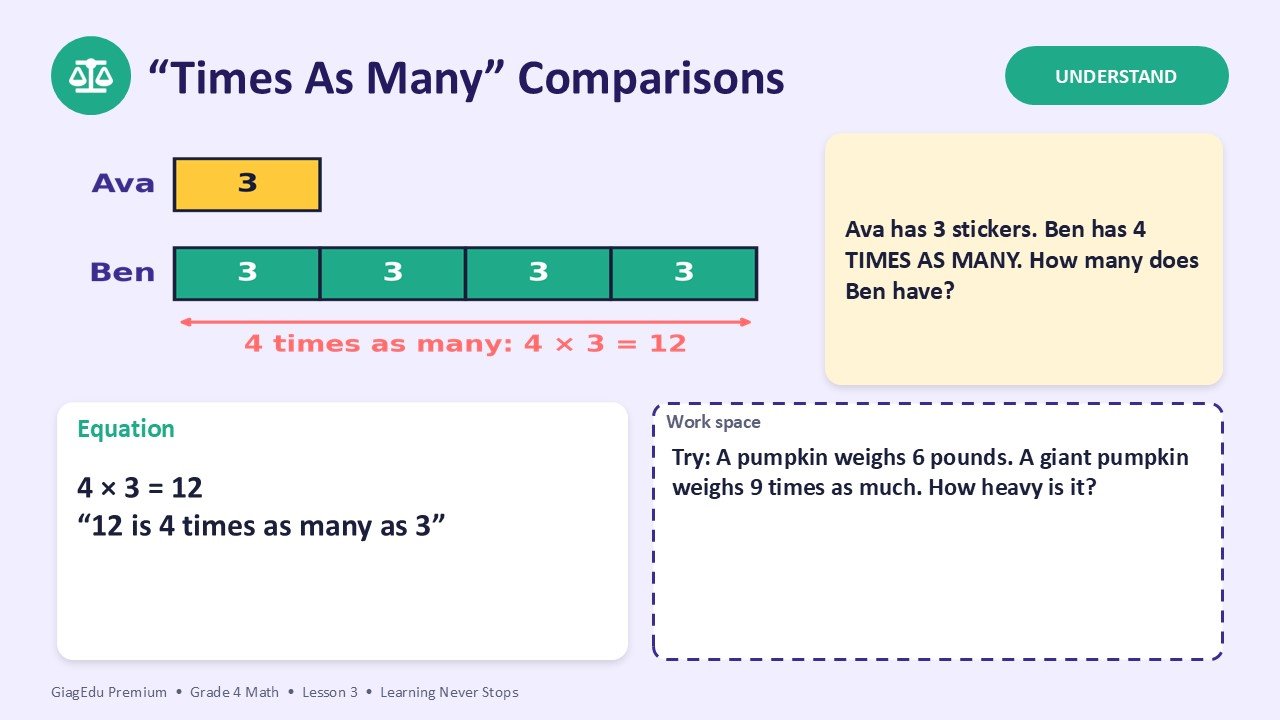
"Ben has 4 times as many stickers as Ava" means Ben's amount is 4 groups of Ava's amount. If Ava has 3, Ben has 4 × 3 = 12. We can say "12 is 4 times as many as 3".
Multiplying by 10, 100 and 1,000
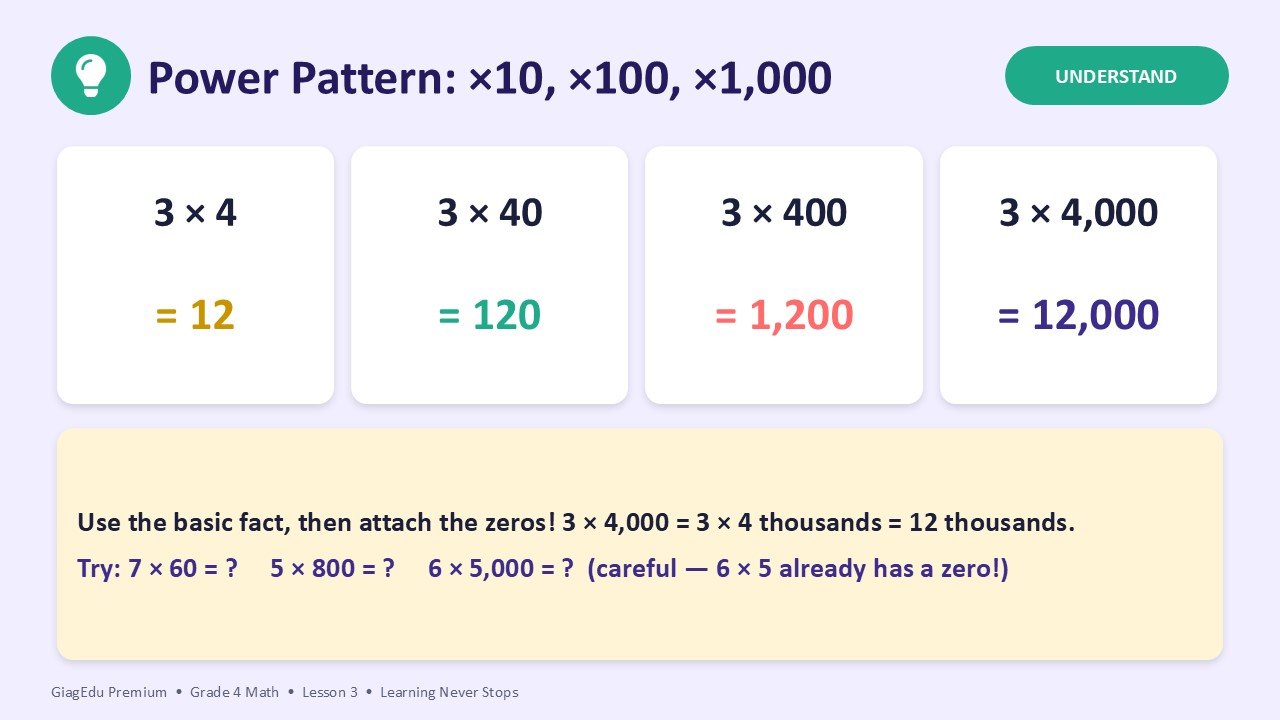
Use the basic fact, then attach the zeros. 3 × 4,000 = 3 × 4 thousands = 12 thousands = 12,000.
When both numbers end in zeros, add the zeros from both: 60 × 40 → 6 × 4 = 24, then two zeros → 2,400.
The area model
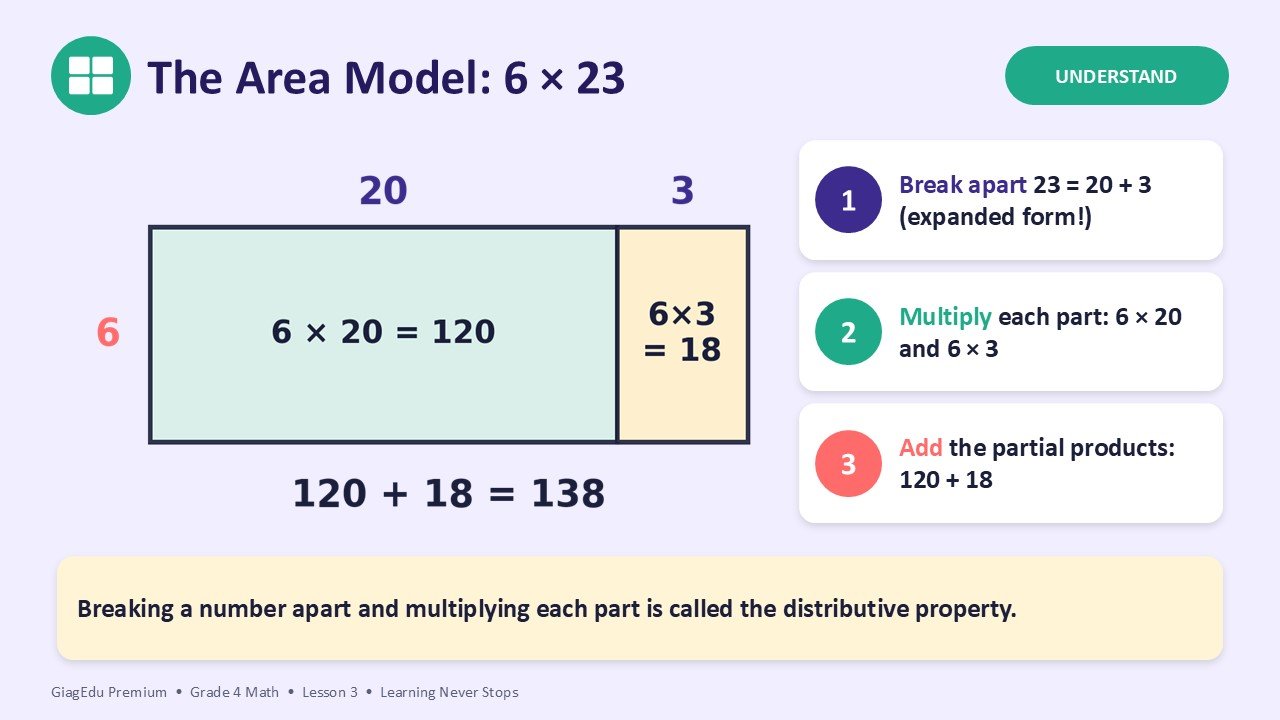
- Break the bigger number apart in expanded form: 23 = 20 + 3.
- Multiply each part: 6 × 20 = 120 and 6 × 3 = 18.
- Add the partial products: 120 + 18 = 138.
Breaking a number apart and multiplying each part is called the distributive property. It works for bigger numbers too: 4 × 1,326 = 4,000 + 1,200 + 80 + 24 = 5,304 (one box for each place).
Two-digit × two-digit
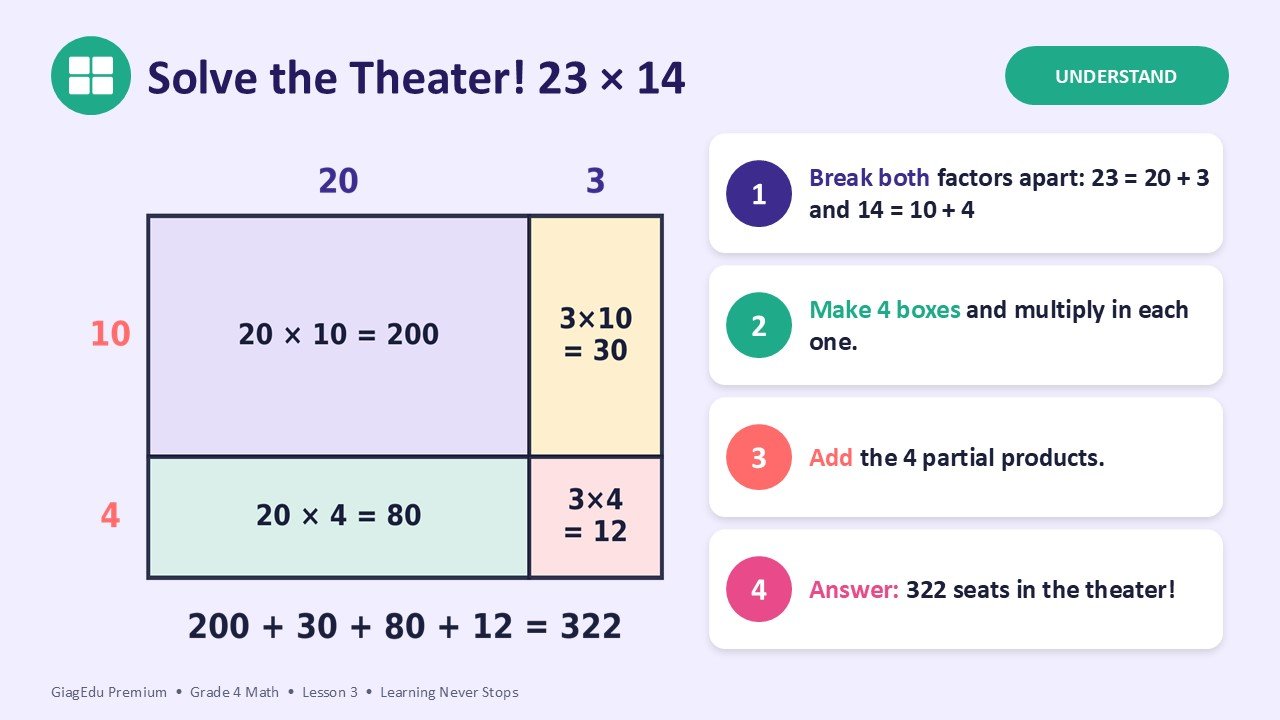
Break both factors apart: 23 = 20 + 3 and 14 = 10 + 4. Make 4 boxes and multiply in each one:
- 20 × 10 = 200
- 3 × 10 = 30
- 20 × 4 = 80
- 3 × 4 = 12
Add: 200 + 30 + 80 + 12 = 322. The cinema has 322 seats.
Partial products without the box
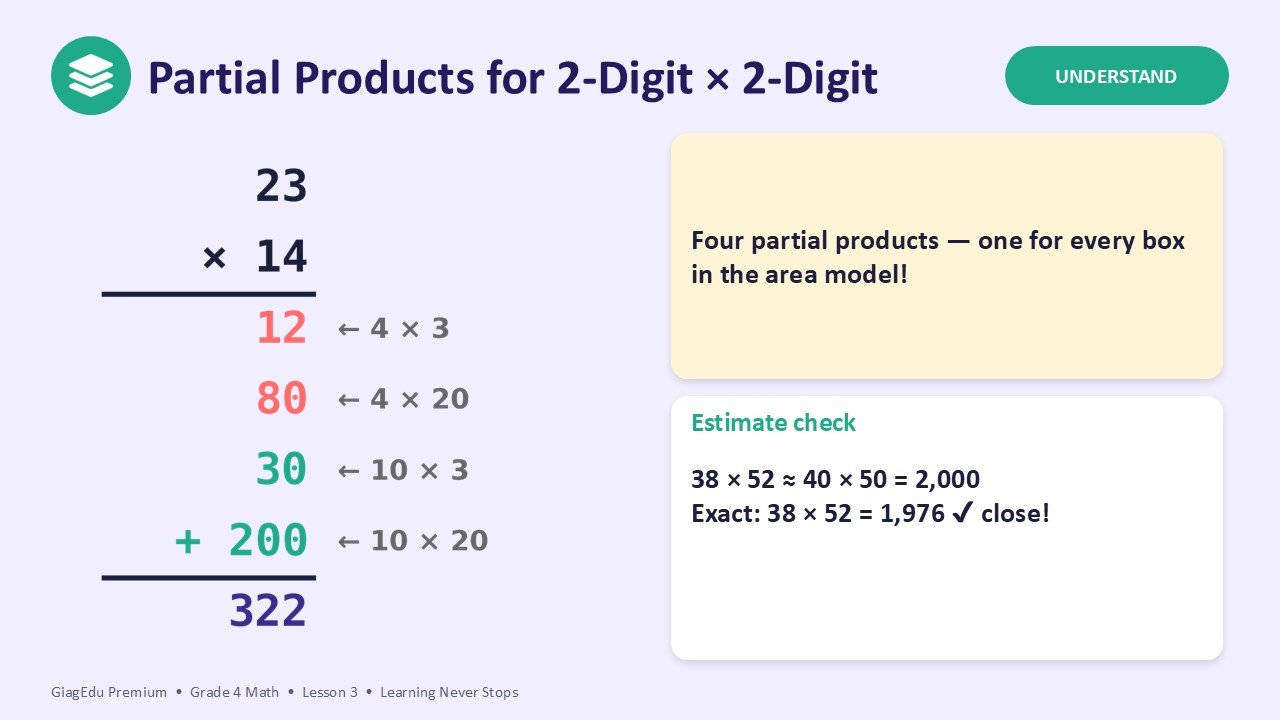
- Start with the ones and multiply each place.
- Write each partial product on its own line, with the places lined up.
- Add all the partial products.
There are four partial products: one for every box of the area model.
The over strategy (mental maths)
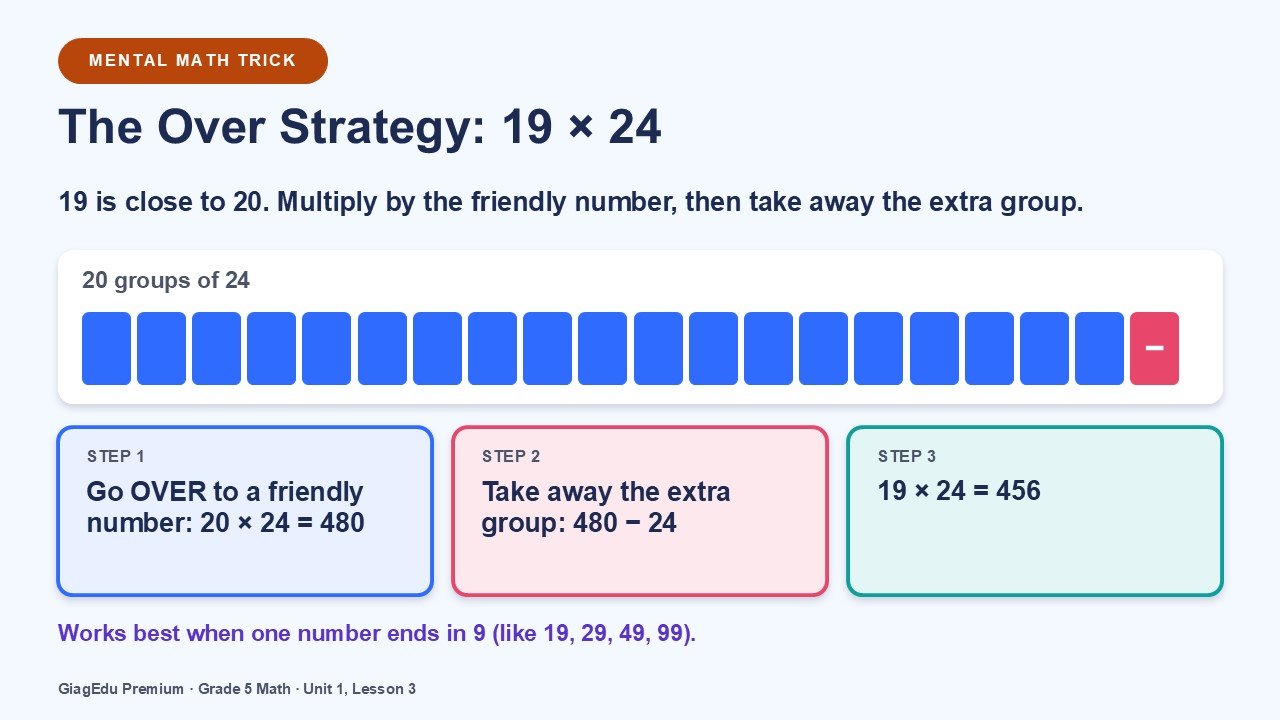
When one number is just below a friendly number (19, 29, 49, 99), go over to the friendly number, then take away the extra group.
- 19 × 24 = 20 × 24 − 24 = 480 − 24 = 456
- 29 × 5 = 30 × 5 − 5 = 145
- 99 × 7 = 100 × 7 − 7 = 693
The standard algorithm
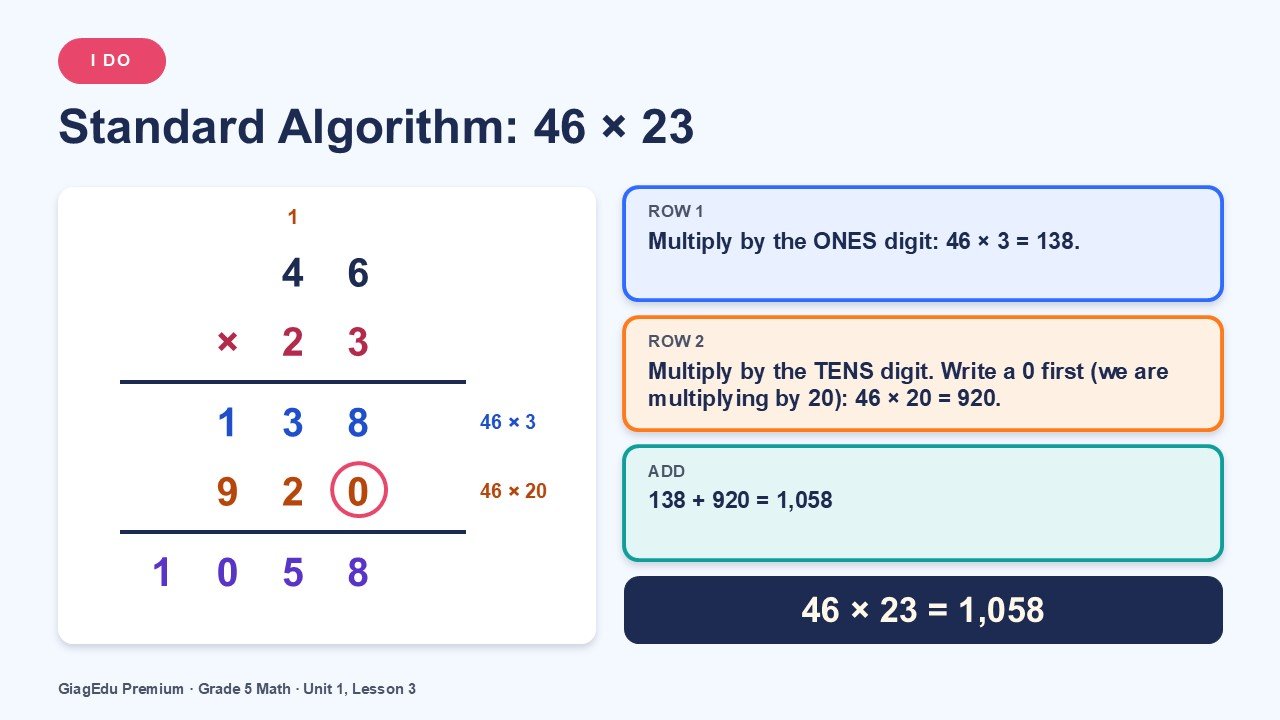
It is partial products squeezed into two rows.
- Row 1: multiply by the ones digit: 46 × 3 = 138.
- Row 2: write a 0 first (you are multiplying by tens), then multiply by the tens digit: 46 × 20 = 920.
- Add the two rows: 138 + 920 = 1,058.
With one-digit multipliers, regroup as you go: 347 × 6 → 6 × 7 = 42 (write 2, carry 4); 6 × 4 = 24, + 4 = 28 (write 8, carry 2); 6 × 3 = 18, + 2 = 20 → 2,082.
Estimate to check
Round each factor to a friendly number. Your exact answer should be close to the estimate.
- 38 × 52 ≈ 40 × 50 = 2,000. Exact: 1,976. Close!
- 58 × 34 ≈ 60 × 30 = 1,800. Exact: 1,972. Close!
If your answer is far from the estimate, check your work.
Mistake detectives
- 6 × 47 = 2,442? Wrong. The student wrote 6 × 4 = 24 and 6 × 7 = 42 side by side. But the 4 in 47 is 4 tens: 6 × 40 = 240, plus 6 × 7 = 42, gives 282.
- 23 × 14 = 212? Wrong. The student did only 20 × 10 and 3 × 4 and forgot 20 × 4 and 3 × 10. The answer is 322.
Practise Multiplication: 10 questions in study mode, with an explanation after each answer.
Start Practice