Lines, Angles and Symmetry (Grade 4): Points, Lines, Rays, Parallel and Perpendicular Lines, Classifying and Adding Angles, Lines of Symmetry
Grade 4-6 Mathematics · Grade 4 geometry: points, lines, segments and rays; parallel, perpendicular and intersecting lines; acute, right, obtuse and straight angles; angles as turns; missing angles; classifying shapes; lines of symmetry; and the Grade 5 shape family tree.
Why this topic matters
Look at a city map. Some streets run side by side and never meet. Some cross to make perfect square corners. One road cuts across at a slant. Geometry gives us the words to describe all of this, and the same ideas help builders, designers and artists.
Geometry building blocks
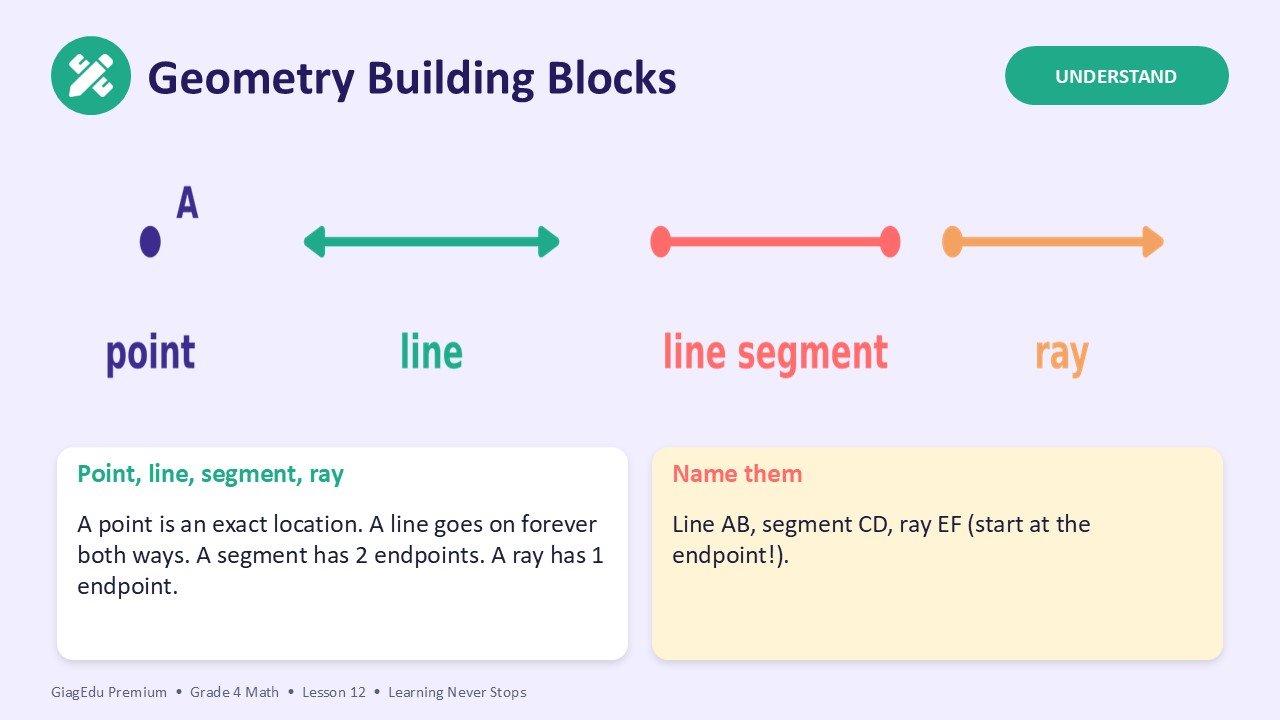
- Point: an exact location, named with a capital letter (point A).
- Line: goes on forever in both directions (line AB).
- Line segment: part of a line with 2 endpoints (segment CD).
- Ray: part of a line with 1 endpoint that goes on forever in one direction. Name it starting at the endpoint (ray EF).
Parallel, perpendicular and intersecting lines
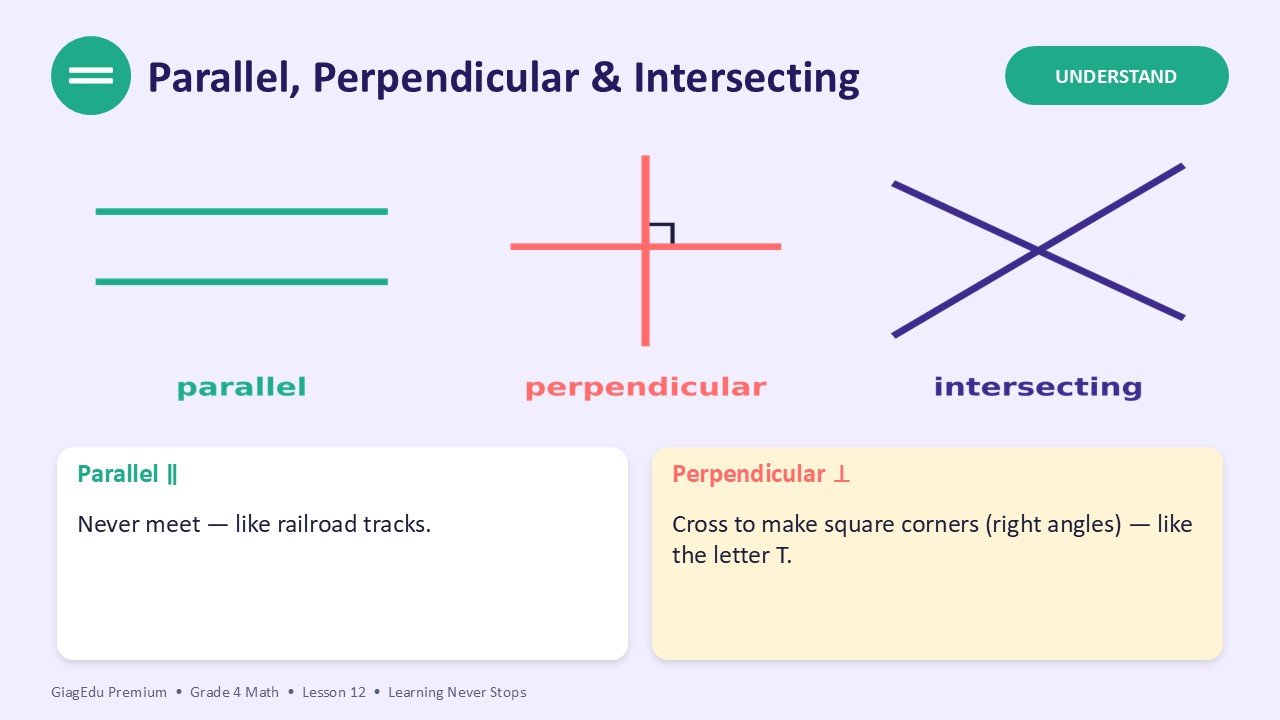
- Parallel (∥): never meet and are always the same distance apart, like railway tracks.
- Perpendicular (⊥): cross to make right angles (square corners), like the letter T.
- Intersecting: cross at one point. Perpendicular lines are a special kind of intersecting lines.
Kinds of angles
An angle is two rays that share an endpoint, called the vertex. Angles are measured in degrees (°).
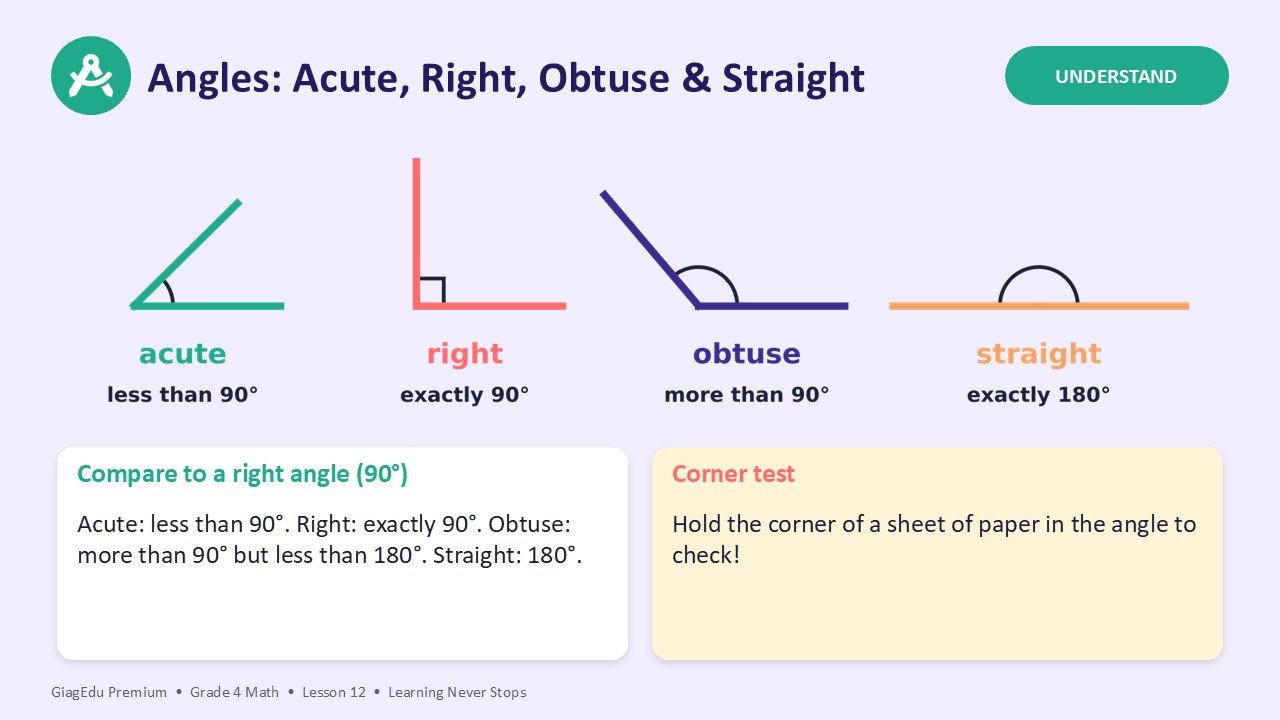
- Acute: less than 90°
- Right: exactly 90°
- Obtuse: more than 90° but less than 180°
- Straight: exactly 180°
Angles are turns in a circle
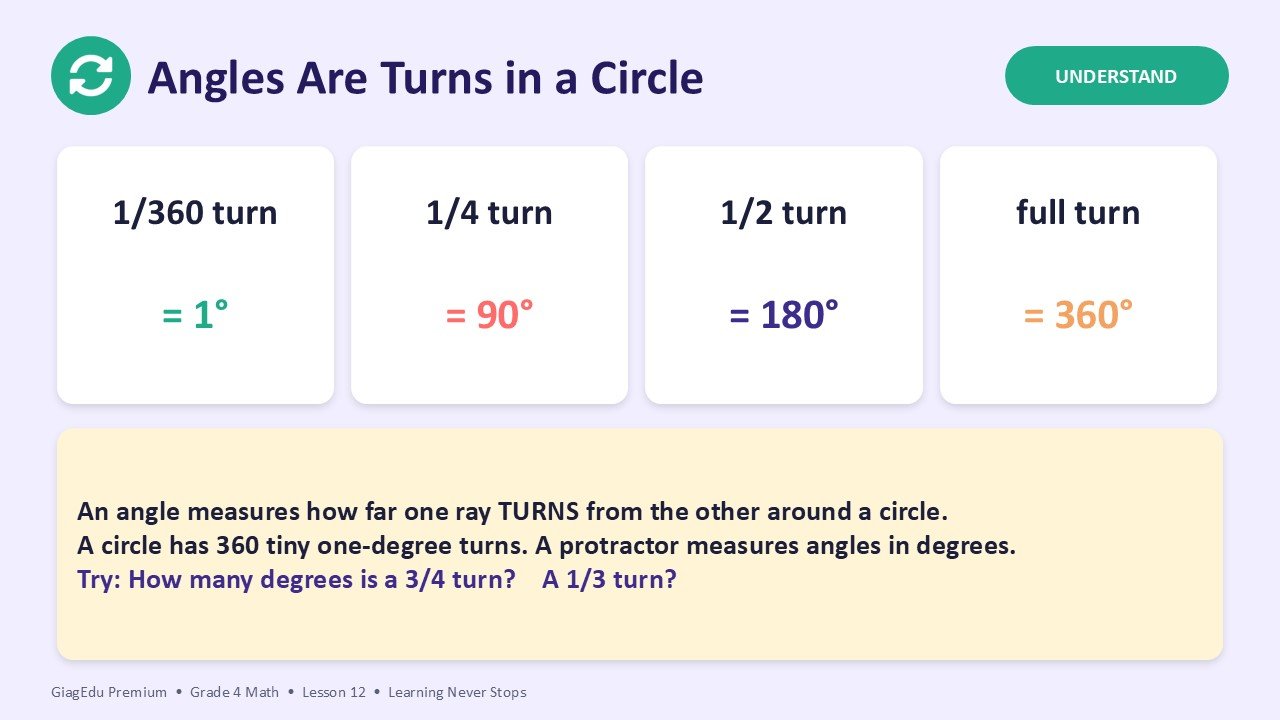
A full turn is 360°, so a 1/4 turn is 90°, a 1/2 turn is 180°, a 3/4 turn is 270° and a 1/3 turn is 120°. A protractor measures angles in degrees.
Adding angles and finding missing angles
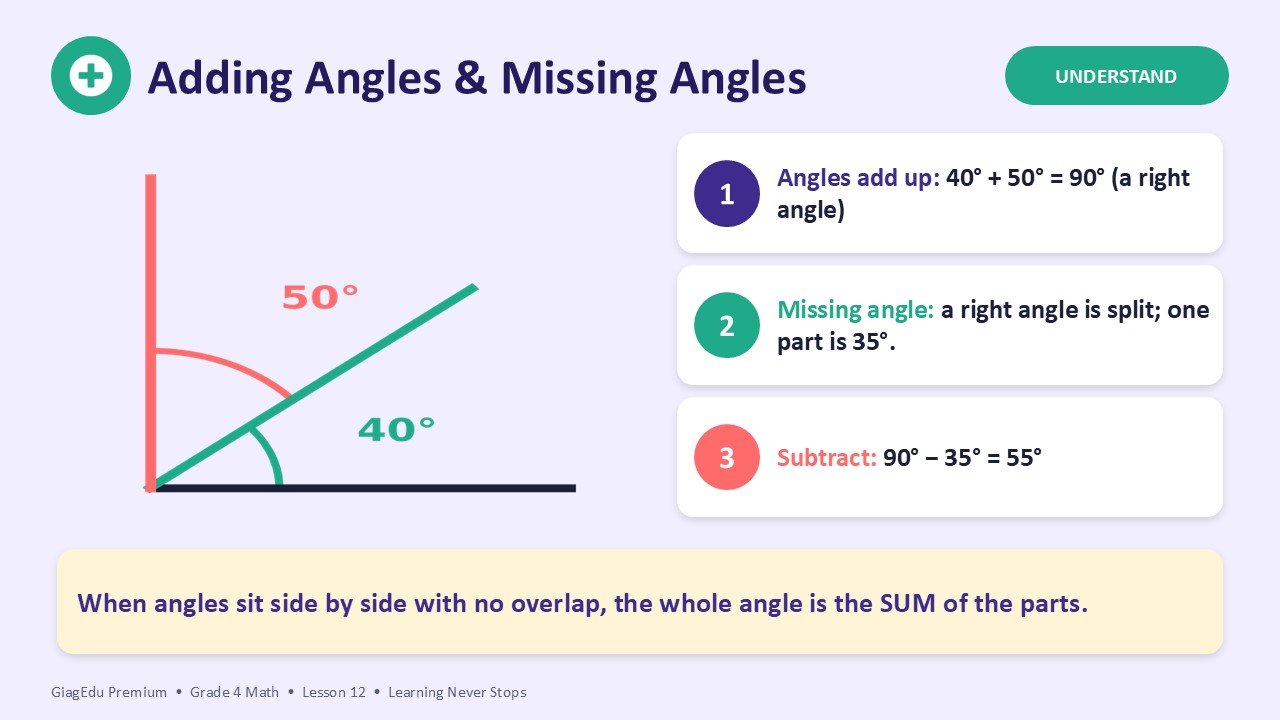
When angles sit side by side with no overlap, the whole angle is the sum of the parts. To find a missing part, subtract.
Classifying shapes by lines and angles
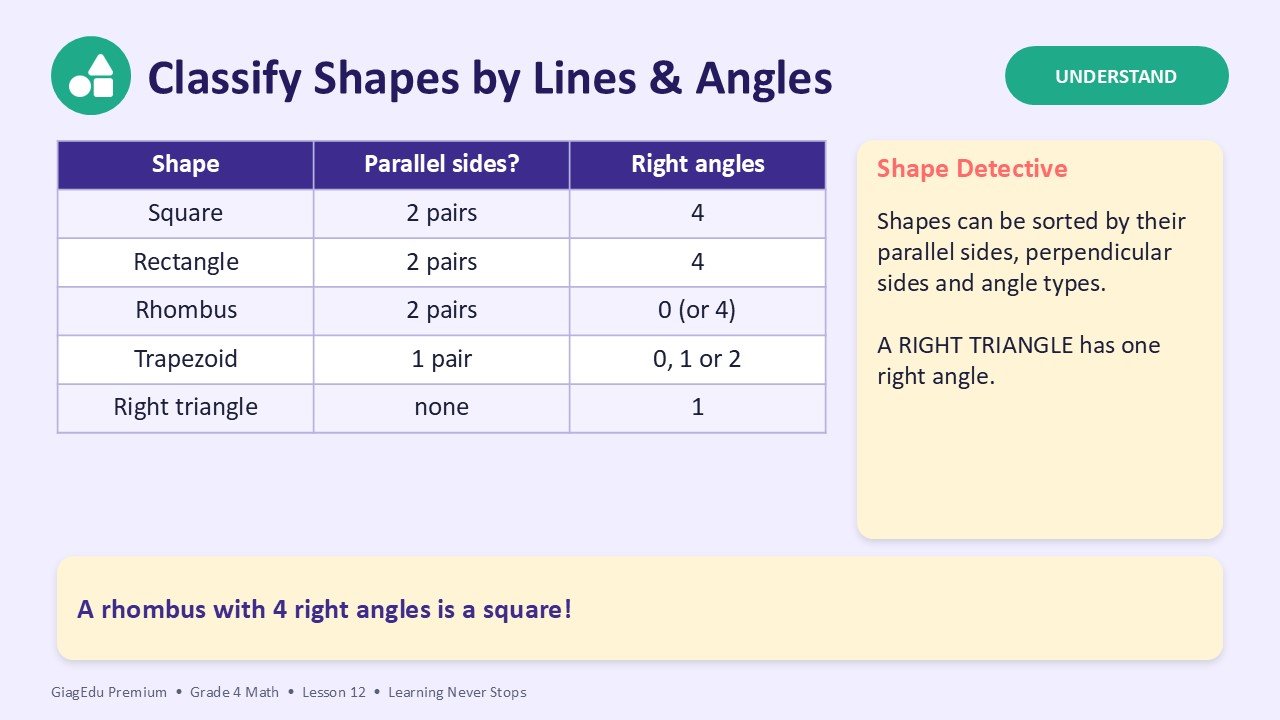
- Square: 2 pairs of parallel sides, 4 right angles, 4 equal sides.
- Rectangle: 2 pairs of parallel sides, 4 right angles.
- Rhombus: 2 pairs of parallel sides, 4 equal sides. A rhombus with 4 right angles is a square.
- Trapezoid: exactly 1 pair of parallel sides.
- Right triangle: has one right angle.
Lines of symmetry
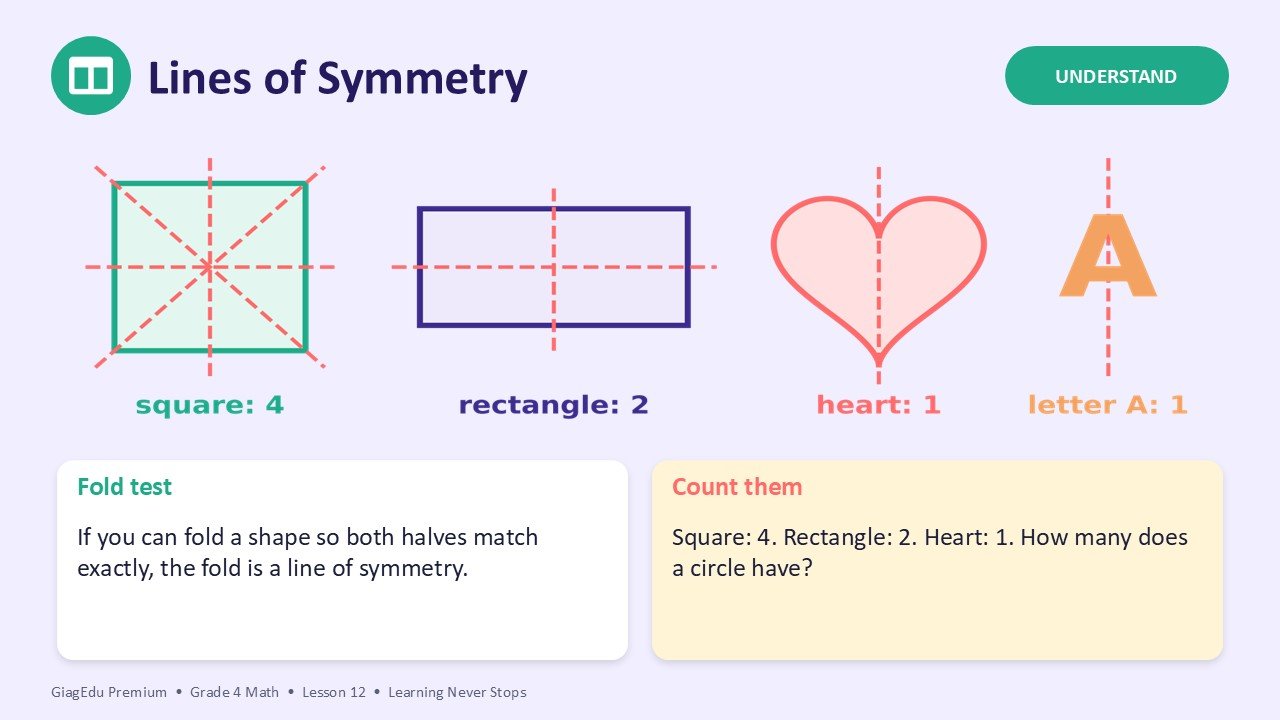
A line of symmetry folds a shape into two matching halves. Square: 4. Rectangle: 2 (not the diagonals!). Heart: 1. Letter A: 1. A circle has infinitely many lines of symmetry.
Grade 5 bridge: the shape family tree
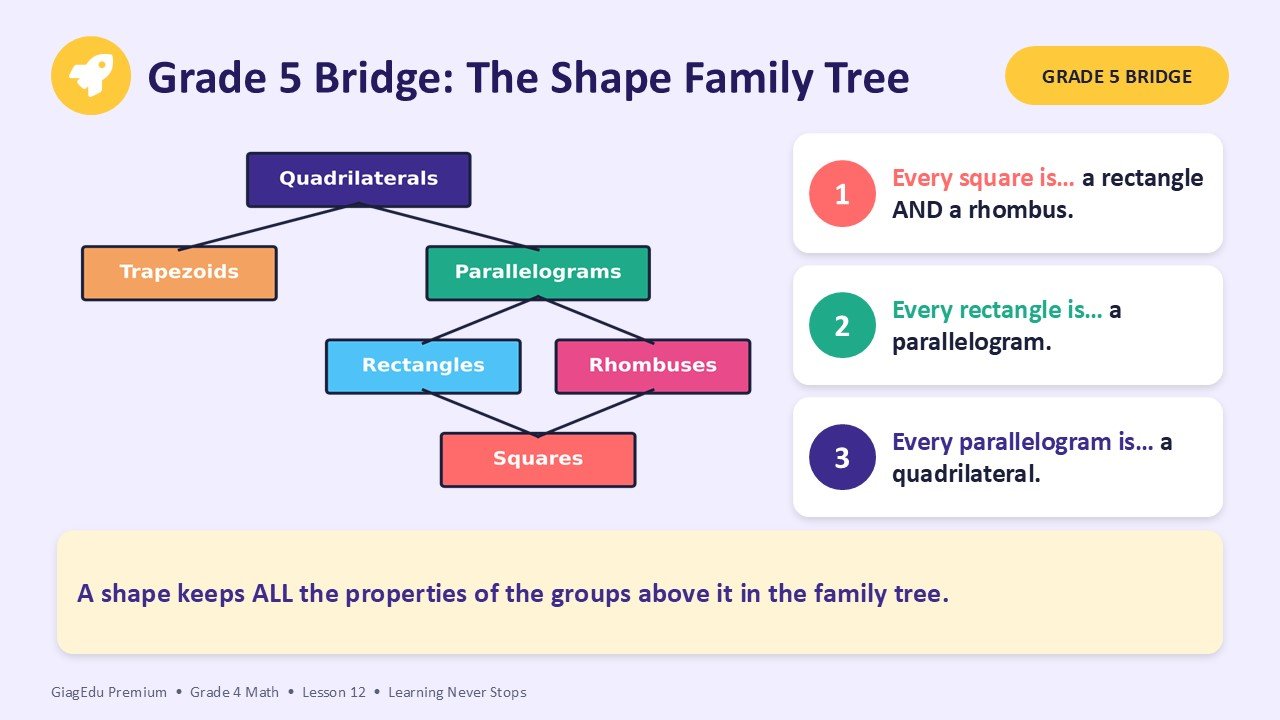
- Every square is a rectangle and a rhombus.
- Every rectangle is a parallelogram.
- Every parallelogram is a quadrilateral.
- But not every rectangle is a square. A shape keeps all the properties of the groups above it.
Common mistakes
- "A rectangle has 4 lines of symmetry." Folding along a diagonal does not make the halves match, so it has only 2.
- "This angle is obtuse because its rays are long." The size of an angle is the turn between the rays, not their length.
- Naming a ray from the wrong end. Always start at the endpoint.
Practice
- Classify a 120° angle.
- How are parallel and perpendicular lines different?
- 90° = 25° + ?
- How many lines of symmetry does a square have?
- How many degrees is a 3/4 turn?
- Is a square a parallelogram?
Answers: 1. Obtuse · 2. Parallel lines never meet; perpendicular lines cross at right angles · 3. 65° · 4. 4 · 5. 270° · 6. Yes: it has 2 pairs of parallel sides
Practise Lines, Angles & Symmetry: 10 questions in study mode, with an explanation after each answer.
Start Practice