Algebraic Expressions (Grade 6): Variables, Evaluating, Writing Expressions, Properties, the Distributive Property and Factoring
Grade 4-6 Mathematics · Grade 6 algebra: variables, terms, coefficients and constants; evaluating expressions; turning words into expressions; commutative, associative, identity and zero properties; the distributive property and like terms; and factoring with the GCF.
Why this topic matters
A box holds some pencils, and you don't know how many. How could you write "the number of pencils plus 6"? In algebra, a letter stands for the number you don't know yet: p + 6. Expressions like this describe taxi fares, phone plans and ticket prices, and they are the first step towards solving equations.
Words to know
- Variable: a letter or symbol that stands for a number (x, n, t).
- Algebraic expression: numbers, operations and at least one variable (5n − 2).
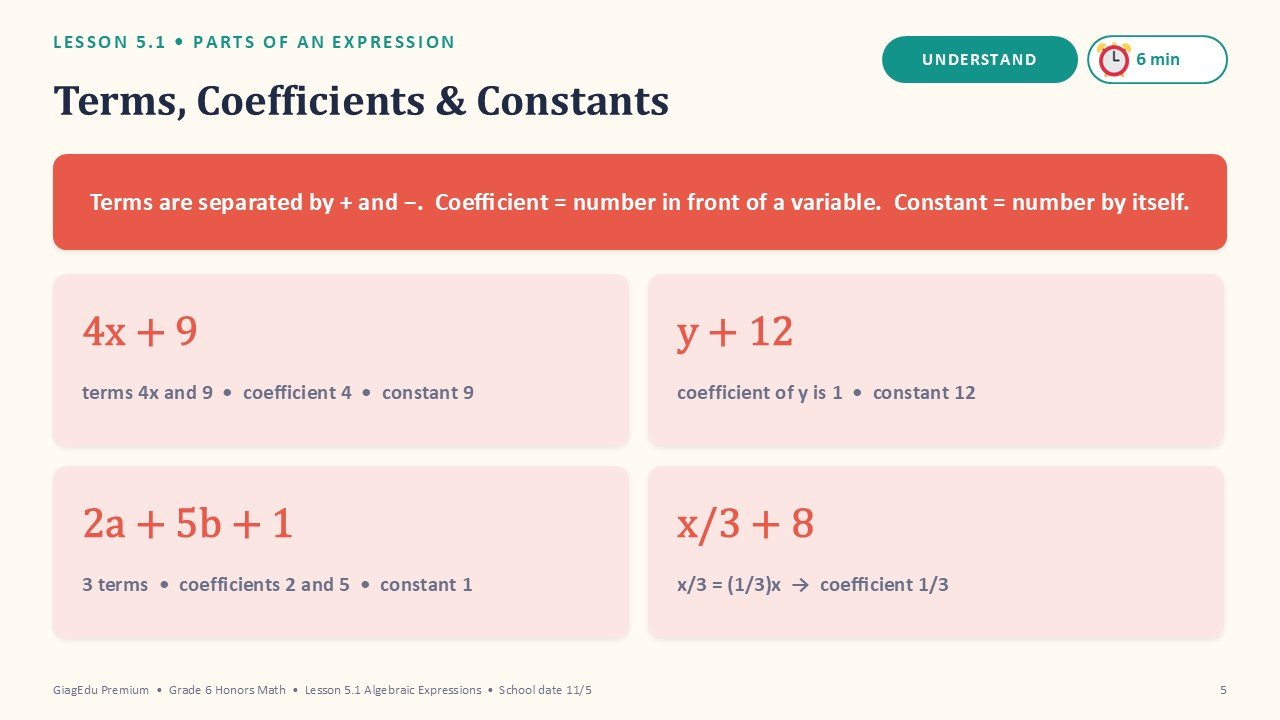
- Term: each part separated by + or − (3x + 7 has terms 3x and 7).
- Coefficient: the number multiplied by a variable (3x → 3).
- Constant: a term with no variable (3x + 7 → 7).
- Evaluate: substitute a value for the variable, then simplify.
Parts of an expression
Variables are like mystery bags
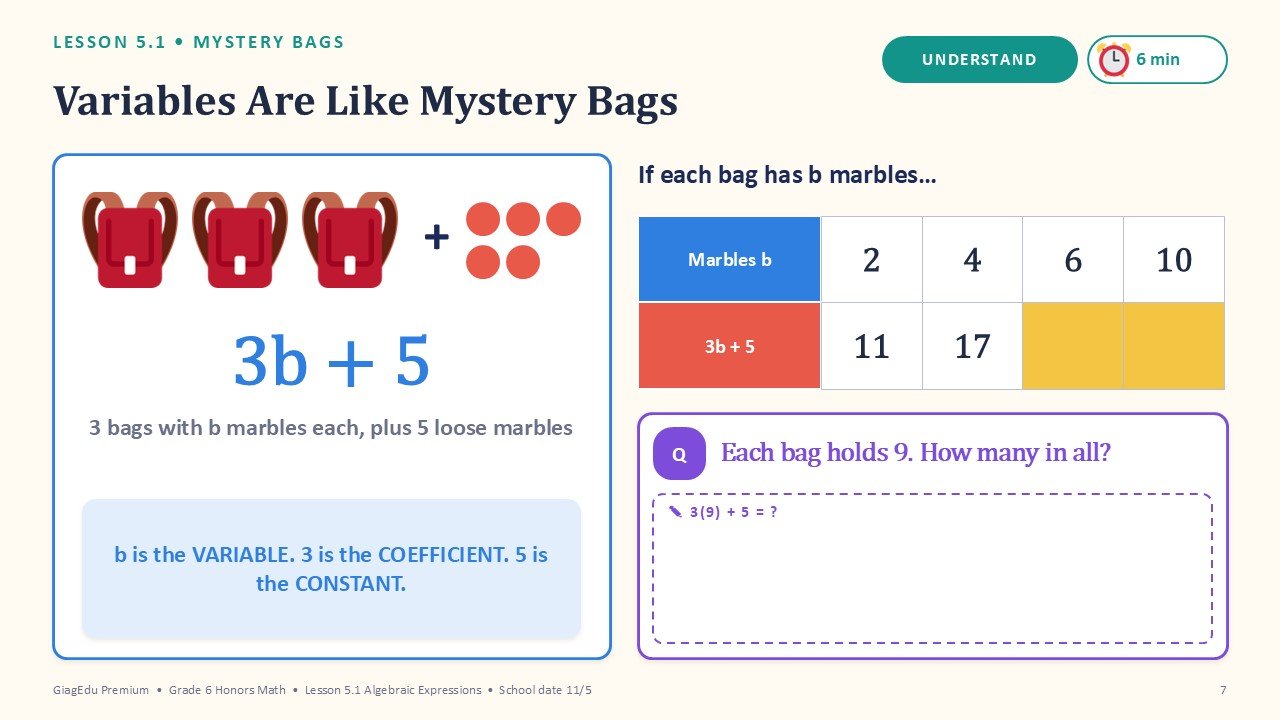
3b + 5 means 3 bags with b marbles each, plus 5 loose marbles. If each bag holds 9, there are 3(9) + 5 = 32 marbles.
Evaluating expressions
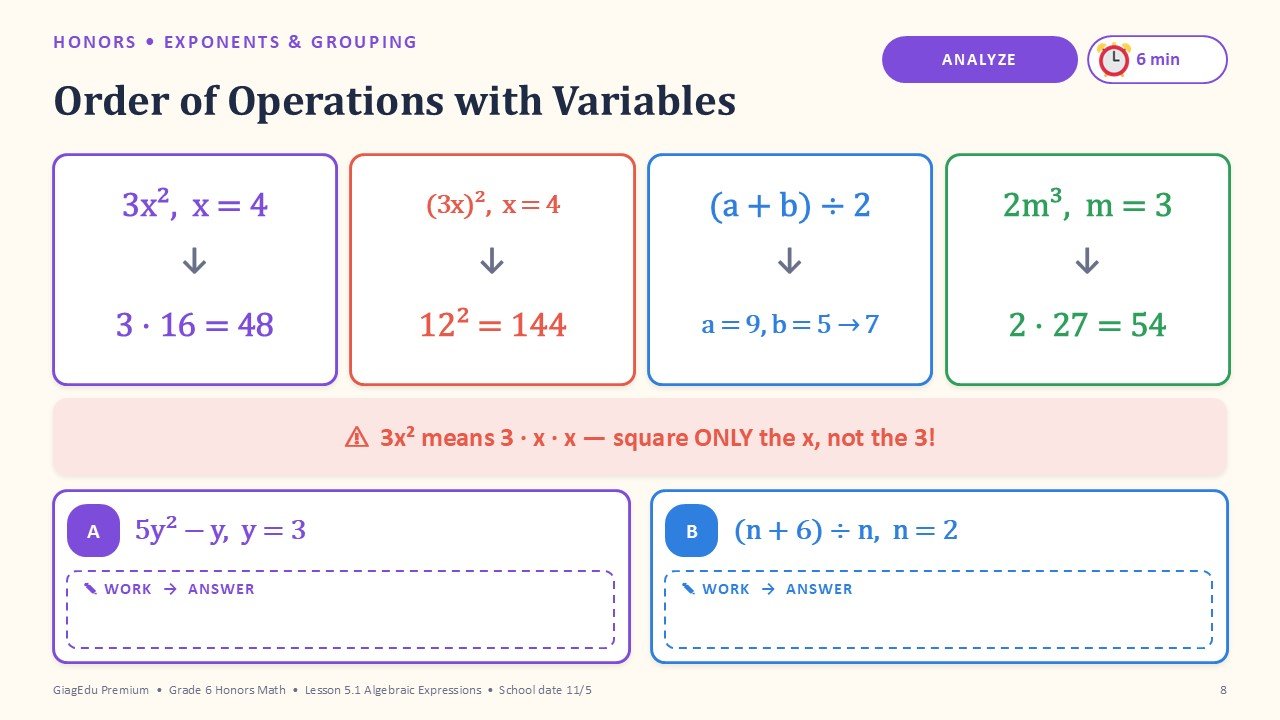
Replace each variable with its value in brackets, then use the order of operations.
Writing expressions from words
- Add: sum, more than, increased by, plus. "8 more than x" → x + 8
- Subtract: difference, less than, decreased by, minus. "6 less than y" → y − 6
- Multiply: product, times, twice. "the product of 4 and w" → 4w
- Divide: quotient, divided by, per. "a number divided by 9" → n ÷ 9
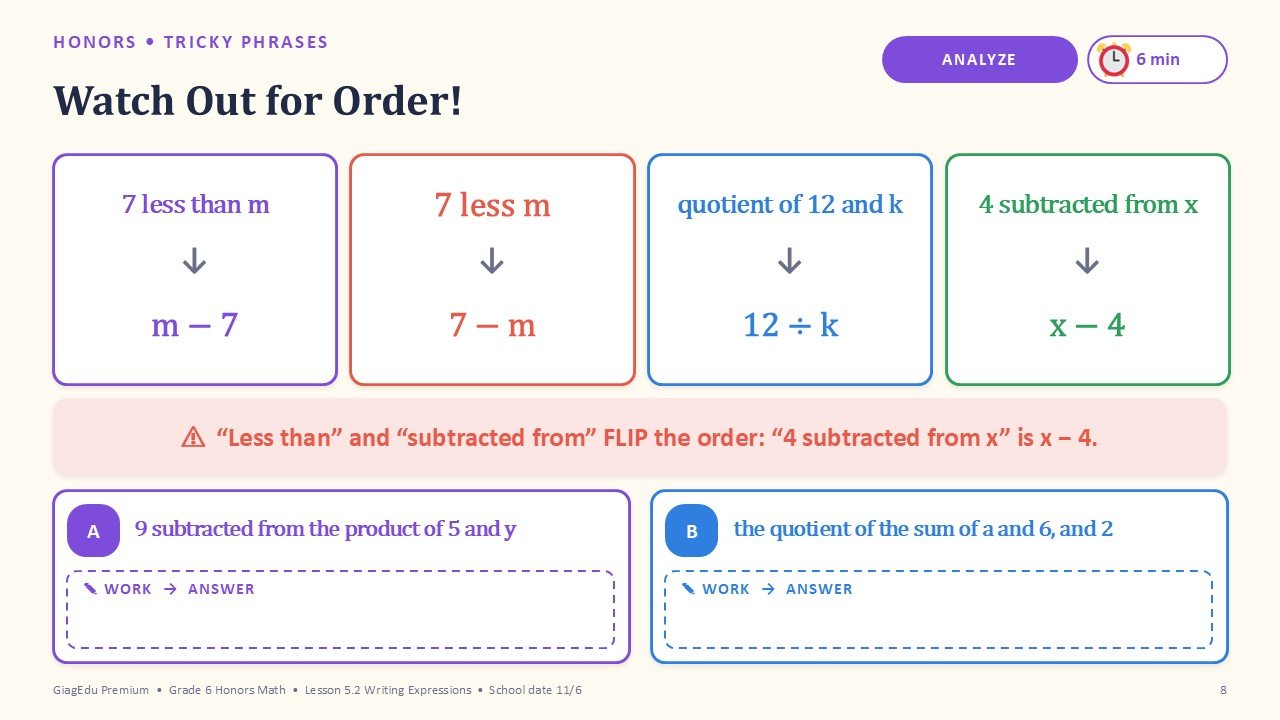
"The sum of…" groups numbers, so use brackets:
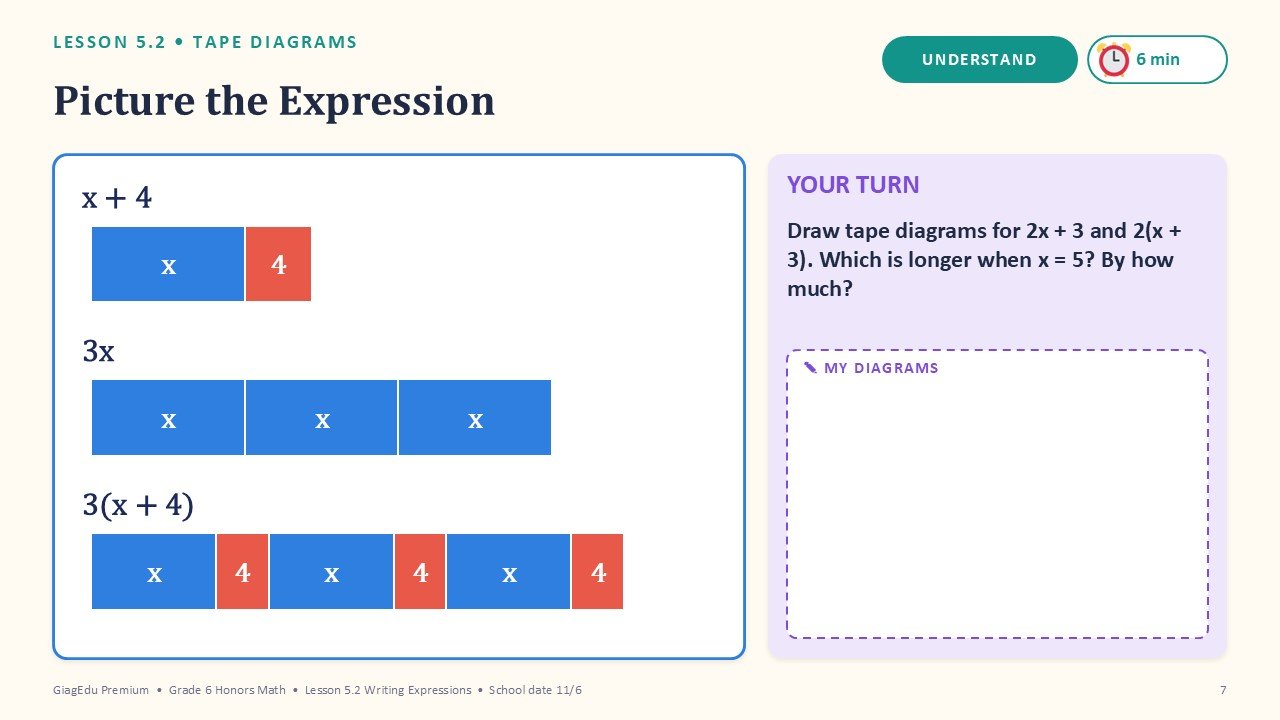
- 3 times a number, plus 5 → 3n + 5
- 3 times the sum of n and 5 → 3(n + 5)
Properties of addition and multiplication
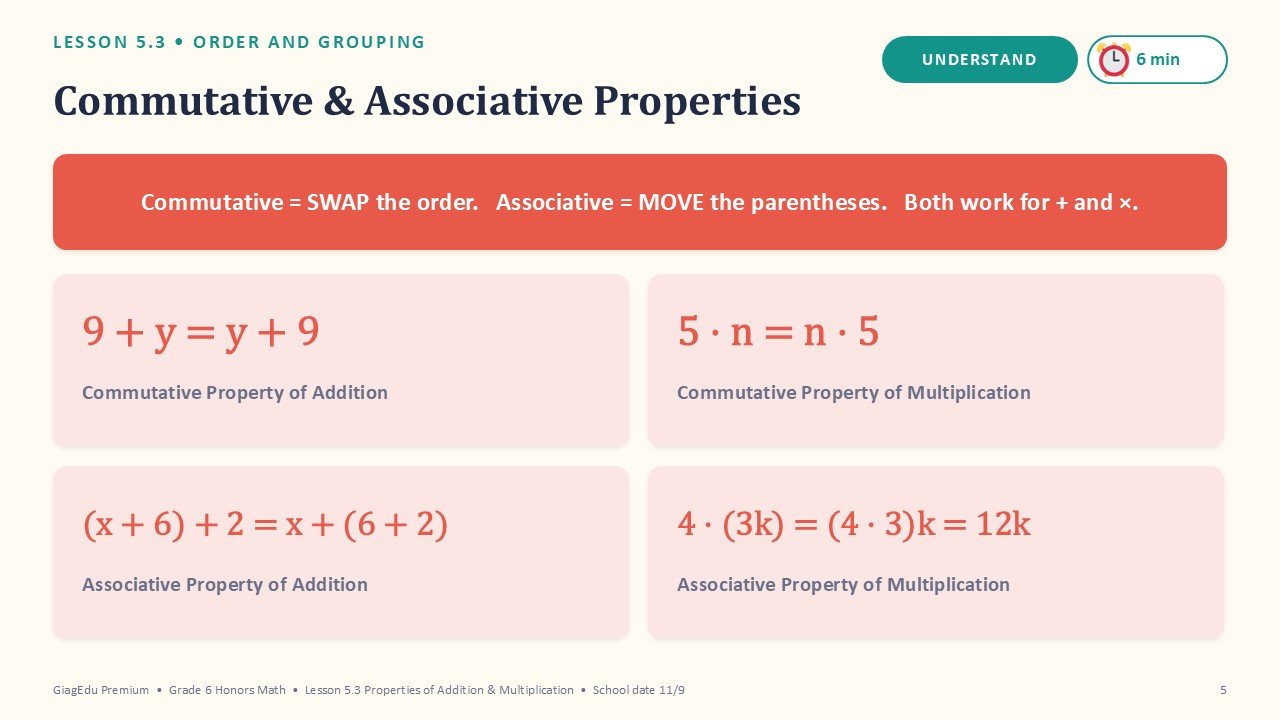
- Commutative: change the order. a + b = b + a; a · b = b · a
- Associative: change the grouping. (a + b) + c = a + (b + c); (ab)c = a(bc)
- Identity: a + 0 = a; a · 1 = a
- Zero property: a · 0 = 0
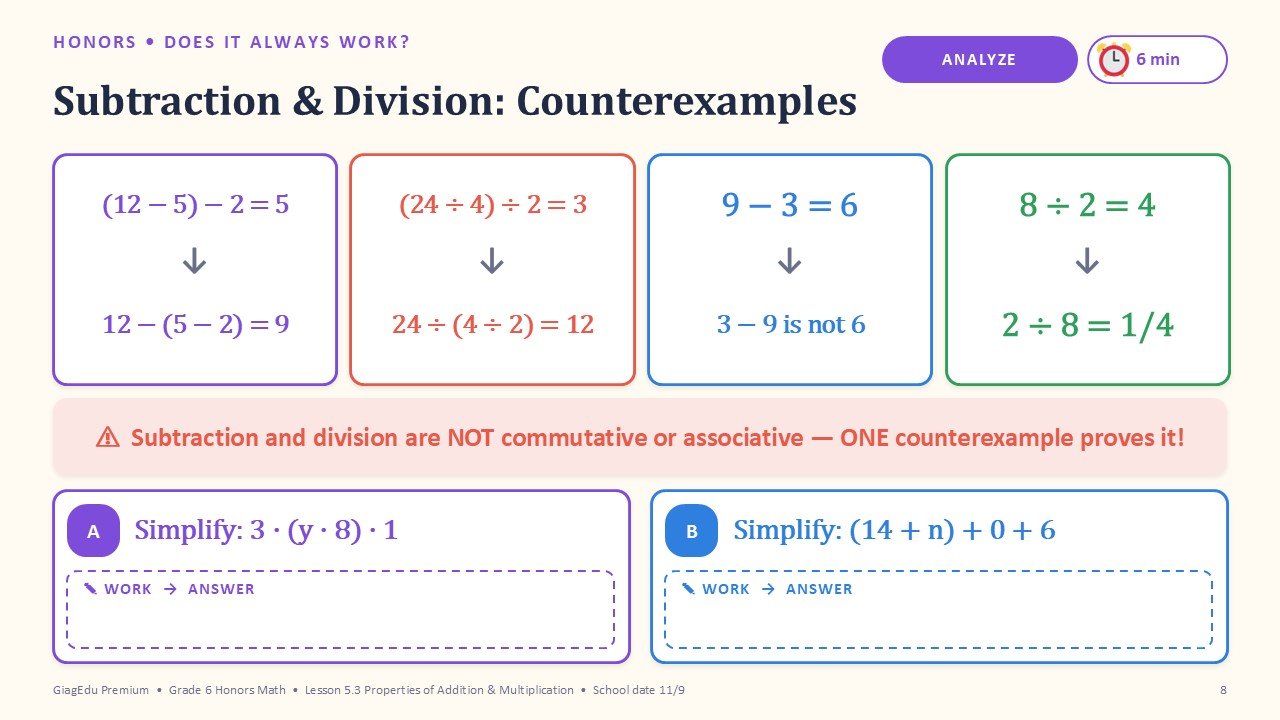
Subtraction and division are not commutative or associative: 10 − 4 is not 4 − 10. One counterexample proves it.
The distributive property
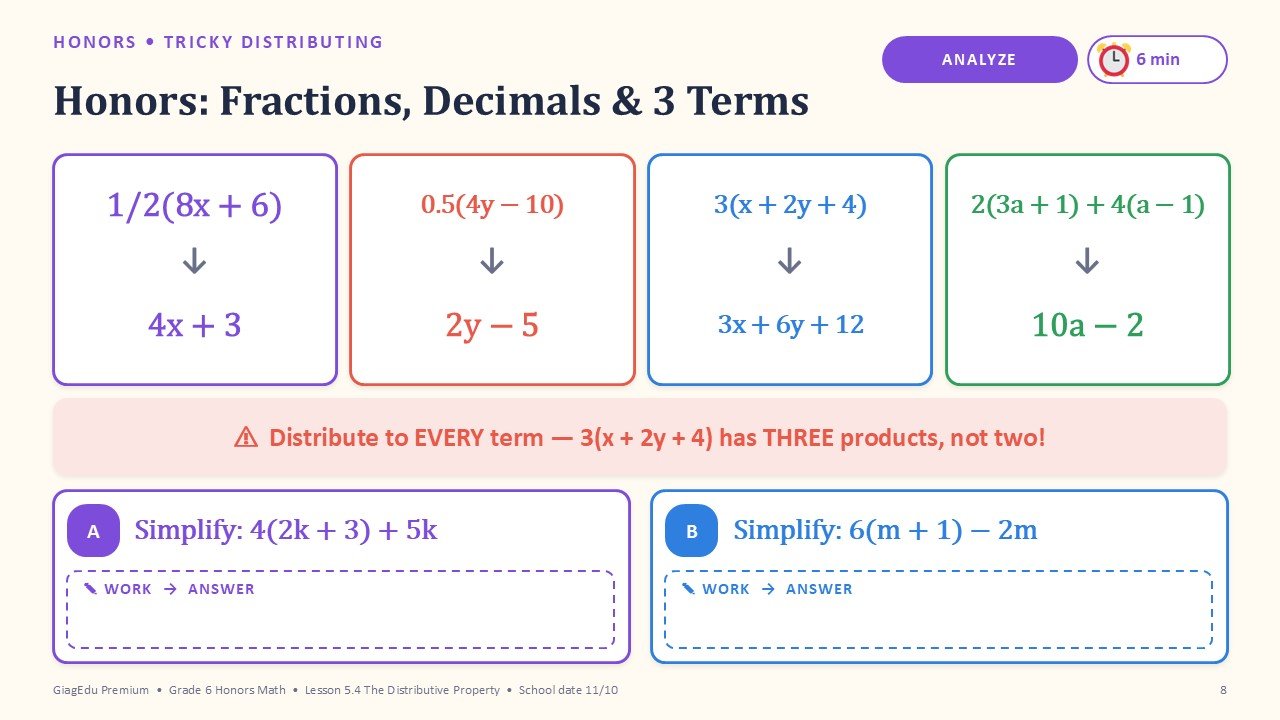
Multiply the outside number by every term inside: a(b + c) = ab + ac.
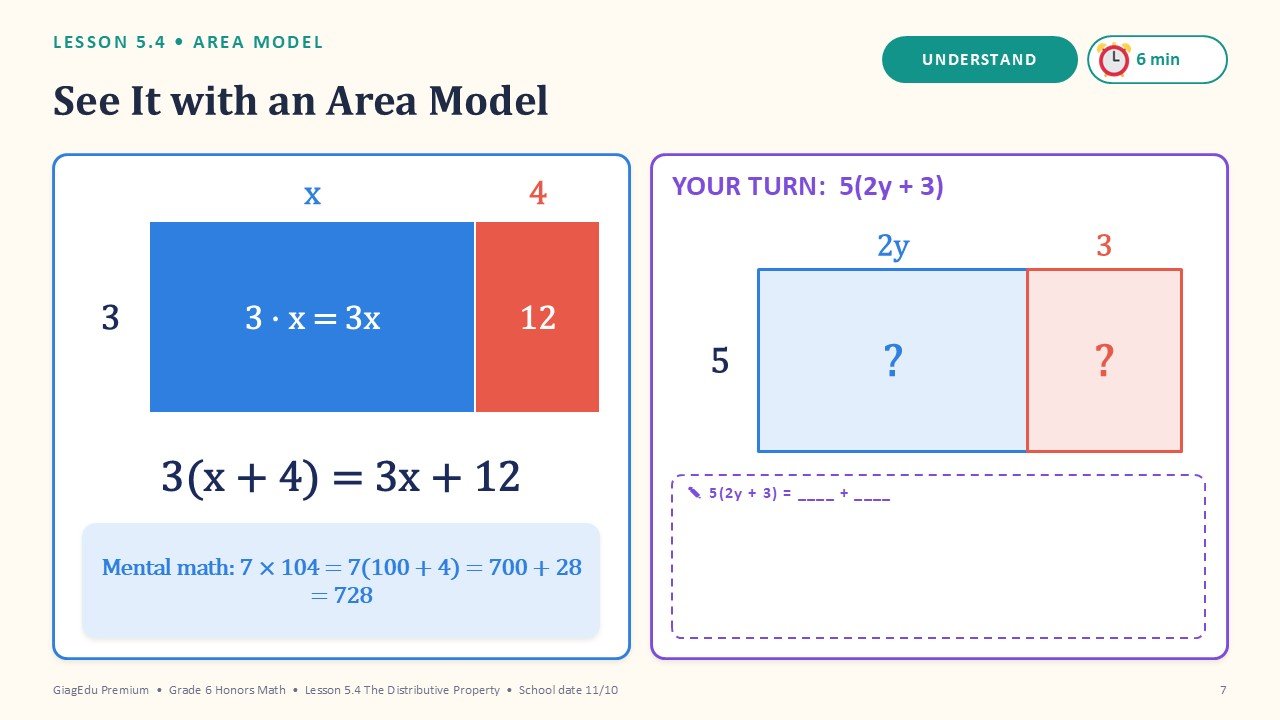
Like terms have the same variable part (4x and 9x; 3 and 8). Combine them by adding their coefficients: 3x + 5x = 8x. To simplify, distribute first, then combine:
Factoring expressions
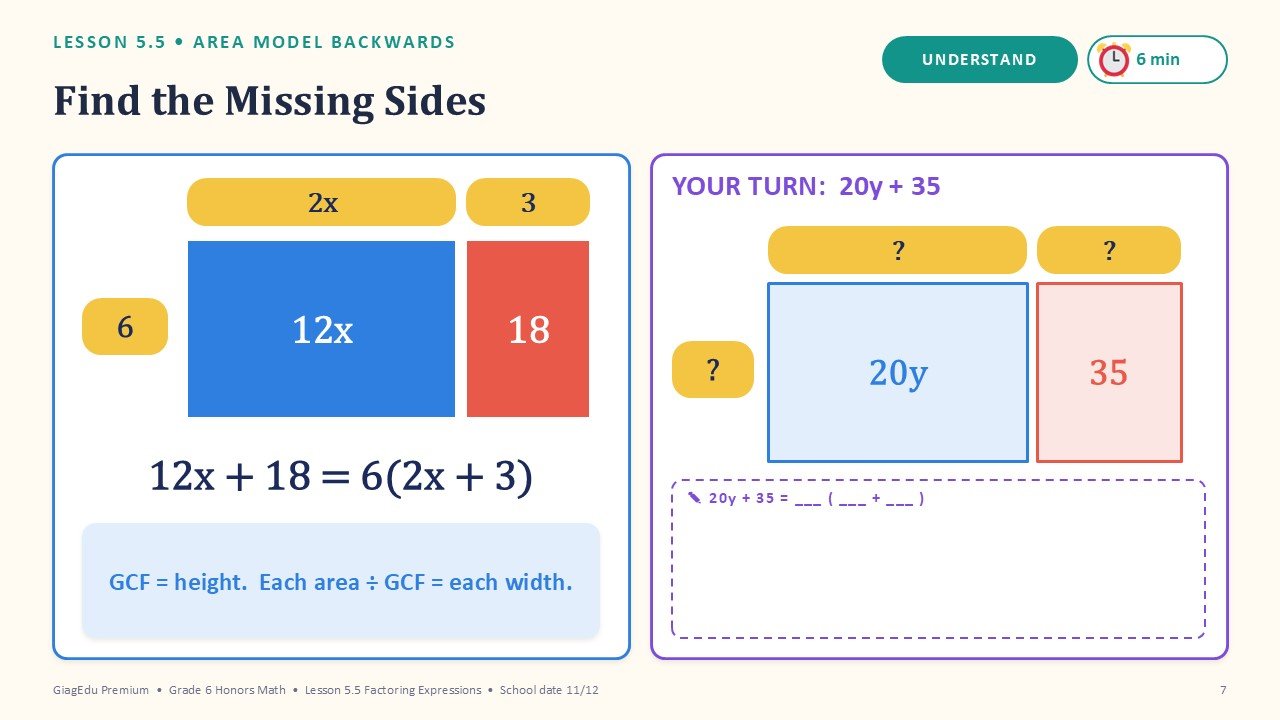
Factoring is distributing backwards: write an expression as a product.
- Find the GCF (greatest common factor) of the terms.
- Divide each term by the GCF.
- Write GCF( … ) and check by distributing.
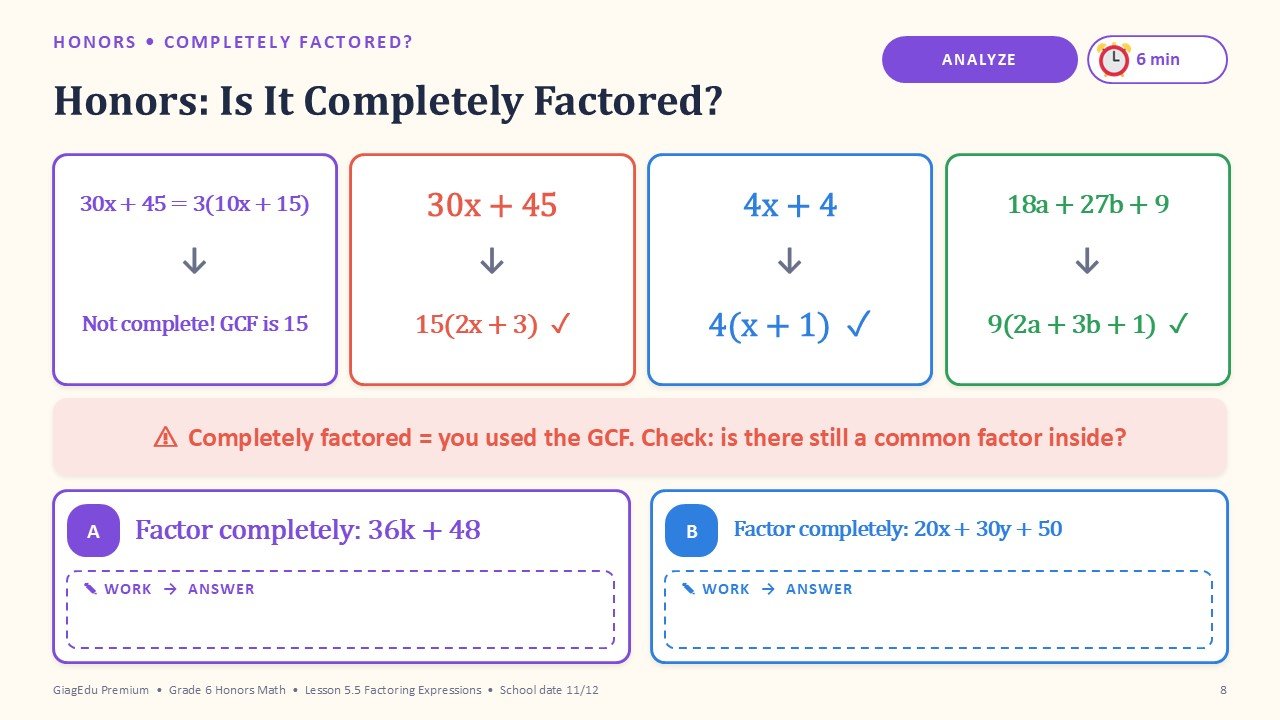
An expression is completely factored when you used the GCF and no common factor is left inside the brackets.
Common mistakes
- 5(x + 4) = 5x + 4. Multiply every term: 5x + 20.
- 3x + 2 + 4x = 9x. Only like terms combine: 7x + 2.
- "8 less than a number" written as 8 − n. It is n − 8.
- 5 + (x + 8) = 13x. 5 and 8 are constants and x is a variable: x + 13.
- 18x + 6 = 6(3x). Dividing 6 by 6 leaves 1: 6(3x + 1).
Practice
- Name the coefficient and the constant in 3x + 7.
- Evaluate 6m − 4 when m = 5.
- Evaluate a2 + b when a = 3 and b = 8.
- Write "9 more than the product of 4 and k".
- Simplify 4(2k + 3) + 5k.
- Factor completely: 36k + 48.
Answers: 1. Coefficient 3, constant 7 · 2. 26 · 3. 17 · 4. 4k + 9 · 5. 13k + 12 · 6. 12(3k + 4)
Videos
Practise Algebraic Expressions: 10 questions in study mode, with an explanation after each answer.
Start Practice