Vectors: Notation, Algebra, Magnitude, Unit Vectors and the Dot Product
Further Mathematics · Column and i–j notation, adding, subtracting and scaling vectors, position vectors, magnitude, unit vectors, the scalar (dot) product, the angle between vectors and the perpendicular test, with WAEC worked examples.
Why vectors matter
A pilot who knows only "fly 240 km" cannot find the missing hikers: they also need the direction. A vector has both magnitude (size) and direction. Vectors appear in almost every WAEC Further Maths paper, and all of mechanics is built on them.
- Scalars (magnitude only): mass, time, speed, distance, temperature, energy.
- Vectors (magnitude and direction): displacement, velocity, acceleration, force, momentum, weight.
Writing vectors
A vector is drawn as a directed line segment: the length shows the magnitude and the arrowhead shows the direction.
You will see these notations:
- AB with an arrow over it: the vector from A to B
- a bold or underlined letter: a or a̲
- column vector: (x over y), where x is the horizontal and y the vertical component
- i–j form: a = xi + yj (in 3-D, + zk), where i and j are unit vectors along the x- and y-axes
Adding and subtracting vectors
Add or subtract the matching components.
Geometrically, a + b follows the triangle law: place the tail of b at the head of a; the resultant runs from the tail of a to the head of b. To subtract, add the negative: a − b = a + (−b).
Scalar multiplication and parallel vectors
ka multiplies every component by k. If k > 0 the direction is unchanged; if k < 0 it is reversed; |k| scales the length.
Laws to quote: a + b = b + a (commutative); (a + b) + c = a + (b + c) (associative); k(a + b) = ka + kb (distributive).
Two vectors are parallel if one is a scalar multiple of the other: a = kb.
Position vectors
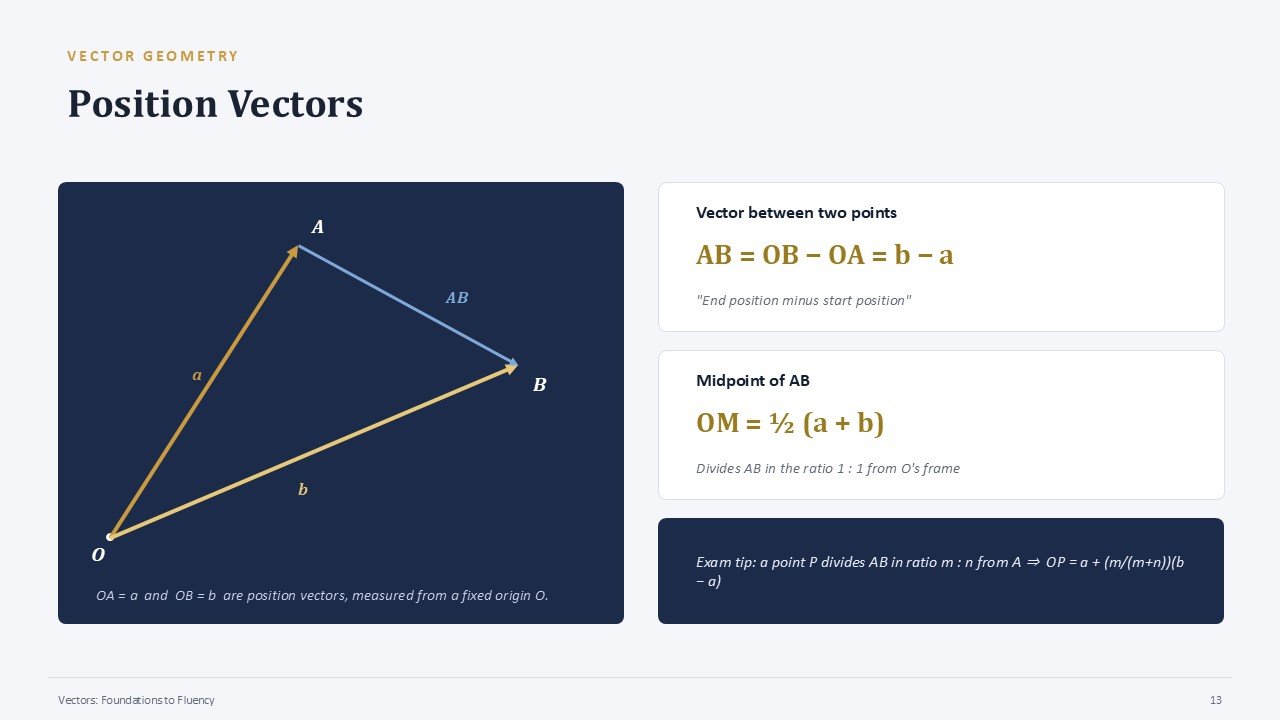
The position vector of a point is its vector from the origin O: OA = a, OB = b.
- AB = OB − OA = b − a ("end minus start")
- Midpoint M of AB: OM = ½(a + b)
- If P divides AB in the ratio m : n, then OP = a + (m/(m + n))(b − a)
Magnitude
- 2-D: if a = xi + yj, then |a| = √(x2 + y2)
- 3-D: if a = xi + yj + zk, then |a| = √(x2 + y2 + z2)
Unit vectors
A unit vector has magnitude 1 and shows direction only:
â = a ÷ |a|
The scalar (dot) product
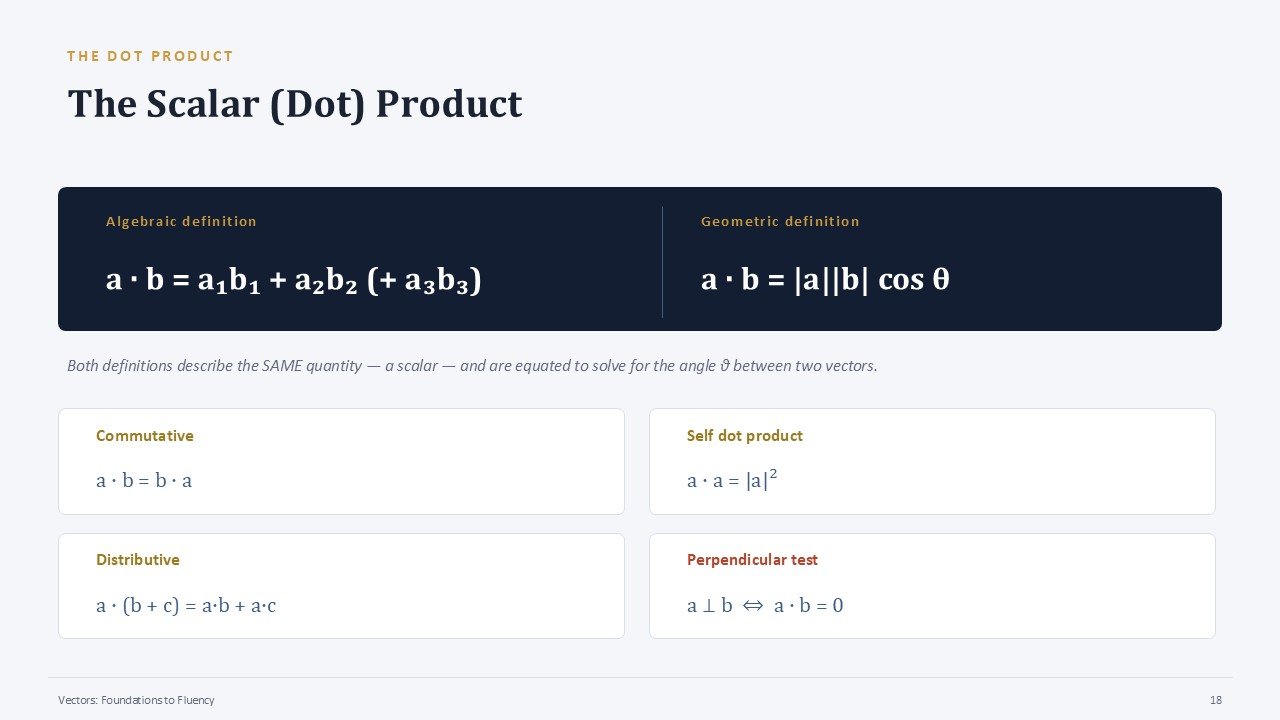
- Algebraic: a · b = a1b1 + a2b2 (+ a3b3)
- Geometric: a · b = |a||b| cos θ, where θ is the angle between the vectors
The dot product is a scalar (a number, not a vector).
Properties: a · b = b · a; a · a = |a|2; a · (b + c) = a · b + a · c. For unit vectors, i · i = j · j = 1 and i · j = 0.
Perpendicular test: a ⊥ b if and only if a · b = 0.
The angle between two vectors
cos θ = (a · b) ÷ (|a||b|)
A full WAEC-style question
Vector equation of a line (extension)
The line through the point with position vector a, in the direction b, is r = a + tb (t is any real number). Through two points A and B: r = a + t(b − a).
Common mistakes
- Subtracting the wrong way round: AB = b − a, not a − b.
- Sign errors when subtracting negative components.
- Forgetting to divide by the magnitude when finding a unit vector.
- Treating the dot product as a vector: it is a number.
Practice
- If a = 3i − 2j and b = i + 5j, find a − b and 2a − 3b.
- Find |a| if a = 6i − 8j.
- Are p = 2i + 3j and q = −3i + 2j perpendicular?
- A is (2, 3) and B is (5, 7). Find |AB|.
- Find the unit vector in the direction of 3i + 4j.
- Find the angle between i + j and i.
Answers: 1. a − b = 2i − 7j; 2a − 3b = 6i − 4j − 3i − 15j = 3i − 19j · 2. 10 · 3. p · q = −6 + 6 = 0, so yes · 4. AB = 3i + 4j, so |AB| = 5 · 5. 0.6i + 0.8j · 6. cos θ = 1/√2, so θ = 45°
Next class: Statics and Equilibrium.
Practise Vectors: 10 questions in study mode, with an explanation after each answer.
Start Practice