Sets: Notation, Types of Sets, Subsets, Set Operations and Venn Diagram Problems
Further Mathematics · What makes a collection a set, set notation and set-builder form, types of sets, subsets and power sets, union, intersection, complement and De Morgan's laws, and two- and three-set Venn diagram problems in the WAEC style.
Why study sets?
Sets are the language of sorting and grouping. A search engine that finds pages containing "WAEC" and "physics" is using an intersection; a playlist that combines two albums is a union. Databases, computer programs and probability all rest on sets, and almost every WAEC Further Mathematics paper has a Venn diagram question.
What is a set?
A set is a well-defined collection of distinct objects, called its elements (or members).
Well-defined means everyone can agree whether an object belongs. "Vowels of the English alphabet" is a set: A = {a, e, i, o, u}. "Beautiful houses" or "brilliant students" is not a set, because beauty and brilliance are opinions.
- Sets are named with capital letters and their elements are listed inside curly brackets { }.
- Each element is listed once: {1, 2, 2, 3} is just {1, 2, 3}.
- Order does not matter: {3, 1, 2} = {1, 2, 3}.
Set notation
- ∈ means "is an element of": 2 ∈ {2, 4, 6}.
- ∉ means "is not an element of": 9 ∉ {2, 4, 6}.
- n(A) is the cardinal number of A, the number of elements: if A = {2, 4, 6} then n(A) = 3.
- ∅ or { } is the empty set, and n(∅) = 0.
A set can contain another set as an element: if A = {1, 2, {3, 4}}, then {3, 4} ∈ A and n(A) = 3.
Three ways to describe a set
- Listing (roster) method: A = {2, 4, 6, 8}
- Description: A is the set of even numbers less than 10
- Set-builder notation: A = {x : x is an even number, x < 10}
Read the colon as "such that". Set-builder notation is the best way to describe large or infinite sets, for example {x : x ∈ ℝ, −2 ≤ x < 5}.
Types of sets
- Finite set: has a definite number of elements, e.g. {January, February, March}.
- Infinite set: never ends, e.g. the natural numbers {1, 2, 3, …}.
- Empty (null) set ∅: has no elements, e.g. months with 32 days.
- Singleton set: has exactly one element, e.g. {the smallest prime number} = {2}.
- Equal sets: contain exactly the same elements: {1, 2, 3} = {3, 2, 1}.
- Equivalent sets: have the same number of elements: {a, b, c} and {2, 4, 6} are equivalent but not equal.
- Universal set U (or ξ): contains every element under discussion, drawn as the rectangle in a Venn diagram.
- Disjoint sets: have no elements in common, so A ∩ B = ∅.
Subsets and power sets
A is a subset of B, written A ⊆ B, if every element of A is also in B. For example {2, 4} ⊆ {2, 4, 6, 8}.
A is a proper subset of B, written A ⊂ B, if A ⊆ B and A ≠ B (B has at least one extra element).
- The empty set is a subset of every set.
- Every set is a subset of itself, but not a proper subset of itself.
The power set P(A) is the set of all subsets of A. A set with n elements has:
- 2n subsets
- 2n − 1 proper subsets
Operations on sets
- Union A ∪ B: every element in A or B (or both). If A = {1, 2, 3} and B = {3, 4, 5}, then A ∪ B = {1, 2, 3, 4, 5}.
- Intersection A ∩ B: only the elements in both A and B. Here A ∩ B = {3}.
- Complement A′: the elements of U that are not in A.
- Difference A − B (= A ∩ B′): the elements in A but not in B. Here A − B = {1, 2}.
Laws of set algebra
- Commutative: A ∪ B = B ∪ A and A ∩ B = B ∩ A
- Associative: (A ∪ B) ∪ C = A ∪ (B ∪ C), and the same for ∩
- Distributive: A ∩ (B ∪ C) = (A ∩ B) ∪ (A ∩ C) and A ∪ (B ∩ C) = (A ∪ B) ∩ (A ∪ C)
- De Morgan's laws: (A ∪ B)′ = A′ ∩ B′ and (A ∩ B)′ = A′ ∪ B′
- Identities: A ∪ ∅ = A, A ∩ ∅ = ∅, A ∪ A = A, A ∩ A = A, A ∪ A′ = U, A ∩ A′ = ∅
Venn diagrams
In a Venn diagram the rectangle is the universal set and each circle is a set. Fill in a Venn diagram from the inside out: start with the region common to all the sets, then subtract.
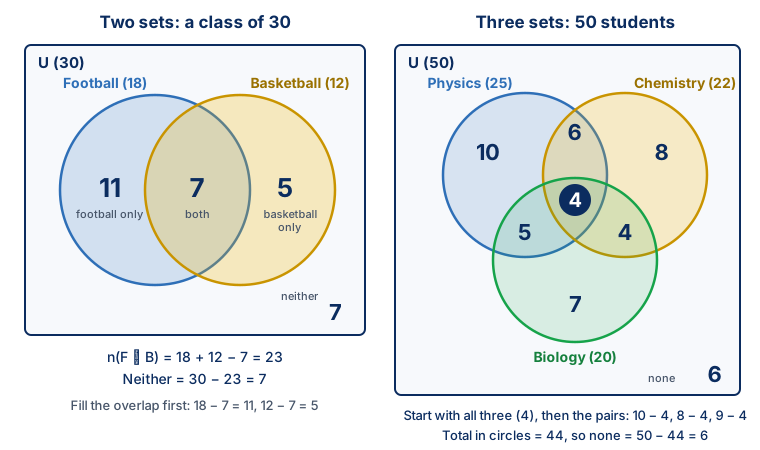
For two sets: n(A ∪ B) = n(A) + n(B) − n(A ∩ B)
For three sets: n(A ∪ B ∪ C) = n(A) + n(B) + n(C) − n(A ∩ B) − n(B ∩ C) − n(A ∩ C) + n(A ∩ B ∩ C)
When the number in a region is unknown, call it x, write every region in terms of x, then use the total.
Common mistakes
- Adding n(A) and n(B) without subtracting the overlap, so the middle region is counted twice.
- Filling the "Physics" circle with 25 straight away instead of starting from the centre.
- Forgetting the region outside all the circles (inside U).
- Mixing up ⊂ (proper subset) and ∈ (element of): 2 ∈ {1, 2} but {2} ⊂ {1, 2}.
- Saying a set with 4 elements has 8 subsets: it has 24 = 16.
Practice
- List the elements of {x : x is a factor of 18}.
- How many proper subsets has {p, q, r, s}?
- U = {1, 2, …, 10}, A = {x : x is odd} and B = {x : x is prime}. Find A ∩ B and (A ∪ B)′.
- If n(A) = 15, n(B) = 12 and n(A ∪ B) = 20, find n(A ∩ B).
- In a group of 60 people, 35 read newspaper X, 30 read newspaper Y and 10 read neither. How many read both?
- Which of these is a set: (a) tall students in your class, (b) even numbers between 1 and 9?
Answers: 1. {1, 2, 3, 6, 9, 18} · 2. 24 − 1 = 15 · 3. A ∩ B = {3, 5, 7}; A ∪ B = {1, 2, 3, 5, 7, 9}, so (A ∪ B)′ = {4, 6, 8, 10} · 4. 15 + 12 − 20 = 7 · 5. 60 − 10 = 50 read at least one, so both = 35 + 30 − 50 = 15 · 6. (b) only: "tall" is not well-defined
Next class: Binary Operations.
Practise Sets: 10 questions in study mode, with an explanation after each answer.
Start Practice