Projectile Motion: Time of Flight, Maximum Height and Range
Further Mathematics · Why horizontal and vertical motion are independent, resolving the launch velocity, the formulas for time of flight, greatest height and range, the 45° angle for maximum range, and horizontal projection, with WAEC worked examples.
What is a projectile?
A projectile is a body moving under gravity alone after it has been launched: a kicked football, a thrown stone, a bullet. Its path is a curve called a parabola.

- Angle of projection (θ): the angle between the initial velocity and the horizontal
- Time of flight (T): the total time in the air
- Maximum (greatest) height (H): the highest point reached
- Range (R): the horizontal distance travelled when it lands
The big idea: horizontal and vertical are independent
Gravity acts only vertically. It never speeds up or slows down the horizontal motion. So we treat the two directions separately:
Horizontal (no acceleration):
- ux = u cos θ, which stays constant
- x = ux t
Vertical (acceleration g downwards):
- uy = u sin θ
- vy = uy − gt
- y = uyt − ½gt2
The three projectile formulas
For launch speed u at angle θ, landing at the same height:
- Time of flight: T = 2u sin θ / g
- Maximum height: H = u2 sin2 θ / 2g
- Range: R = u2 sin 2θ / g
Which angle gives the greatest range?
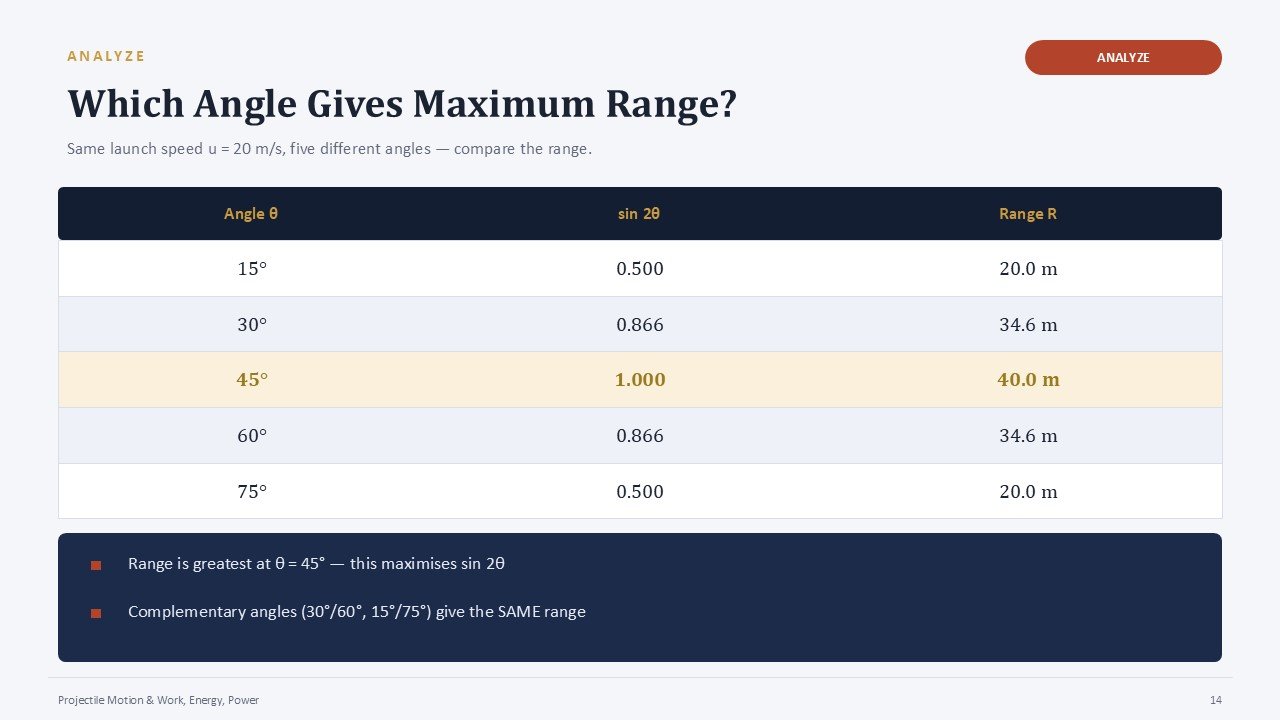
- R = u2 sin 2θ / g is greatest when sin 2θ = 1, i.e. θ = 45°. Then Rmax = u2/g.
- Complementary angles (such as 30° and 60°) give the same range, but the larger angle goes higher and stays in the air longer.
Horizontal projection
If a body is launched horizontally (θ = 0) from a height h, then uy = 0:
- time to fall: h = ½gt2
- horizontal distance: x = ut
Velocity at any time
At time t: vx = u cos θ and vy = u sin θ − gt. The speed is √(vx2 + vy2), at angle tan−1(vy/vx) to the horizontal.
Common mistakes
- Applying g to the horizontal motion: horizontally, a = 0.
- Using the range formula when the projectile lands at a different height from where it started: use the component equations instead.
- Saying the velocity is zero at the top: only the vertical part is zero.
- Forgetting that sin 2θ means sin(2θ), not 2 sin θ.
Practice
- A ball is launched at 12 m/s at 45°. Find its time of flight (g = 10 m/s2).
- For u = 25 m/s and θ = 30°, find T, H and R (g = 10 m/s2).
- For u = 40 m/s and θ = 60°, find T, H and R (g = 10 m/s2).
- Find the maximum possible range for a launch speed of 30 m/s (g = 10 m/s2).
- A stone is thrown horizontally at 8 m/s from a cliff 20 m high. How far from the foot of the cliff does it land? (g = 10 m/s2)
Answers: 1. T = 2 × 12 × 0.707/10 ≈ 1.70 s · 2. T = 2.5 s, H ≈ 7.81 m, R ≈ 54.1 m · 3. T ≈ 6.93 s, H = 60 m, R ≈ 138.6 m · 4. Rmax = u2/g = 90 m · 5. 20 = 5t2, so t = 2 s and x = 16 m
Previous topic: Momentum and Impulse · Next class: Work, Energy and Power.
Practise Projectile Motion: 10 questions in study mode, with an explanation after each answer.
Start Practice