Probability Distributions: Laws of Probability, Expectation and Variance, Binomial and Normal Distributions
Further Mathematics · The complement, addition, multiplication and conditional laws; random variables with E(X) and Var(X); the binomial distribution with its mean np and variance npq; and the normal distribution with z-scores and tables, with WAEC and UTME worked examples.
Toss 3 coins: a first distribution
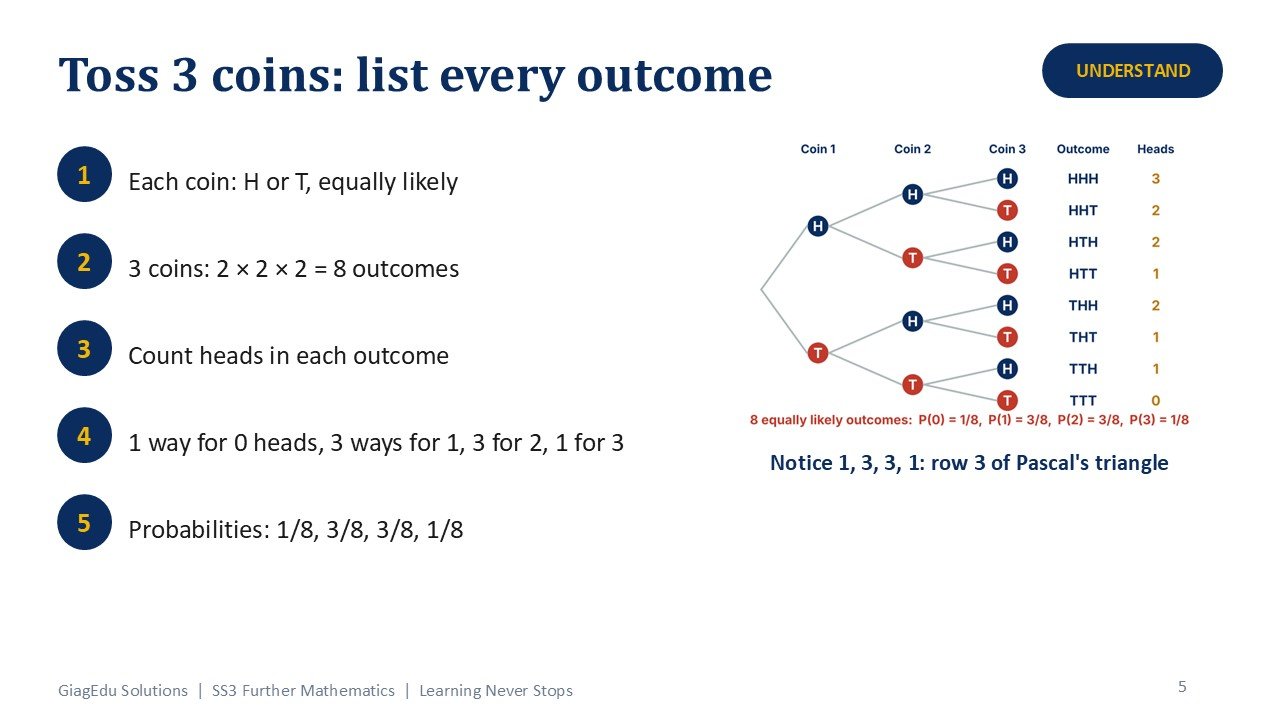
Each coin is H or T, so 3 coins give 2 × 2 × 2 = 8 equally likely outcomes. Counting heads gives 1, 3, 3, 1 ways for 0, 1, 2, 3 heads, so the probabilities are 1/8, 3/8, 3/8, 1/8. Those counts are row 3 of Pascal's triangle.
Laws of probability
- 0 ≤ P(A) ≤ 1, and all the probabilities in a sample space add up to 1.
- Complement: P(not A) = 1 − P(A).
- Mutually exclusive (cannot happen together): P(A or B) = P(A) + P(B).
- General addition: P(A ∪ B) = P(A) + P(B) − P(A ∩ B).
- Independent: P(A and B) = P(A) × P(B).
- Conditional: P(A | B) = P(A ∩ B) ÷ P(B).
- Without replacement, the second probability changes.
Random variables, expectation and variance
- E(X) = Σx P(x): the long-run average.
- Var(X) = E(X2) − [E(X)]2, and the standard deviation is √Var(X).
- Use ΣP = 1 to find an unknown probability.
The binomial distribution
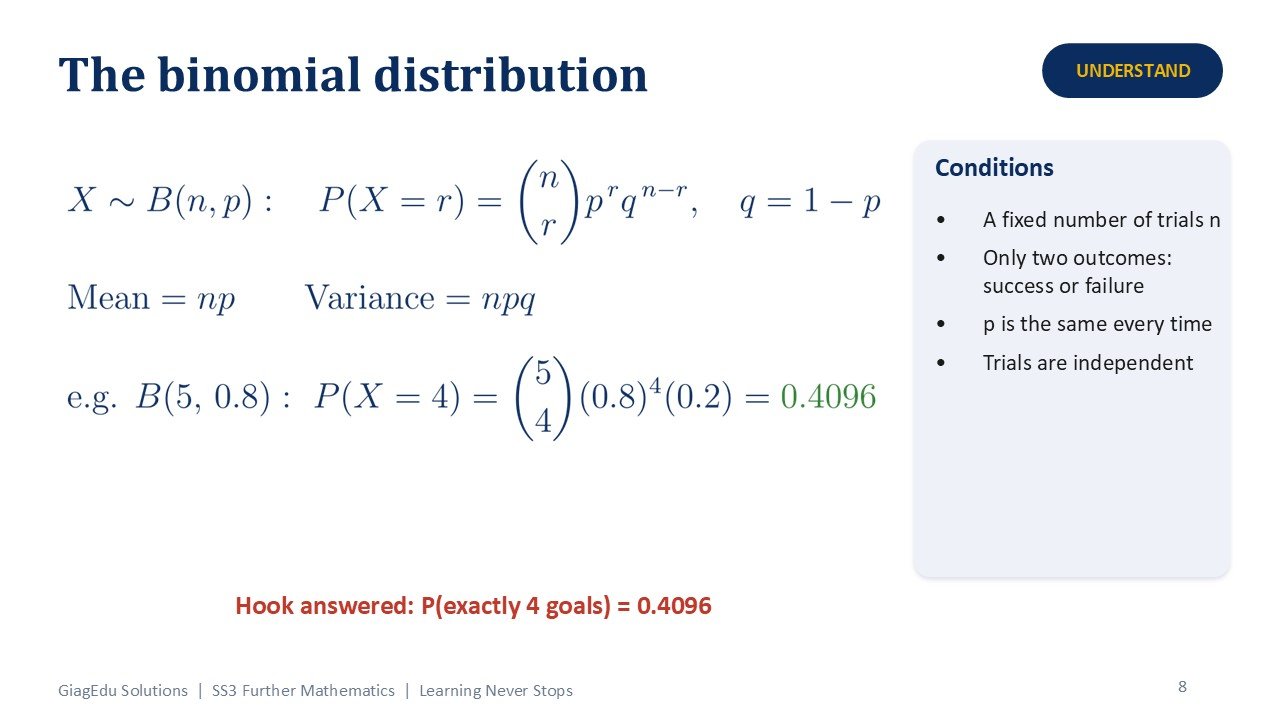
Use the binomial distribution when there is a fixed number of trials n, only two outcomes (success or failure), the same probability p every time, and independent trials.
P(X = r) = ⁿCr pr qn − r, where q = 1 − p. The mean is np and the variance is npq.
The normal distribution
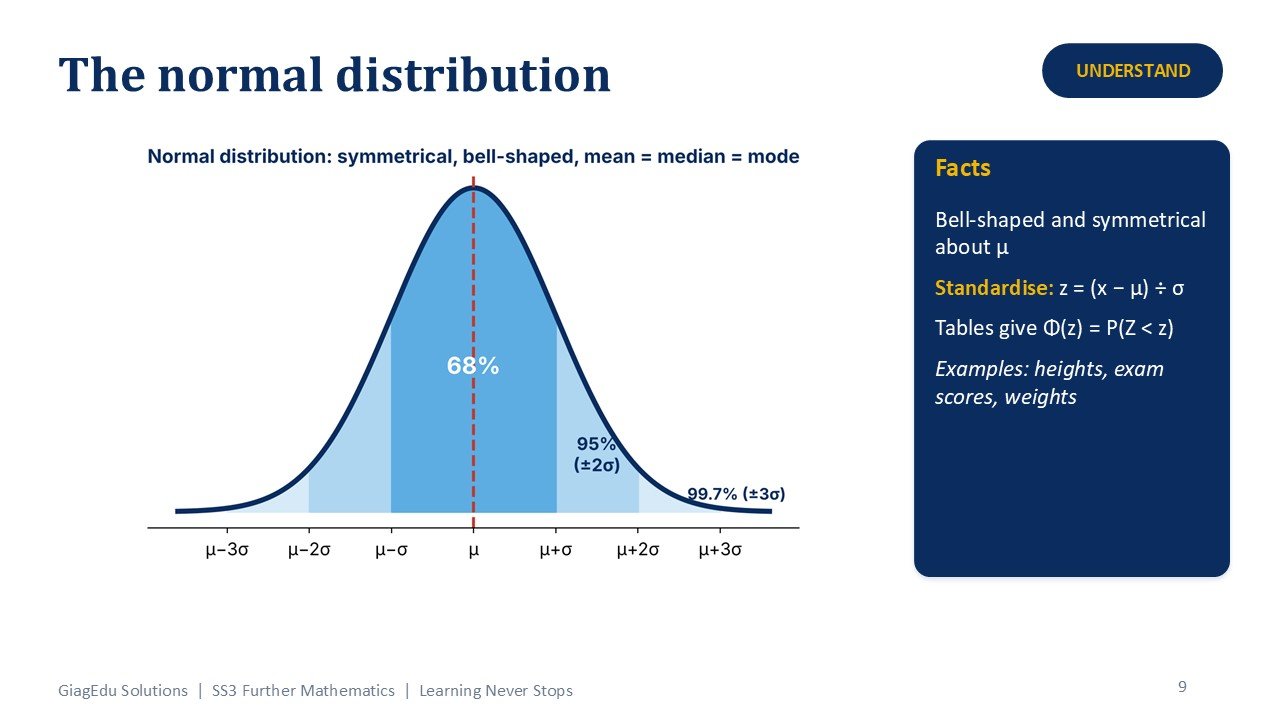
- Bell-shaped and symmetrical about the mean μ.
- About 68% of values lie within 1σ of the mean, 95% within 2σ and 99.7% within 3σ.
- Standardise: z = (x − μ) ÷ σ, then read Φ(z) = P(Z < z) from the table.
- P(X > a) = 1 − Φ(z).
Marks students lose
- Adding probabilities for independent "and" events: AND means multiply.
- Leaving ⁿCr out of the binomial formula.
- Not checking that ΣP = 1.
- Writing Var(X) = E(X2) − E(X): the mean must be squared.
- Taking P(X > a) as Φ(z): it is 1 − Φ(z).
- Working out "at least one" the long way instead of 1 − P(none).
Practice
- A and B are mutually exclusive with P(A) = 0.3 and P(B) = 0.4. Find P(A or B).
- Two fair coins are tossed. Find P(two heads).
- Find the mean of X ~ B(10, 0.4).
- Two dice are thrown. Find the probability of a total of 7.
- X ~ B(4, 0.5). Find P(X = 2).
- X is normal with μ = 60 and σ = 5. Find the z-score of 70.
- The probability that a student passes is 0.6. Five students sit the exam. Find the probability that exactly 3 pass.
Answers: 1. 0.7 · 2. ¼ · 3. 10 × 0.4 = 4 · 4. 6/36 = 1/6 · 5. ⁴C2(0.5)4 = 6/16 = 0.375 · 6. (70 − 60) ÷ 5 = 2 · 7. ⁵C3(0.6)3(0.4)2 = 10 × 0.216 × 0.16 = 0.3456
This completes the five-class Further Maths exam series. Take a timed Further Maths practice test on giagedu.site to check everything together.
Practise Probability Distributions: 10 questions in study mode, with an explanation after each answer.
Start Practice