Permutation, Combination and the Binomial Theorem: Counting, nPr, nCr and (a + b)ⁿ
Further Mathematics · Factorials and the counting principle, when to use nPr or nCr, arrangements with repeated letters, blocks and round tables, the binomial theorem, the general term, the term independent of x and binomial approximations, with WAEC and UTME worked examples.
Counting: factorials and the counting principle
Counting principle: if one task can be done in m ways and a second in n ways, both can be done in m × n ways. For example, 3 shirts and 4 trousers give 3 × 4 = 12 outfits.
n factorial: n! = n × (n − 1) × … × 2 × 1. So 4! = 24, 5! = 120 and 6! = 6 × 5! = 720.
Permutation or combination?

- Permutation (order matters): ⁿPr = n! ÷ (n − r)!. Key words: arrange, order, rank, positions.
- Combination (order does not matter): ⁿCr = n! ÷ [r!(n − r)!]. Key words: choose, select, committee, team.
- Link: ⁿPr = r! × ⁿCr, and ⁿCr = ⁿCn − r (symmetry).
Arrangements with conditions
- Repeated items: divide by the factorial of each repeat. ABUJA has 5 letters with A twice: 5! ÷ 2! = 60.
- Items that must be together: treat them as one block, then multiply by their own arrangements. 2 friends together in a row of 8: 2 × 7!
- Items that must NOT be together: total − together = 8! − 2 × 7!
- Round a table: (n − 1)! arrangements. 4 people: 3! = 6.
- "At least one": total − none.
Worked examples: permutations and combinations
The binomial theorem
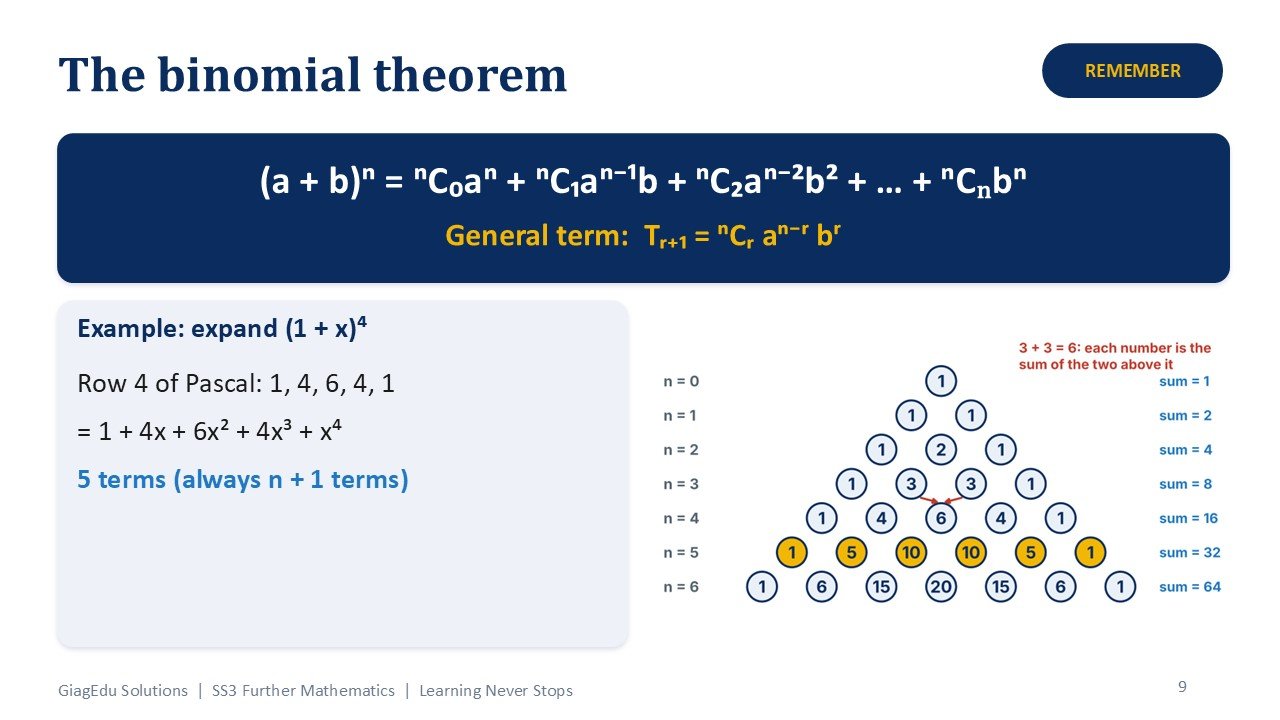
(a + b)n = ⁿC0an + ⁿC1an − 1b + ⁿC2an − 2b2 + … + ⁿCnbn
- There are always n + 1 terms.
- The coefficients are row n of Pascal's triangle: row 4 is 1, 4, 6, 4, 1, so (1 + x)4 = 1 + 4x + 6x2 + 4x3 + x4.
- The coefficients add up to 2n (put x = 1).
- General term: Tr + 1 = ⁿCr an − r br. The 1st term has r = 0, so the 4th term has r = 3.
The term independent of x
Write the general term, collect the powers of x, and set the power equal to 0.
Marks students lose
- Using ⁿPr for a committee or team: selecting a group is ⁿCr.
- Writing (2x)3 = 2x3: raise the number too, (2x)3 = 8x3.
- Dropping the minus sign in (a − b)n: the signs alternate + − + −.
- Using r = 4 for the 4th term: Tr + 1 means the 4th term uses r = 3.
- Forgetting to divide by p! for repeated letters.
- Writing 0! = 0: it is 1.
Practice
- Evaluate ⁵P2.
- Evaluate ⁶C2 and ¹⁰C8.
- How many arrangements of the letters of BANANA are there?
- In how many ways can 4 people sit round a table?
- Find the 4th term of (1 + x)7.
- Find the coefficient of x2 in (1 + 3x)5.
- A committee of 3 is chosen from 6 men and 4 women. How many include at least one woman?
Answers: 1. 5 × 4 = 20 · 2. 15 and 45 · 3. 6! ÷ (3! × 2!) = 60 · 4. 3! = 6 · 5. ⁷C3x3 = 35x3 · 6. ⁵C2 × 32 = 10 × 9 = 90 · 7. ¹⁰C3 − ⁶C3 = 120 − 20 = 100
Next class: Matrices and Determinants.
Practise Permutation, Combination & Binomial Theorem: 10 questions in study mode, with an explanation after each answer.
Start Practice