Matrices and Determinants: Operations, Determinants, Inverses, Simultaneous Equations and Transformations
Further Mathematics · Order and types of matrices, addition and row-by-column multiplication, 2 × 2 and 3 × 3 determinants, the inverse of a 2 × 2 matrix, solving simultaneous equations with X = A⁻¹B, and linear transformations with the area scale factor, with WAEC and UTME worked examples.
What is a matrix?
A matrix is an organised table of numbers in rows and columns.
(In these notes a matrix is written row by row, with / between rows: (3 2 / 1 4) has first row 3, 2 and second row 1, 4.)
Order and types
- Order = rows × columns (m × n). Always say rows first.
- Square matrix: m = n.
- Identity matrix I: 1s on the leading diagonal, 0s elsewhere, e.g. (1 0 / 0 1). AI = IA = A.
- Transpose AT: rows become columns. The transpose of (1 2 / 3 4) is (1 3 / 2 4).
- Equal matrices: same order and the same entries in the same places.
Operations
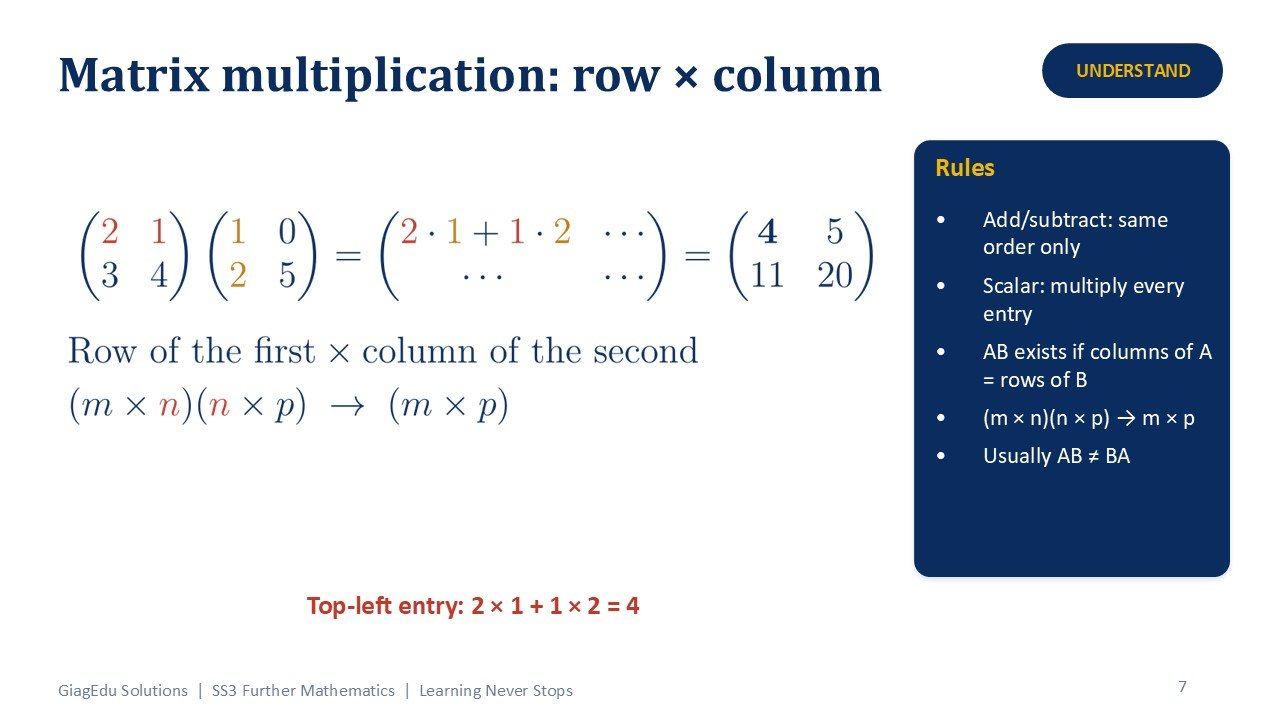
- Add or subtract: only matrices of the same order; work entry by entry.
- Scalar multiplication: multiply every entry.
- Matrix multiplication: AB exists only if the number of columns of A = rows of B. (m × n)(n × p) gives an m × p matrix. Each entry is a row of the first × column of the second.
- In general AB ≠ BA, so the order matters.
Determinants
- For A = (a b / c d): |A| = ad − bc.
- For a 3 × 3 matrix, expand along row 1 with the sign pattern + − +.
- If |A| = 0 the matrix is singular and has no inverse.
The inverse of a 2 × 2 matrix
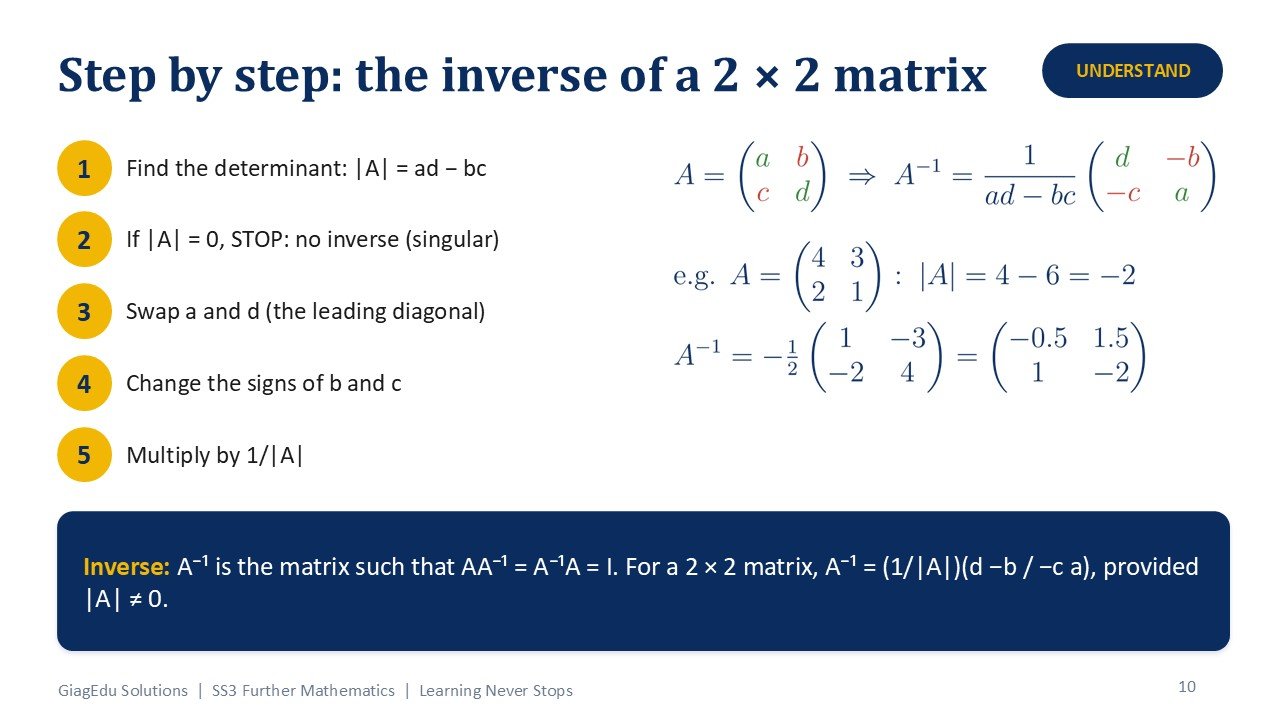
For A = (a b / c d), A−1 = (1/|A|)(d −b / −c a), provided |A| ≠ 0. Then AA−1 = A−1A = I.
Solving simultaneous equations
Write the equations as AX = B, then X = A−1B (the inverse goes on the left).
Linear transformations
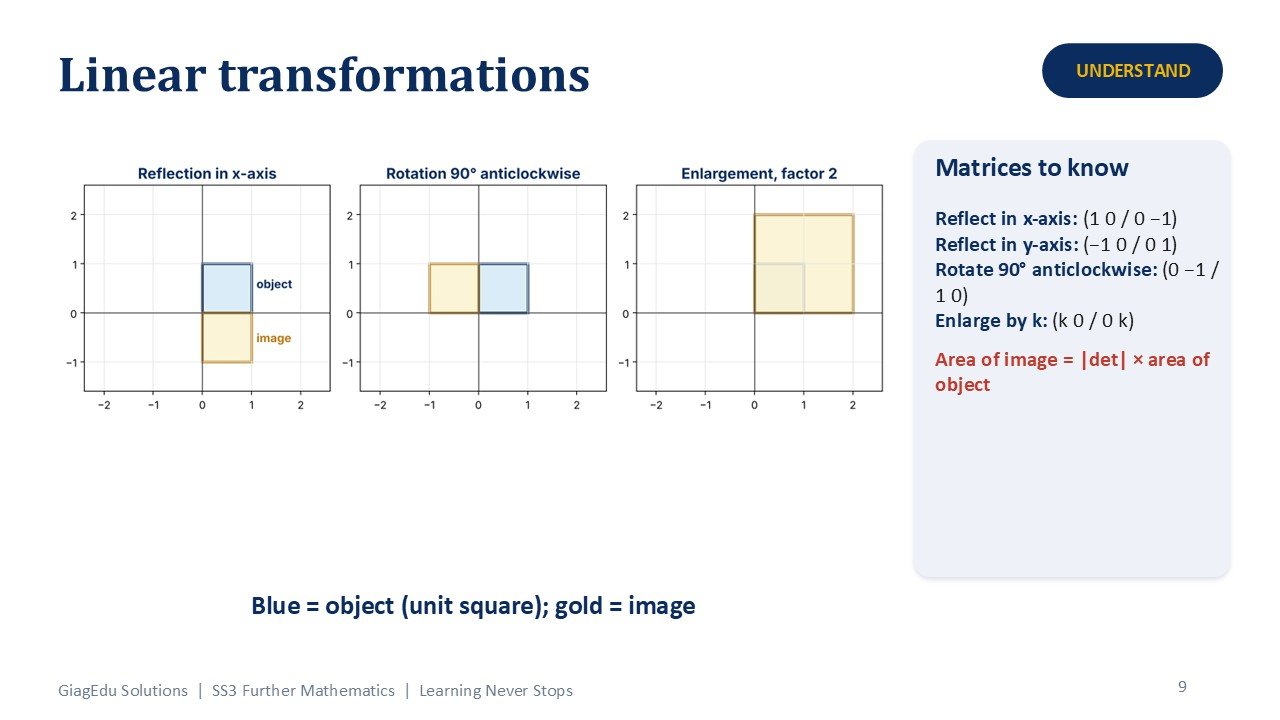
- Reflection in the x-axis: (1 0 / 0 −1)
- Reflection in the y-axis: (−1 0 / 0 1)
- Rotation of 90° anticlockwise: (0 −1 / 1 0)
- Enlargement by scale factor k: (k 0 / 0 k)
- Area of image = |det M| × area of object
Marks students lose
- Multiplying entry by entry instead of row × column.
- Adding matrices of different orders.
- Writing |A| = ad + bc: it is ad − bc.
- Forgetting the 1/|A| in the inverse.
- Using + + + signs when expanding a 3 × 3 determinant: the pattern is + − +.
- Writing X = BA−1: it must be X = A−1B.
Practice
- What is the order of the product of a 2 × 3 matrix and a 3 × 1 matrix?
- Find the determinant of (4 2 / 3 5).
- If (x 2 / 4 8) is singular, find x.
- Find the inverse of (4 7 / 1 2).
- Find the determinant of the diagonal matrix (1 0 0 / 0 2 0 / 0 0 3).
- Given P = (2 3 / 1 4), find P−1 and hence solve 2x + 3y = 12 and x + 4y = 11.
Answers: 1. 2 × 1 · 2. 20 − 6 = 14 · 3. 8x − 8 = 0, x = 1 · 4. |A| = 1, so (2 −7 / −1 4) · 5. 1 × 2 × 3 = 6 · 6. |P| = 5, P−1 = (1/5)(4 −3 / −1 2); x = (48 − 33) ÷ 5 = 3, y = (−12 + 22) ÷ 5 = 2
Next class: Differentiation and its applications.
Practise Matrices & Determinants: 10 questions in study mode, with an explanation after each answer.
Start Practice