Coordinate Geometry and Conic Sections: Lines, Circles, Parabola, Ellipse and Hyperbola
Further Mathematics · Gradient, parallel and perpendicular lines and the perpendicular distance from a point to a line; the equation of a circle and finding its centre and radius; the parabola's focus and directrix; the ellipse, hyperbola and eccentricity, with WAEC and UTME worked examples.
Conics all around us
Slicing a cone at different angles gives four curves, the conic sections:
- Circle: a wheel or a roundabout.
- Ellipse: a planet's orbit or a stadium track.
- Parabola: a kicked football or a satellite dish.
- Hyperbola: the outline of a cooling tower.
The straight-line toolkit
- Distance between (x1, y1) and (x2, y2): √[(x2 − x1)2 + (y2 − y1)2]
- Midpoint: ((x1 + x2)/2, (y1 + y2)/2)
- Gradient m = (y2 − y1) ÷ (x2 − x1)
- y = mx + c has gradient m and y-intercept c; ax + by + c = 0 has gradient m = −a/b
- Parallel lines have the same gradient. Perpendicular lines have m1 × m2 = −1.
- Perpendicular distance from (x1, y1) to ax + by + c = 0: |ax1 + by1 + c| ÷ √(a2 + b2)
The circle
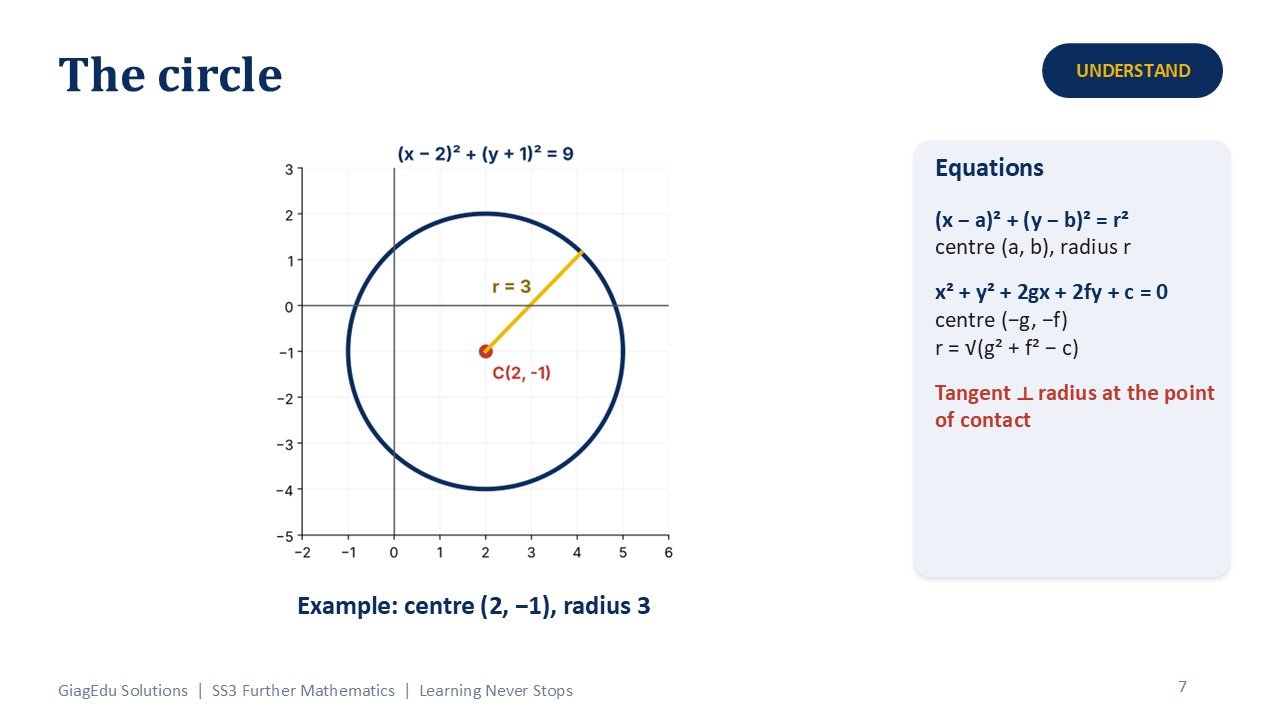
- (x − a)2 + (y − b)2 = r2 has centre (a, b) and radius r.
- x2 + y2 + 2gx + 2fy + c = 0 has centre (−g, −f) and radius √(g2 + f2 − c).
- A tangent is perpendicular to the radius at the point of contact.
The parabola
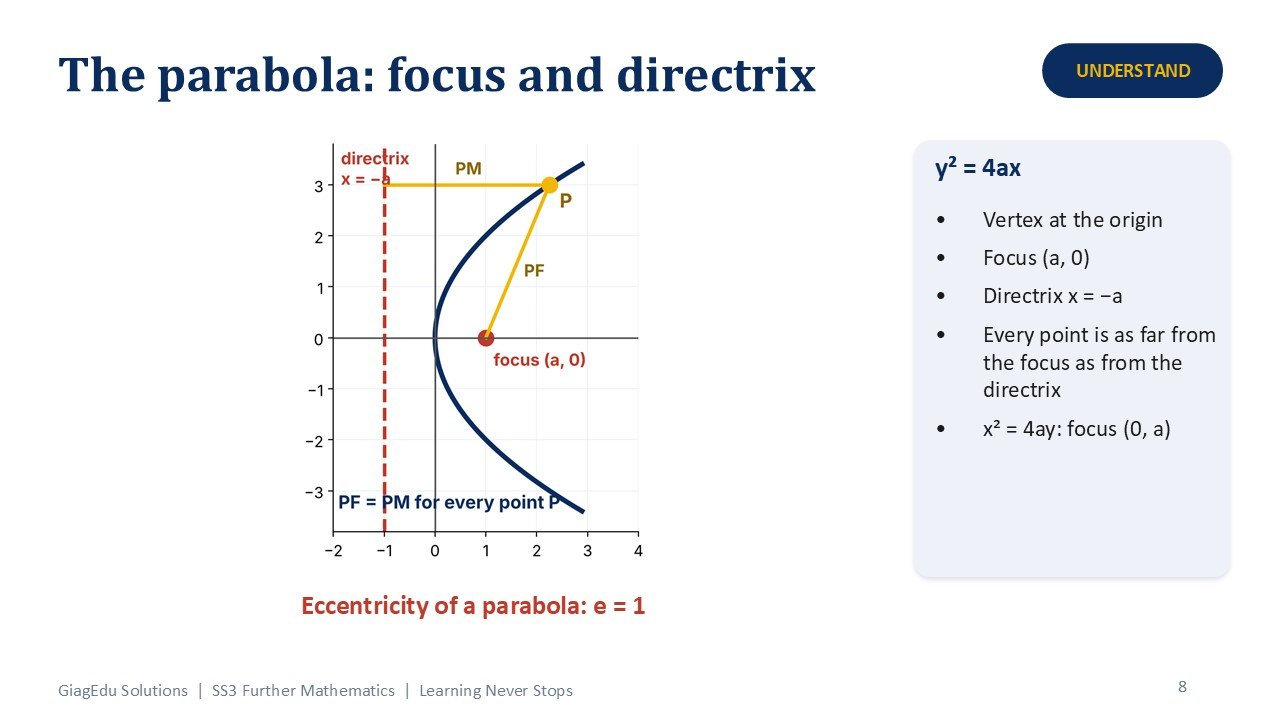
- y2 = 4ax: vertex at the origin, focus (a, 0), directrix x = −a.
- x2 = 4ay: focus (0, a), directrix y = −a.
- Every point on a parabola is the same distance from the focus as from the directrix, so its eccentricity is e = 1.
Ellipse, hyperbola and eccentricity
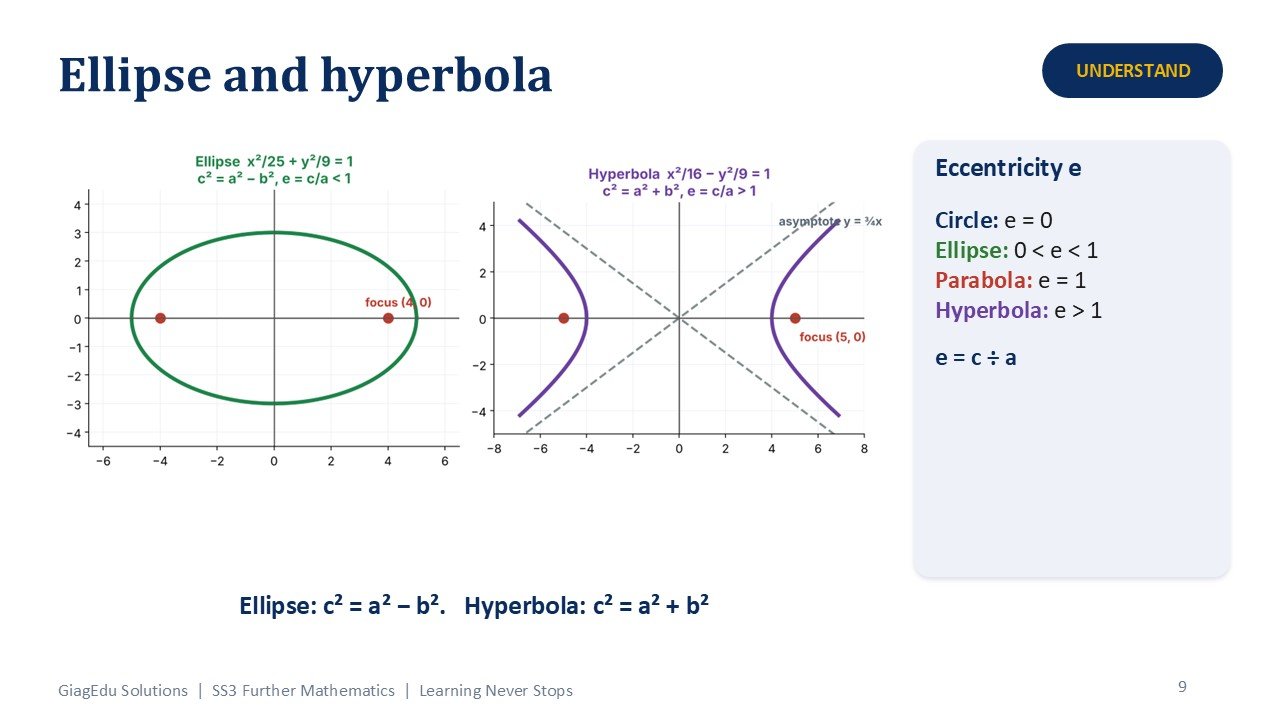
- Ellipse x2/a2 + y2/b2 = 1 (a > b): c2 = a2 − b2, foci (±c, 0), e = c/a.
- Hyperbola x2/a2 − y2/b2 = 1: c2 = a2 + b2, foci (±c, 0), e = c/a, asymptotes y = ±(b/a)x.
- Eccentricity: circle e = 0, ellipse e < 1, parabola e = 1, hyperbola e > 1.
Marks students lose
- Reading the centre of (x − 3)2 + … as (−3, …): the signs flip, so x = 3.
- Giving r2 as the radius: r2 = 16 means r = 4.
- Using −m for the perpendicular gradient: it is −1/m.
- Putting the focus of y2 = 12x at (12, 0): 4a = 12, so a = 3.
- Using c2 = a2 + b2 for an ellipse.
- Leaving out the absolute value in the distance formula: distance is never negative.
Practice
- Find the distance between (−1, 2) and (2, 6).
- Find the midpoint of (−2, 3) and (4, −1).
- Find the centre of x2 + y2 − 6x + 4y − 3 = 0.
- Find the gradient of a line perpendicular to 3x + y = 7.
- Find the focus of y2 = 8x.
- Find the centre and radius of x2 + y2 + 6x − 8y = 0.
- Find the eccentricity of 4x2 + 9y2 = 36.
Answers: 1. √(9 + 16) = 5 · 2. (1, 1) · 3. (3, −2) · 4. The line has m = −3, so ⅓ · 5. a = 2, (2, 0) · 6. (x + 3)2 + (y − 4)2 = 25: centre (−3, 4), radius 5 · 7. x2/9 + y2/4 = 1, c2 = 9 − 4 = 5, e = √5/3 ≈ 0.745
Next class: Probability Distributions.
Check your understanding
Practise Coordinate Geometry & Conic Sections: 10 questions in study mode, with an explanation after each answer.
Start Practice