Binary Operations: Closure, Commutative, Associative and Distributive Laws, Identity and Inverse
Further Mathematics · How to evaluate a binary operation, test it for closure, commutativity, associativity and distributivity, find the identity element and inverses by algebra, and read all of these from an operation (Cayley) table, with WAEC worked examples.
What is a binary operation?
A binary operation on a set S is a rule that takes two elements of S and combines them to give one result. Addition, subtraction and multiplication of numbers are binary operations. In exams, new operations are defined with symbols such as ∗, ∘, ⊕ or Δ.
The properties (laws) at a glance
- Closure: a ∗ b is always in S. 🔒
- Commutative: a ∗ b = b ∗ a. The order changes. 🔄 Swap
- Associative: (a ∗ b) ∗ c = a ∗ (b ∗ c). The grouping changes, never the order. 🧩 Group
- Distributive (∗ over +): a ∗ (b + c) = (a ∗ b) + (a ∗ c). The outside element spreads over the bracket. 🎯 Spread
- Identity element e: a ∗ e = e ∗ a = a for every a.
- Inverse a−1: a ∗ a−1 = a−1 ∗ a = e.
Closure
S is closed under ∗ if combining any two elements of S always gives an element of S.
- The whole numbers are closed under + and ×, but not under − (3 − 5 = −2 is not a whole number).
- The integers are not closed under ÷ (1 ÷ 2 is not an integer).
Commutative law
Associative law
Subtraction is a classic trap: (8 − 5) − 2 = 1 but 8 − (5 − 2) = 5, so subtraction is not associative (and not commutative either).
Distributive law
Ordinary multiplication is distributive over addition: 3(4 + 5) = 3(4) + 3(5) = 27.
Finding the identity element
Solve a ∗ e = a for e. The identity must be a single number that does not depend on a.
Finding inverses
Solve a ∗ a−1 = e, using the identity you have just found.
Operation (Cayley) tables
A finite set can be shown in a table: the entry in row a and column b is a ∗ b.
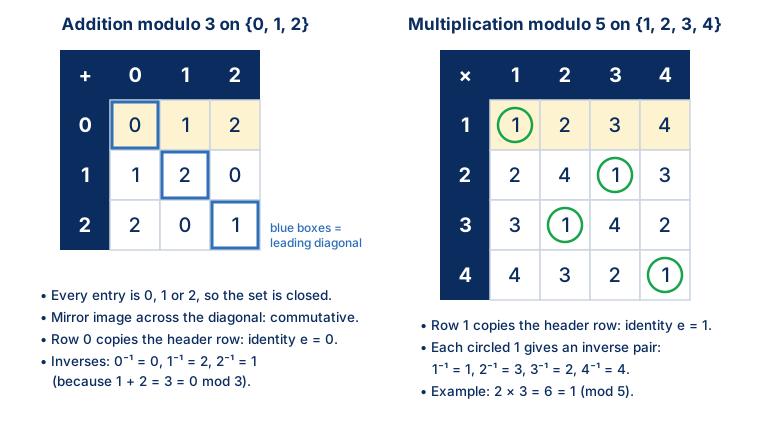
How to read a table:
- Closed? Every entry is a member of the set.
- Commutative? The table is a mirror image across the leading diagonal (top-left to bottom-right).
- Identity? Find the row that copies the header row exactly: the element at the start of that row is e.
- Inverses? Find where e appears in each row; the column heading is that element's inverse.
Common mistakes
- Working left to right instead of doing the bracket first.
- "Proving" a law with one example: use letters to prove, one counter-example to disprove.
- Giving an identity that contains a, such as e = a/(1 + a): that is not an identity.
- Forgetting to state the value(s) with no inverse (where the denominator is zero).
- Moving the order in the associative test: only the brackets move.
Practice
- a ∗ b = 3a − 2b. Find (4 ∗ 2) ∗ 1.
- Is a ∗ b = a + b + 5 commutative? Is it associative?
- Find the identity element and the inverse of a for a ∗ b = a + b + 5.
- For a ∗ b = 2ab on the non-zero real numbers, find the identity and the inverse of 3.
- Is a ∗ b = a − b + ab commutative? Give a reason.
- In multiplication modulo 5, solve 2 ⊗ x = 4.
Answers: 1. 4 ∗ 2 = 12 − 4 = 8, then 8 ∗ 1 = 24 − 2 = 22 · 2. Yes and yes: (a ∗ b) ∗ c = a ∗ (b ∗ c) = a + b + c + 10 · 3. a + e + 5 = a, so e = −5; a + a−1 + 5 = −5, so a−1 = −10 − a · 4. 2ae = a gives e = ½; 2(3)x = ½ gives x = 1/12 · 5. No: 2 ∗ 1 = 2 − 1 + 2 = 3 but 1 ∗ 2 = 1 − 2 + 2 = 1 · 6. x = 2 (2 × 2 = 4)
Next class: Mathematical Induction.
Practise Binary Operations: 10 questions in study mode, with an explanation after each answer.
Start Practice