Reading Comprehension (Grade 5): Three Nature Stories with Text Evidence
English Language Arts · Three original GiagEdu stories, "Kofi and the Coral Garden", "Ama and the Treetop Walk" and "Wings in the Garden", with background words, comprehension questions (recall, word clues, cause and effect, inference, theme) and the RACE method for answering with text evidence.
How to read for understanding
Good readers ask questions as they read and prove their answers with words from the text. For each story, look for:
- Recall: facts stated in the text.
- Word clues: nearby words that explain a new word.
- Cause and effect: what happened and why.
- Inference: what the author hints at but does not say.
- Theme: the lesson the story teaches.
Answer the RACE way: Restate the question, Answer it, Cite evidence from the text ("In the text it says…"), and Explain how the evidence proves your answer.
Story 1: Kofi and the Coral Garden
Kofi pressed his mask to his face and floated above the reef. Below him, the water was teeming with life. Yellow fish darted between pink and orange corals, and a sea turtle glided past like a slow green kite. The reef seemed vast, stretching farther than he could see.
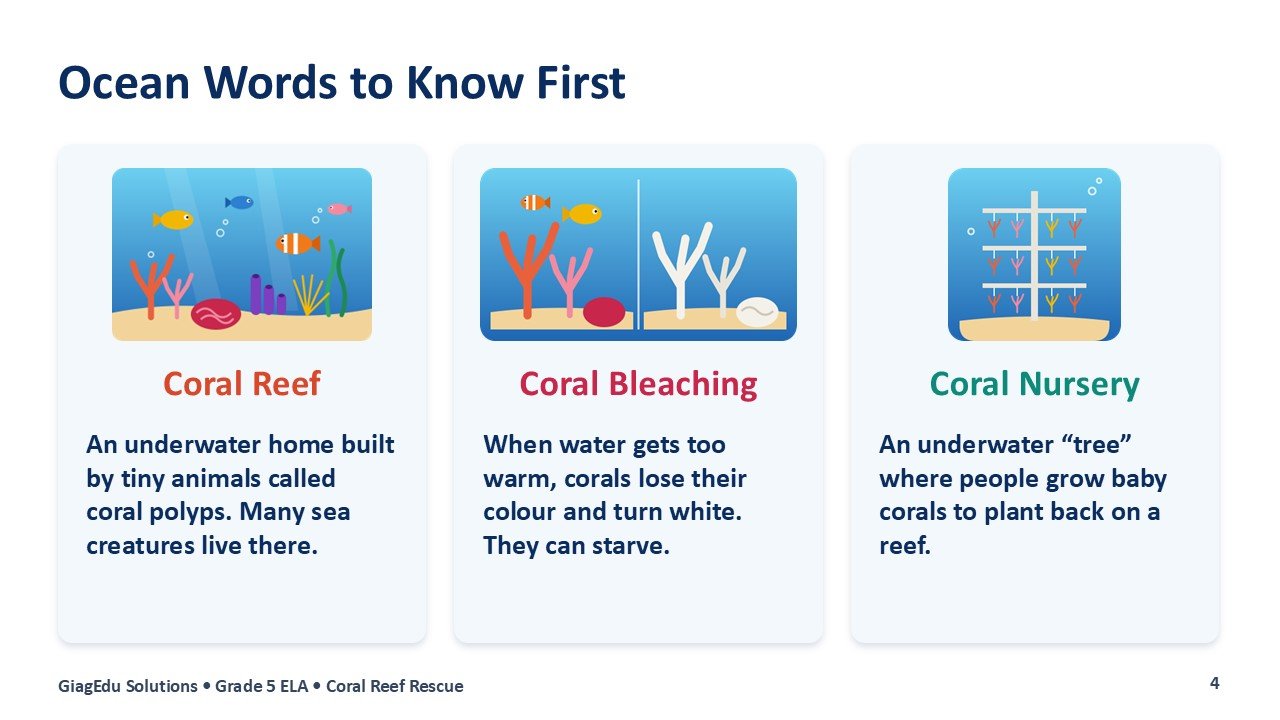
"Did you know corals are animals?" asked Aunt Esi, a marine biologist. "Each coral is made of tiny creatures called polyps. Reefs cover less than one percent of the ocean floor, yet about one quarter of all ocean creatures live there. The diverse reef is like a busy underwater city that helps shelter fish from danger."
Then Kofi saw something strange. Beyond the bright corals, a patch of reef was ghostly white, and the water near it looked murky. "That coral is bleached," Aunt Esi explained. "When the ocean gets too warm, corals lose the tiny algae that live inside them and give them food and colour. Bleached corals are vulnerable. If the water stays hot, they can starve."
Kofi felt a lump in his throat. "Can we help them?" "We can," said Aunt Esi. She led him to an underwater "tree" made of pipes. Hundreds of small coral pieces hung from its branches like ornaments. "This is a coral nursery. We nurture these baby corals until they are strong enough to thrive on the reef."
Divers from many countries cooperate to plant the young corals back on the damaged reef. "It is slow work, because corals are fragile and grow only a little each year," Aunt Esi said. "But we are determined. Together we can restore the reef and transform grey rubble into a colourful garden again."
As the sun set, Kofi watched the water glimmer with golden light. He made a promise to himself: he would learn everything he could to conserve the ocean.
Story 2: Ama and the Treetop Walk

"Wow!" Ama whispered. She stood on a wooden walkway high above the ground. All around her, the dense green canopy stretched as far as she could see. The air was hot and humid, and her shirt stuck to her back. Below her, leaves began to rustle.
Ama's uncle, Mr. Boateng, was a park ranger in a remote part of the rainforest. "Rainforests cover only a small part of Earth," he said, "but about half of all the world's plants and animals live in them. This forest is the habitat of jaguars, sloths, toucans and thousands of insects."
Suddenly, Ama gasped. A tiny green frog sat on a leaf, almost invisible. Its skin helped it camouflage itself perfectly. When it opened its bright red eyes, Ama was astonished. "Hey! I thought that leaf was empty!" she laughed. A moment later, a toucan began to emerge from a hole in a tree trunk.
Mr. Boateng pointed to a bare brown hillside in the distance. "Oh no," Ama said quietly. "Where did the trees go?" "That area was cut down for farms," her uncle explained. "When forests disappear, many animals lose their homes. Some, like the jaguar, are becoming rare. If we are not careful, some animals could become extinct."
"Can we help?" Ama asked. Mr. Boateng smiled. "Yes! Rangers protect the forest, and scientists observe animals to learn what they need. Villagers plant new trees on cleared land. Healthy forests make fresh air and abundant food, and they help sustain life all over the planet."
That night, Ama wrote in her journal: "Today I saw a frog, a toucan and a forest that needs our help. Hooray! I am going to be a Rainforest Guardian."
Story 3: Wings in the Garden

Every morning, Grandma Rose's garden burst into vibrant colour. Red hibiscus, orange marigolds and purple morning glories opened their petals to the rising sun. Amara loved to sit on the porch steps and watch the birds arrive.
The first visitor was always a tiny hummingbird. Its wings were so swift that they looked like a blur. It would hover in front of a red flower, then dip its long, thin beak deep inside. "Why does it always choose the red ones?" Amara whispered.
"Flowers attract birds in clever ways," Grandma explained. "Birds see bright reds and oranges very well, so those dazzling colours work like signs. They make a flower visible from far away. Inside, the flower hides sweet nectar, an abundant food that gives birds energy."
Next, an orange oriole landed to linger on a fragrant honeysuckle vine. As it drank, yellow dust stuck to its feathers. "That is pollen," Grandma said. "Funny thing: most birds rely on their eyes much more than their noses, so that sweet scent is really for the bees!"
"When the bird visits the next flower, it carries the pollen along. That helps flowers make seeds," Grandma said. "So the bird helps the flower, and the flower helps the bird?" asked Amara. "Exactly! It is a mutual friendship. Nectar will nourish the bird, and the bird helps the garden flourish. Each one is essential to the other."
Amara watched the delicate petals sway in the breeze. Before sunset, she decided to gather hibiscus seeds to plant a garden of her own.
Compare the three stories
All three stories have a young character who learns from an older relative who knows about nature, discovers a problem or a surprising fact, and decides to help or to learn more. Two stories (the coral reef and the rainforest) show how people damage nature and how they can repair it; the third shows how nature's parts depend on each other.
Practise Reading Comprehension: 10 questions in study mode, with an explanation after each answer.
Start Practice